Comparing Document Intelligence APIs for Regulated Industries Across SOC 2, ISO 27001, and Zero Retention Criteria
Certifications don't reveal where your documents actually go.

For regulated document extraction, compare APIs on three separate grounds, namely SOC 2 Type II scope, ISO 27001 coverage, and enforceable zero data retention. Certifications alone do not show whether sensitive files and extracted fields enter logs, caches, or subprocessor systems. The strongest choice is the vendor that documents both its audited controls and a processing architecture that does not persist document content.
Why regulated industries need more than a compliance badge when evaluating document intelligence vendors
The security questionnaire is complete, the compliance logos are present, and the deal reaches information security review. Then someone asks where the uploaded PDFs go after extraction. That question can stall the purchase because the certificate does not answer it. Buyers now expect compliance documents before serious evaluation begins, but those documents do not automatically explain what data the vendor touches, where it travels, or who can read it.
Document intelligence works with more than account details or usage records. It ingests invoices, payslips, mortgage files, health records, and tax forms, including the sensitive financial and personal information inside them. The raw content is the working material. Keeping an upload or extracted field puts the customer’s regulated records at risk as well as the service’s own account system.
A vendor can have a valid SOC 2 Type II report while it logs extracted fields, keeps uploaded PDFs for weeks, or sends content to subprocessors. A shared database that holds customer content still holds it after certification. A real certificate can be asked to prove something outside its scope.
What SOC 2 Type II actually audits, and where document processing workflows fall inside or outside its scope
SOC 2 Type II tests whether controls worked as intended over a past audit period. Type I examines control design at a point in time. That distinction is important for document extraction because a written restriction on access to uploaded files is different from evidence that access controls worked over time. Enterprise procurement teams require Type II for that reason. Even then, the evidence covers only the processing that falls within the report’s system boundary.
SOC 2 has five Trust Services Criteria, which are Security, Availability, Processing Integrity, Confidentiality, and Privacy. Only Security is mandatory. The others are optional inclusions. A vendor can therefore have a SOC 2 report without Confidentiality or Privacy in scope. For a buyer sending health records or payslips, the report’s name is not enough to establish which protections were examined. The selected criteria must match the concerns raised by the documents.
The same scrutiny applies to the API itself. Procurement and engineering teams must establish whether the report’s coverage extends beyond the company’s general systems to the specific endpoint and infrastructure processing document content. Relevant controls include who can read extracted values, encryption at rest and in transit, and change management for model updates. Processing Integrity adds another question, namely whether the output is complete, accurate, and unaltered. An audit of access restrictions does not, by itself, answer that output-quality question.
What ISO 27001 adds that SOC 2 does not cover, and why regulated industries in Europe and beyond require both
ISO 27001 and SOC 2 overlap substantially while using different audit methods and meeting different needs for buyers in different geographic markets. SOC 2 Type II is commonly the gatekeeper for US enterprise buyers, while ISO 27001 is expected by buyers in other geographic markets. Document intelligence vendors may need both before they can sell in those markets. One does not substitute for the other.
An ISO 27001 certificate covering corporate IT does not establish coverage of the environment that processes uploaded documents and extracted content. A buyer needs to know where the certificate’s boundary falls and whether the extraction environment sits inside it, including the relevant handling of content by subprocessors. Otherwise, the second credential may leave the same processing path unexplained.
SOC 2 Type II shows how the controls in its report worked, while ISO 27001 has its own certification boundary to check against the document-processing environment. Neither label states whether uploaded PDFs are cached or extracted values enter logs. For a legal team requiring SOC 2, GDPR, and ISO 27001, the certificates do not settle every data-handling question. Retention, residency, and third-party processing still need their own answers.
Why zero data retention is an architectural constraint, not a policy commitment — and what the difference means in a document processing pipeline
A deletion policy permits storage and promises its eventual removal, while an in-memory processing design avoids writing the content to persistent storage in the first place. That is a technical distinction. For as long as stored copies are kept within a retention window, they are at risk of breach, subpoena, and regulatory consequences. Shortening that window does not make it zero.
The same distinction separates retention from model training. A provider can exclude customer documents from training while still storing files, prompts, and extracted outputs for other purposes. “No training” answers a question about use. For document extraction, a logged field or cached PDF is still a copy of sensitive data inside a third-party system. Passing content to an LLM endpoint can also move that risk beyond the primary vendor.
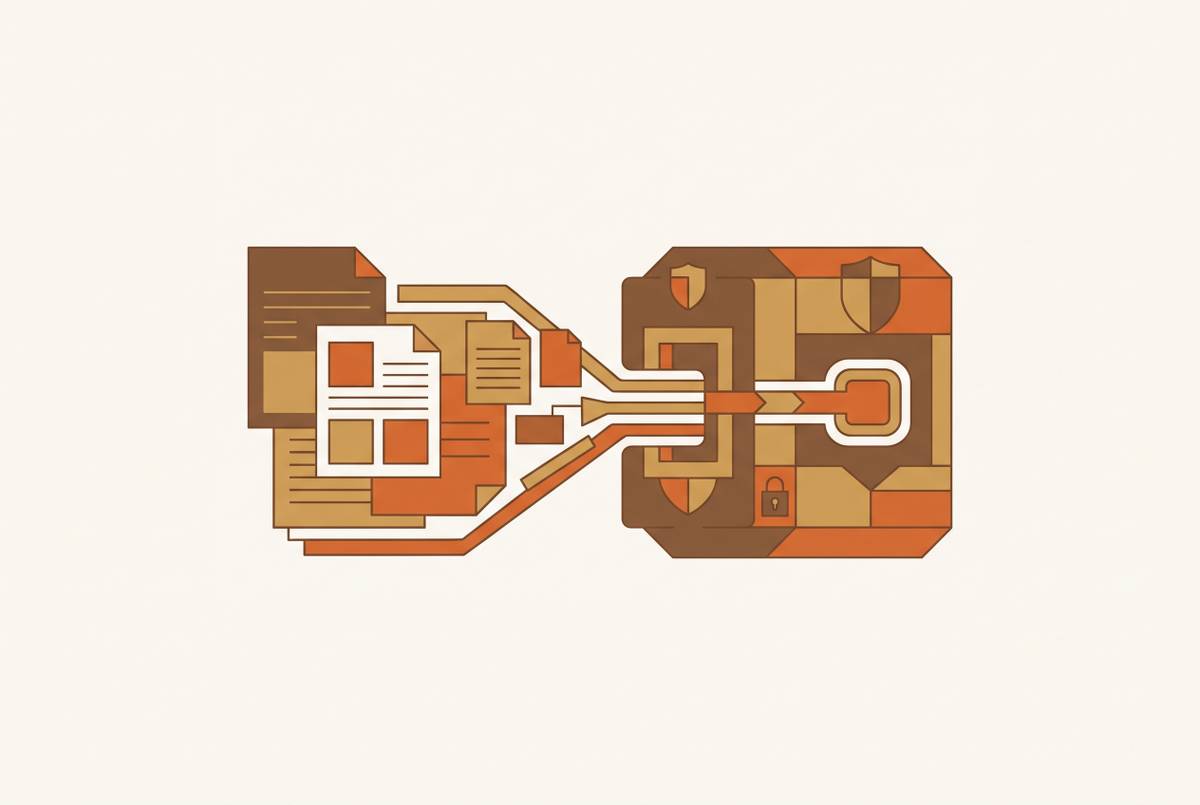
The architecture described in the notes rests on three safeguards, including dynamic PII masking before transmission, a stateless AI gateway that never writes to disk, and metadata-only audit logging. Each addresses a different part of the processing path. Masking reduces the personal information transmitted, stateless processing prevents content from persisting between requests, and metadata-only logs record activity without recording the document. To back up a ZDR claim, a vendor must explain how those boundaries work together as well as when it deletes content.
How default AI API retention behaviors create vendor-side risk that certifications do not disclose
Default API behavior can preserve more than the uploaded file. The retention surface may include prompts, model responses, metadata, and embeddings, as well as the original document. Each category needs to be checked because an extraction request can leave information at several points outside the customer’s infrastructure. A clean final response says little about those copies. Buyers need to ask what the entire request path retains.
Subprocessor routing makes that question harder to answer. A document intelligence provider may have SOC 2 Type II while it sends extraction work to an OCR or LLM service that has its own default retention terms. The primary vendor’s certification does not automatically cover that service’s retention behavior. Unless the scope and contractual commitments address the downstream path, the buyer has an unresolved dependency. Logs for debugging, abuse monitoring, and service-improvement can keep content even when it cannot be used for training.
A general ZDR claim leaves unresolved whether every endpoint, model, or processing route receives it by default or through a separate arrangement. The contract and architecture must resolve that distinction. The evidence supplied does not show how named vendors rank on default versus paid ZDR.
Vendor-side ZDR also stops at the customer’s boundary. Internal logging, observability systems, error monitoring tools, and data warehouses can keep copies of document content after the API returns it. Those copies are outside the vendor’s retention guarantee. A credible vendor should make that limit clear rather than imply that its own architecture removes every source of document exposure.
What should procurement and engineering ask before trusting a document API’s compliance claim?
The lesson for procurement and engineering teams is to turn each claim into a request for evidence. Does the SOC 2 Type II report cover this API product and the infrastructure processing its documents? Request the report itself. Does the ISO 27001 certificate cover the extraction environment, and how are OCR, classification, and LLM subprocessors addressed? These questions locate the audit boundaries before the team evaluates the controls within them.
For retention, what exactly does the DPA or MSA promise? The commitment must specify covered endpoints, models, retention windows, inputs and outputs, error logs, retries, and subcontractors. Is ZDR the default for the proposed service? A promise found only on a marketing page is not the contractual obligation the buyer needs. The agreement must spell out exceptions for specific routes or failures so buyers know about them before deployment.
For third-party handling, which companies get document content during extraction, and what retention terms must they follow? For audit trails, do logs contain only event type, timestamp, and field count, or do they include document content? Is that distinction documented in the DPA? EU-regulated buyers should also ask whether document content is processed and not retained outside EU infrastructure. Finally, does any extracted content enter retraining, fine-tuning, evaluation, or improvement pipelines, including in aggregated or anonymized form?
How architecture choices — caching, logging, subprocessor routing, and deployment model — determine real compliance posture
The technical evidence behind a strong response starts with the request lifecycle. Stateless processing handles each document in an isolated, ephemeral execution context without persistent storage of inputs or outputs. There is no cross-request cache containing document content. Session state also keeps none of that content between API calls. A design that stores uploads for later deletion is a different architecture, even if its retention window is short.
Useful records include request receipt, field count, processing time, and error type, and exclude extracted values or file payloads. The evidence should also account for error handling, because a content-free success path does not explain what happens when extraction fails. The retention commitment must cover both.
Downstream routing needs an equally clear boundary. If content reaches a third-party LLM, OCR engine, or storage layer, a DPA must enforce ZDR on the same terms, or the regulated flow must avoid that route. Regional EU/US deployments can address residency requirements, while on-premise processing can eliminate the third-party path for buyers able to support it. A single-tenant option also belongs in the review, but isolation alone does not describe retention behavior.
Processing quality requires evidence beyond storage controls. Per-field confidence scores, schema validation, and human review routing for low-confidence extractions provide mechanisms for supporting complete, valid, and accurate output. They make Processing Integrity relevant to the returned fields. A vendor’s security posture and its extraction quality remain distinct questions, even when both appear in the same procurement review.
Applying the framework — how to score and compare document intelligence vendors across these three criteria in a real procurement process
A comparison should check SOC 2 scope, ISO 27001 coverage, and ZDR architecture on their own terms. Each vendor’s evaluation should record what is supported by documentation and what remains an assurance. Start with the actual Type II report, ISO certificate, and scope appendix, and check whether they cover the proposed API and processing environment. A credential covering corporate IT cannot fill a gap in extraction coverage. The comparison must preserve that distinction.
Next, evaluate the contractual ZDR commitment for the exact service being purchased. Covered endpoints, models, retention windows, inputs, outputs, errors, retries, and subcontractors should be explicit in the DPA or MSA. Then compare those terms with a data flow diagram showing every endpoint, processing step, and storage location. Ask where document content reaches third parties and whether logs retain content or metadata only. A contractual promise and a conflicting data path should not receive the same assessment as a documented match.
Accuracy belongs in the commercial review as well. A vendor with Processing Integrity in scope but no per-field accuracy SLA has not made a measurable contractual commitment at that level. An accuracy guarantee tied to a commercial consequence, such as paying only for correctly processed pages, makes the performance claim testable. That evidence complements confidence scores and validation controls. The buyer can then compare both the technical safeguards and the obligations attached to their performance.
This produces a defensible shortlist without inventing a universal winner. A vendor with documented extraction coverage, enforceable ZDR terms, and matching architecture ranks ahead on these criteria than one offering the same badges with unresolved retention paths. Default retention, regional deployment, and subprocessor exceptions stay in view as caveats, even when there is a combined compliance score.