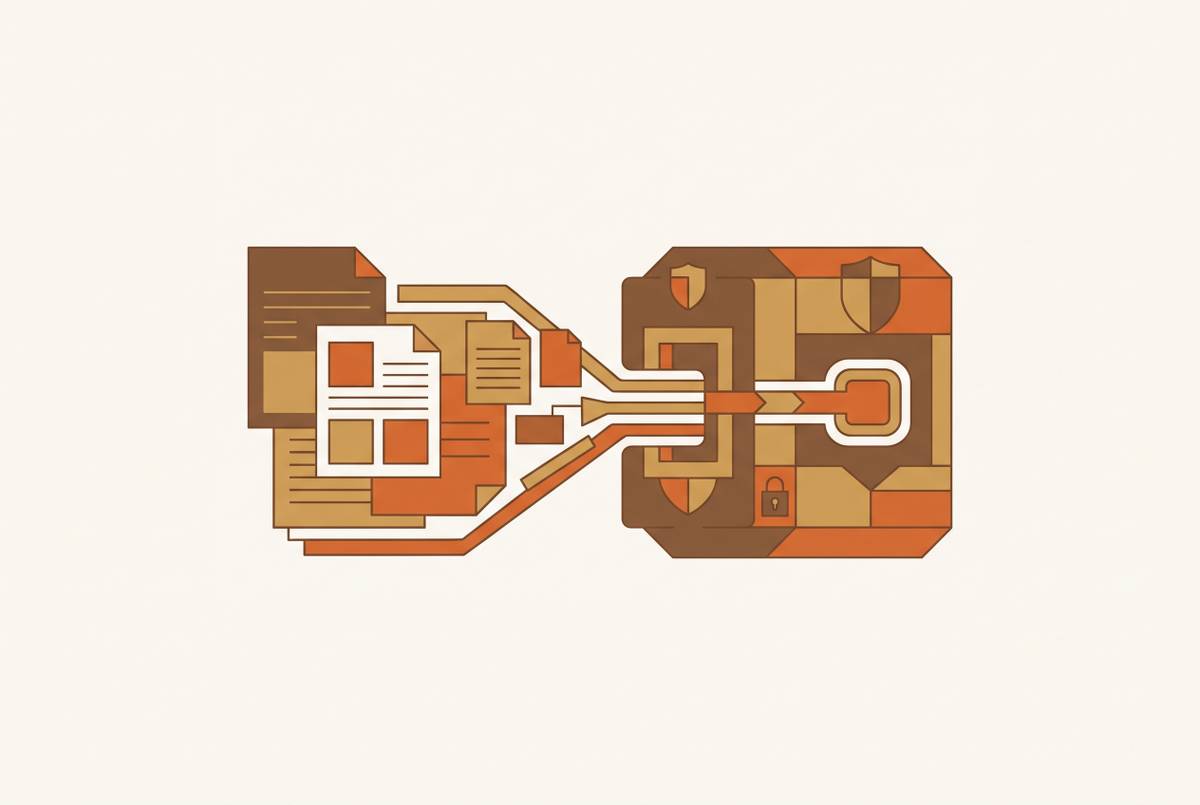
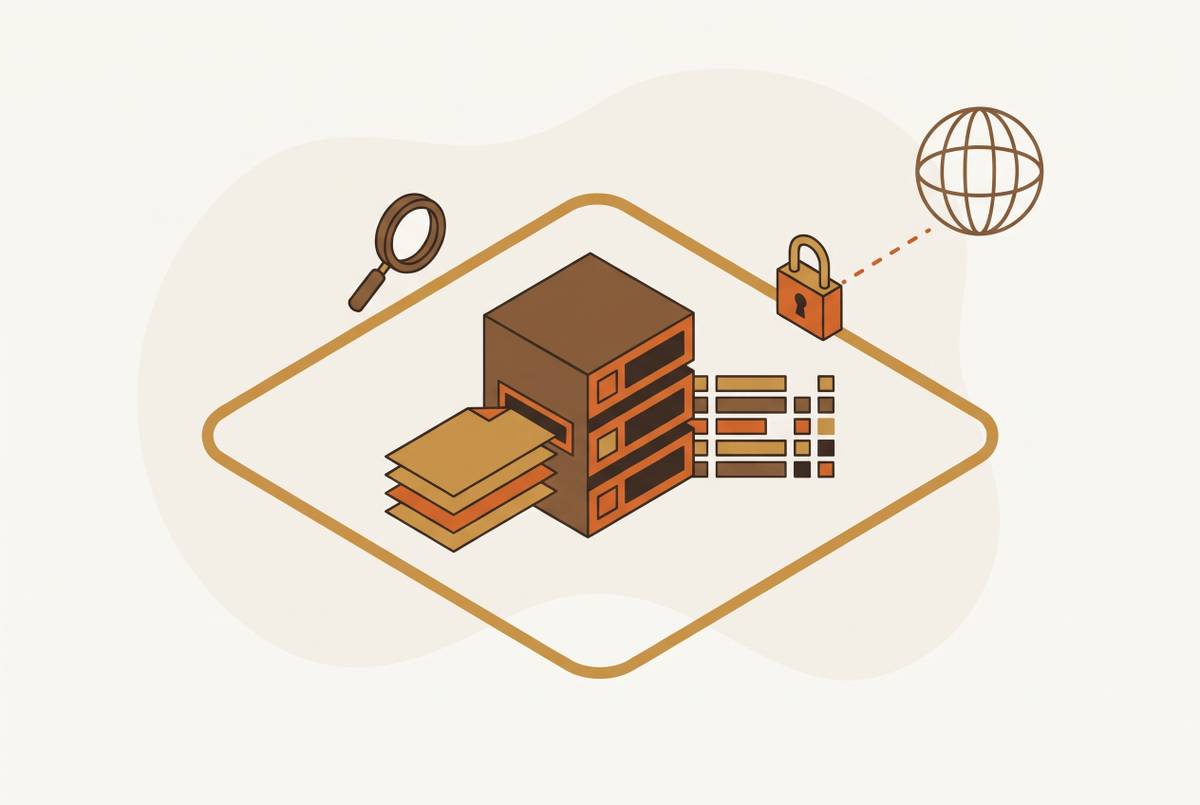
On-Premises Document Extraction Deployment for Air-Gapped Environments
Secure document AI without external connectivity or data transmission.

On-premises document extraction for air-gapped environments is a different engineering problem from a configuration setting on a cloud product: it has its own failure modes, its own evaluation discipline, and its own update mechanics. Any API that promises zero data retention by default, paired with SOC 2, GDPR, and ISO 27001 coverage, needs to prove that every one of those controls runs on hardware the organization owns, not on infrastructure the vendor manages on its behalf.
Why air-gapped environments require different engineering
A true air gap means you get complete physical and logical severance from outside networks. No inbound or outbound automated data flow is permitted, and the only way data moves in or out is through removable media that has been manually scanned and audited. That constraint rules out every assumption a cloud-first document AI product is built on.
The organizations that operate this way are not a niche. Healthcare research groups isolate protected health information, critical infrastructure operators keep their OT document systems sealed off, and a power grid keeps its control systems off the public internet, all for the same reason. None of these sectors treat isolation as a cost-benefit decision. Regulatory mandates or operational safety requirements make it non-negotiable.
Cloud-first document AI products fail this requirement at the architecture level, not at the configuration level. Every inference call is built to reach a hosted model. There is no setting that turns a cloud-native extraction pipeline into a self-contained island, because the assumption of network reachability is baked into how the system was designed. So you have to rethink every layer of the stack that normally runs invisibly in the cloud.
What self-containment demands of the extraction stack
A compliant air-gapped deployment needs every component, model weights, the inference engine, the OCR pipeline, validation logic, schema enforcement, and the update mechanism, running on hardware the organization controls, with zero runtime dependency on anything outside the boundary. Each of these is a layer that a cloud-first vendor normally manages invisibly. Inside a sealed environment, each layer turns into an explicit engineering obligation, and someone on the buyer's side has to own it.
Model weights have to be staged on removable media before the environment seals, because there is no pulling a newer checkpoint from a model registry once the network connection is gone. The inference engine, the OCR runtime, and any layout detection model are external services in a typical cloud deployment. In an air-gapped stack, each of these has to be containerized and deployable from a local image registry, with no outbound pull attempted anywhere in the stack.
Validation logic has to run locally as well. Confidence scoring, field-level flagging, and schema enforcement are the mechanisms that catch a bad extraction before it reaches a downstream system, and any one of them that calls an external API or a cloud-hosted model breaks the isolation boundary the whole deployment exists to protect. A document extraction API like Invofox can satisfy this requirement when deployed on-premises, because it provides field-level confidence scores and validation outputs traceable to source document pixels rather than inferred after the fact, but only if the vendor built zero-data-retention and self-contained validation into the product from the start, not added an on-prem mode onto a cloud-first design.
Logging infrastructure has to write to local storage with no telemetry leaving the boundary. Every access attempt and every data transfer event has to be logged comprehensively, because in an air-gapped architecture that is a core security mechanism, not a nice-to-have audit feature. And the update mechanism itself is a component of the stack, not an afterthought bolted onto deployment day. You have to move model weight updates, container image patches, and security fixes through that same scanned removable media protocol, the one you would use for any other data transfer. An improvised update process is a compliance gap waiting to be found during an audit.
Error cascading in document parsing without a cloud fallback
Every layout or OCR error introduced at the parsing stage propagates forward uncorrected in an air-gapped pipeline. There is no cloud model to fall back on when something goes wrong, no vendor-managed reprocessing queue to catch a bad batch, and no runtime model update available to fix a systematic recognition failure the moment it is spotted.
Layout error cascading is one of the most common production failure modes in document parsing generally, and when there is no correction path, it hits harder. If you run a retrieval-augmented generation pipeline or a structured extraction system, one layout error can corrupt an entire section of retrieved context, not just one field.
Peer-reviewed benchmark work on real documents has found specific failure patterns, and they repeat. Entire sections of a document can be dropped from the output without any visible indication that anything is missing. The error is invisible unless someone runs a side-by-side comparison against the original file.
Tables and checkboxes carry the highest risk of all. Checkboxes are among the elements vision-language models handle worst, and the severity is particularly sharp in healthcare forms, which happens to be the document type most likely to show up in an air-gapped healthcare deployment.
Multi-column layouts cause a different kind of corruption. The result looks like a coherent sentence. It is structurally plausible and semantically wrong, and nothing about its formatting gives that away.
In a cloud pipeline, a vendor can push a model update overnight, and that fixes a systematic recognition failure for every customer at once. In an air-gapped environment, that same failure persists until a new model weight package is prepared, transferred through the media protocol, validated, and deployed, a cycle that can run for weeks. If these failure modes can be predicted, the organization's real leverage comes from catching them before the model ever crosses the isolation boundary.
Evaluating extraction accuracy before a model enters an air-gapped environment
Updating a model inside a sealed environment is slow and operationally expensive, so the only practical moment to catch a systematic extraction failure is before the model ever crosses the boundary. So you need an evaluation methodology that goes well past an aggregate accuracy score on a vendor's marketing page.
You need per-field accuracy as your unit of measure, not document-level accuracy. An aggregate score that looks acceptable on paper can hide a specific field type failing often enough to make it unusable in production.
You need two independent human reviewers to check a random sample against human-labeled ground truth. Confidence thresholds need calibration on top of that. A 2026 preprint formalized why: the common practice of thresholding a confidence score on a calibration split silently breaks the trust contract once applied to real documents, because document clustering creates a design effect that roughly halves the effective size of the calibration sample. Field-specific thresholds, rather than one document-level threshold applied uniformly, are the production standard for a reason: a single cutoff treats a clean total field the same as a messy handwritten annotation.
The evaluation corpus has to reflect the organization's real document distribution, so you can't just pull a generic benchmark dataset off the shelf. ExtractBench is one benchmark that measures grounding explicitly: it scores whether a predicted value can be traced back to its source, something existing schema-guided extraction benchmarks don't account for. That distinction is what separates a pre-production test from a demo built to look good in a sales call.
Contractual accuracy guarantees matter here, because they give a buyer something to hold a vendor to after the environment is sealed. Invofox's field-level confidence scoring is tied to a contractual accuracy SLA: a number the organization can point to, not a claim buried in a product page.
Architecting the offline validation pipeline that replaces vendor-managed correction
An air-gapped deployment has to internalize every correction mechanism a managed cloud service normally provides without anyone thinking about it: confidence-based routing, human review queues, schema enforcement, and structured output validation. None of that can be delegated to an external service once the environment is sealed, so it all has to be designed into the local stack from the start.
The runtime architecture breaks into four pieces that sit in sequence. The extraction agent, whether an LLM or a dedicated OCR model, runs off prompts that specify the document type, the expected fields, the output format, explicit data-type constraints, and instructions for handling missing or ambiguous information. All of this gets defined and frozen at deployment time, since there is no live tuning loop available once the system is sealed off.
Next comes the schema enforcement layer: JSON schema validation that constrains the structure of the output and prevents the model from inventing fields that don't exist in the schema. Providing schema-conformant examples before generation improves correctness further.
After that sits the confidence routing layer, which applies field-specific thresholds and sends low-confidence fields to a human review queue instead of auto-accepting them. You need to host the human-in-the-loop review queue locally, so corrections feed back into the model improvement cycle instead of getting discarded after use. In an air-gapped pipeline there is no cloud model to fall back on and no vendor-managed reprocessing queue, so a per-field accuracy guarantee backed by continuous learning from on-premises corrections is what keeps a parsing error from becoming a permanent blind spot instead of something that gets fixed.
Chunking strategy matters for any document sections feeding an extraction or retrieval component. If chunks are too small, they lose the context a model needs to extract a field correctly. Chunks that are too large dilute retrieval relevance and pull in irrelevant text. You should preserve semantic boundaries, paragraphs and sections, instead of fixed character counts, and for most embedding models you should aim for a moderate chunk size, large enough to retain context but well short of a full document. If you run automated upstream quality checks on incoming scans before the extraction step, the human review queue floods less often, and manual review time scales more predictably as document volume grows.
Invofox's deployment specification, SOC 2 Type II attestation, ISO 27001 certification, GDPR compliance, EU and US hosting options alongside on-premise deployment, optional zero data retention on its Scale and Enterprise plans, and field-level confidence scoring tied to a contractual SLA, is a useful reference point for what this looks like in practice. Every one of those controls has to be reproducible on hardware the organization owns for an air-gapped deployment to actually qualify, regardless of which vendor is providing the underlying technology.
Designing an auditable, controlled model update mechanism for sealed environments
The update mechanism for an air-gapped deployment is a security control in its own right. If you improvise or ad-hoc your update process, you reopen the exact attack surface the air gap was built to close, so you have to make update design an architectural decision before you seal the environment, not something you work out under pressure once a model starts missing fields in production.
A controlled update package needs several things bundled together. And release documentation needs to describe what changed, which failure modes the update addresses, and what regression testing was run against the organization's own hard-case corpus before the package was transferred.
Update cadence has to be negotiated with the vendor before deployment begins, not discovered after the fact. If a vendor's continuous learning happens only in the cloud, with no way to export a tested weight snapshot onto removable media, it cannot support a true air-gapped deployment, no matter how capable its model is otherwise. Continuous learning from human corrections has to be re-architected for this setting: corrections accumulate locally, get exported through the media protocol for training on external infrastructure, and come back as a new weight package through the same controlled process used for every other update.
Every update event, the transfer date, the hash verification result, the installer's identity, and rollback availability, needs to be logged in the same audit trail as document access events. The complexity of maintaining this lifecycle, package by package, hash by hash, rollback by rollback, is a major part of why the next question matters so much.
The build-vs-buy calculus specific to air-gapped document extraction
Building an air-gapped extraction stack in-house means owning every layer described above indefinitely: the containerized inference engine, the local schema enforcement, the confidence calibration work, the review queue, and the update protocol, all maintained by an internal team with no vendor safety net once something breaks inside the boundary. That is a real option for an organization with the engineering staff to support it long-term, and for some government and defense environments it may be the only option policy allows.
If you buy, you need a vendor that already treats zero-data-retention and self-contained validation as core infrastructure. The criteria worth checking are concrete: SOC 2 Type II attestation, ISO 27001 certification, GDPR compliance, on-premise deployment as a genuine option rather than a roadmap item, field-level confidence scoring backed by a contractual accuracy SLA, and a documented process for exporting tested model updates onto removable media rather than only pushing them through a cloud registry. When a vendor can answer all of those questions concretely, the way Invofox's published deployment architecture does, a legal or compliance team gets something specific to evaluate.
Whichever path an organization chooses, the standard that matters is the same one this entire piece has been building toward. Every control that keeps a cloud deployment safe, sovereignty, confidence calibration, validation logic, update integrity, has to be reproducible on hardware the organization owns, with the audit trail to prove it.
Sources
- ExtractBench: A Benchmark for Schema-Guided Enterprise Document Extraction
- Air-Gapped MLOps for On-Prem AI: How to Ship Models Without Internet Access - Sysart Systemic Agile Consulting | SysArt Consulting
- Beyond Accuracy: Robustness, Cost, and Governance Trade-offs for Vision-Language Models in Templated Document Extraction
- Evaluation Blindness: How Silent Measurement Failures Corrupt AI Systems from Training to Deployment
- On-Premise RAG: Deployment Guide for Regulated Sectors — Edtek