On-Premise Document Parsing APIs Evaluated Against GDPR Data Transfer and Residency Requirements
On-premise processing avoids GDPR transfer rules that cloud deployments cannot escape by contract.
For document parsing APIs evaluated against GDPR transfer and residency requirements, deployment architecture is decisive. On-premise processing that keeps the full pipeline inside the EEA and off third-party infrastructure avoids the Article 44 transfer event, while cloud deployments need a close look at how they are set up, where data flows, and what legal safeguards apply. For buyers seeking zero data retention, SOC 2, and ISO 27001, those claims must cover the actual processing service.
Why the Article 44 transfer event is the right starting point for architectural decisions
GDPR Chapter V, Articles 44–49, restricts transfers of personal data outside the EEA. It does not simply prescribe a storage location. Adequacy decisions, standard contractual safeguards, and binding internal rules for corporate groups provide ways to permit transfers. They do not make a transfer disappear. Architectural review should therefore begin by asking whether the processing pipeline creates one.
That question follows the document through upload, processing, storage, onward transfer, and deletion. An EU storage address answers only part of it. If on-premise processing keeps documents and extracted personal data inside the organisation’s EEA environment with no third-party transit, the pipeline avoids the cross-border transfer event. Cloud processing needs a closer look at where each step runs and who gets the data. The deployment determines which legal safeguards need to be considered, rather than the paperwork determining what the deployment does.
What GDPR actually requires — and what it does not — on location, residency, and sovereignty
Data residency describes where data is physically stored or processed. For document extraction, the practical question is where the files and their contents go. Data sovereignty describes which countries’ laws and authorities can reach that data, including through the way the provider’s corporate structure is set up. Data localization is different again. It means an applicable legal requirement prevents data from leaving a specified jurisdiction.
GDPR allows transfers outside the EEA when Chapter V requirements are met. EU-only storage can simplify the analysis, but it does not establish GDPR compliance by itself. A file may sit on an EU server while another service processes what is in it somewhere else. Subprocessor locations and backup destinations belong in the assessment because they can change the answer without changing the primary storage region.
Location also leaves other GDPR duties untouched. Article 5 principles include purpose limitation, data minimisation, accuracy, storage limitation, and integrity and confidentiality. In an extraction API, those principles connect to concrete design choices such as extracting only required fields, setting storage time limits, verifying results, and encrypting data at rest and in transit. Residency addresses one dimension of the system. It cannot substitute for controls over what the system collects, keeps, or gets wrong.
How the US CLOUD Act creates a sovereignty gap that EU-region cloud deployments cannot close by contract
For most B2B document AI workloads, including invoice and contract extraction, a properly configured EU-region cloud deployment is a practical fit. Foreign-access exposure does not automatically make that choice unsuitable. The distinction becomes important when a requirement goes beyond EU processing and demands protection from foreign government access. A provider’s server location and legal exposure are separate questions.
The US CLOUD Act allows US authorities to request or subpoena data held abroad by an American provider. Standard AWS EU regions, Azure EU, and Google Cloud EU regions therefore still have that exposure even when their servers stay in Europe. A DPA or SCC cannot contract it away. Microsoft’s Services Agreement names Microsoft Ireland Operations Limited as the company that EU customers contract with, and Irish law applies to the specified claims. Under that arrangement, Microsoft still has its headquarters in the US and says it challenges non-EU government requests while complying when the law requires it.
Sovereign branding needs the same careful reading. AWS European Sovereign Cloud GmbH is a wholly owned subsidiary of Amazon.com, Inc., despite its organisational separation. The CLOUD Act’s specific reach into that structure remains legally unresolved. It should not be described as proven immunity. Operational separation and legal insulation are different protections, even when both appear in the same offering.
For finance, health, and public-sector workloads that must show they are protected from foreign access, contracts alone cannot meet that requirement. The EDPB’s April 2025 guidance identified on-premise inference as the strongest available LLM data protection mitigation. Its position on US transfers has also pointed to encryption with EU-controlled keys as the technical protection that survives Section 702 scrutiny. The practical distinction is structural. Customer-held EU keys or an on-premise pipeline use technical design to control access, so protection depends on more than a provider’s promise.
A four-tier deployment spectrum, mapped to what each tier actually resolves and what it leaves open
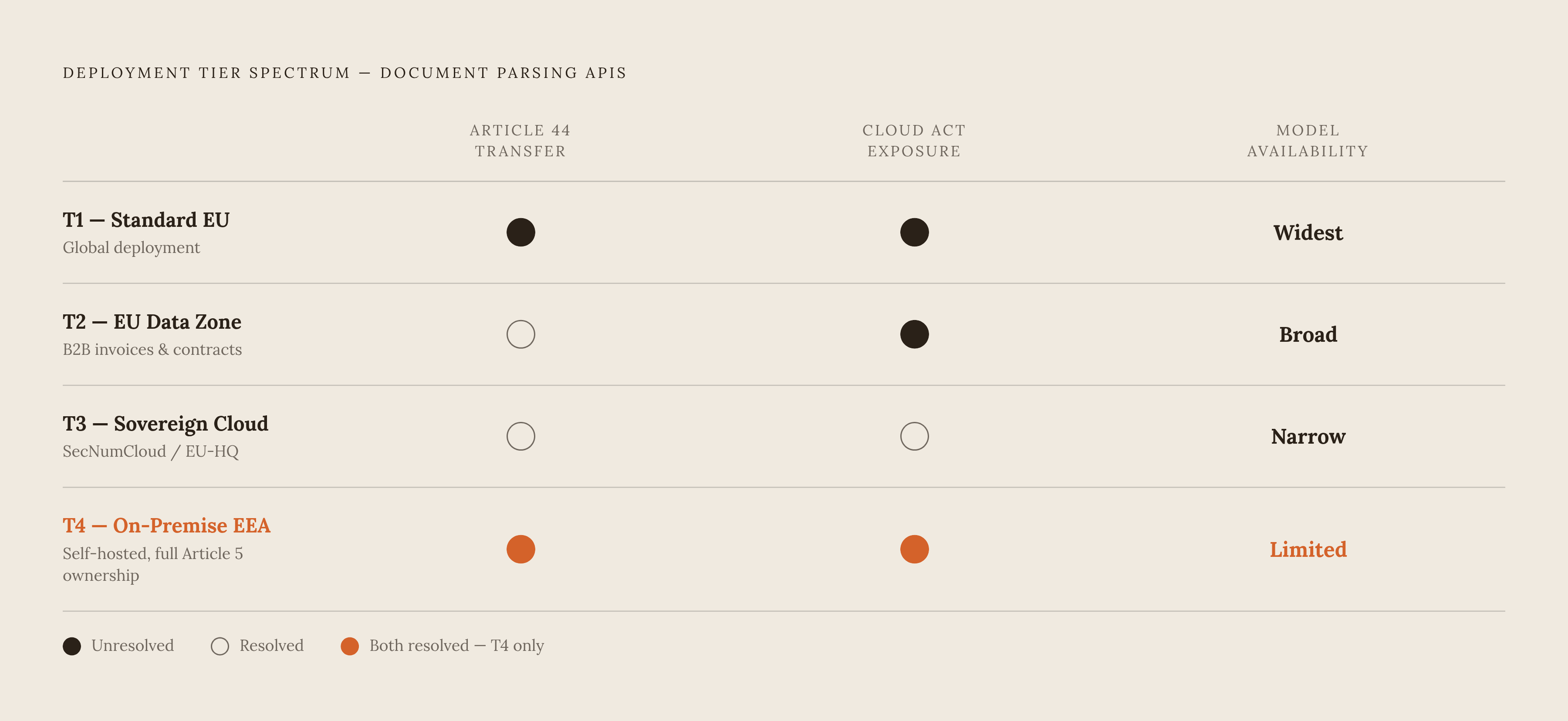
The right tier follows the data class and regulatory sector. An invoice with company identifiers presents a different risk from a medical claim or customer identity verification scan. The tiers below differ in where data stays, their foreign-access exposure, which models they offer, and who does the work of running them. They are not a best-to-worst ranking. A stronger jurisdictional boundary can come with fewer models or more work for the operator.
Tier 1 uses a standard EU region with a global deployment type. Processing may occur worldwide, so the region label supplies no Article 44 guarantee. This tier has the widest choice of models, is easy to use, and offers a quick way to get into production. In this framework, it works well for non-personal data or synthetic test workloads. Its defining weakness is that the endpoint’s address does not constrain the processing geography.
Tier 2 uses a standard EU region with an EU Data Zone or geographic EU inference profile. Processing stays inside the specified EU boundary or named geography, which takes care of the transfer issue for that processing path. CLOUD Act exposure remains, as do Article 32 security duties and Article 28 processor obligations. Model availability is broad, with some delay for the newest releases. This is the practical fit for most B2B invoice and contract extraction, provided the rest of the data path respects the same boundary.
Tier 3 covers hyperscaler sovereign clouds and EU-headquartered providers with relevant SecNumCloud-qualified services. A hyperscaler sovereign offering can add separate staff controls and a distinct technical partition without resolving every parent-company question, while an EU-only provider can remove that US-parent exposure by structure. Model choice may narrow sharply. AWS ESC Bedrock launched with only Amazon Nova Lite and Nova Pro, without Claude, Mistral, or Llama at that point. This tier fits public-sector, defence-adjacent, and regulated-finance workloads where auditors need demonstrable legal insulation.
Tier 4 is self-hosted on-premise processing using GPU or CPU inference without third-party transit. Within an EEA deployment, it avoids the Article 44 transfer event and removes the parsing pipeline’s cloud-provider access exposure and subprocessor chain. It works well for highly sensitive files such as customer identity verification scans, medical claims, payslips with full personal identifiers, and mortgage closing disclosures. The obligations do not vanish. The organisation that runs it must put Article 5 controls in place, keep retention policies up to date, support data subject rights, and take responsibility for validation.
A hybrid pipeline needs assessment at each handoff. Local extraction followed by cloud validation or enrichment reopens the transfer question for the data sent onward. Its protection therefore depends on the complete route.
Configuration mistakes that undermine the tier you think you are on
An engineering review should start with deployment type. Azure’s Worldwide Standard or Global deployment can process outside the EU even when the endpoint is in West Europe. The resource location is not the processing boundary. On AWS, geographic EU inference profiles stay within their named geography, while Global profiles do not. Reviewing the model call is therefore part of reviewing residency.
Batch processing needs its own check. Microsoft’s Foundry data-privacy page states that batch processing is a Global deployment type, with processing potentially occurring in any geography where the relevant model is deployed. Data remaining in the designated geography at rest does not fix that distinction. Teams seeking EU-bound batch processing must explicitly select the Data Zone batch variant. A correctly configured interactive path does not establish that the batch path is also correct.
The review should then trace every service receiving document contents, including OCR, backup, integration, logging, and telemetry services. Model training is a separate purpose to examine, even when all processing stays in Europe. Some providers use API-submitted documents to improve models by default, and training on personal data requires a clear legal basis and often explicit consent. Residency does not answer whether that use is permitted.
SecNumCloud applies to a specific service. OVHcloud’s AI Endpoints were outside its qualified scope as of early 2026, with no published date for extending coverage. Teams should ask for the dated qualified service list that covers the AI service they plan to use. These checks are achievable, but they treat residency as a property of the running configuration.
What on-premise document parsing actually requires engineering teams to own
The organisation must document the data types processed, legal basis, data flows, retention periods, and protections in its Records of Processing Activities. It must also implement time limits and automatic deletion internally. There is no external retention policy doing that work. A zero-retention processing model does not remove the need to govern source documents and extracted records retained elsewhere in the organisation.
Accuracy becomes an internal control as well as a product requirement. Extracted fields need verification so errors do not cascade into downstream systems. Data lineage must link each extracted record to its source document so that requests to correct or delete data can reach the versions they apply to. Removing only the uploaded file is insufficient if its personal data remains in extracted records. These responsibilities remain with the controller regardless of deployment model.
Multi-column layouts, scanned-document OCR, embedded tables, and mixed encoding in hybrid documents can undermine accuracy. Even after a demo goes well, those cases still need to be checked. Keeping the document intelligence layer on-premise preserves the intended boundary, whereas cloud-based validation or enrichment introduces another data flow to assess. Portability also needs to be designed in from the start because extraction pipelines tied to one cloud ecosystem can be expensive and disruptive to move.
For most organisations choosing this route, an on-premise-deployable parsing API offers a middle path between hosted processing and building the ML pipeline internally. A contractual accuracy SLA, field-level confidence scores, and a zero-retention processing model can support that approach. The vendor still supplies the parsing software. The operating team still owns its GDPR controls and validation process, but it need not also develop the extraction model from scratch.
What should teams ask a document parsing API vendor about zero retention, SOC 2, GDPR, and ISO 27001?
A practical vendor checklist starts with the full processing boundary. Does self-hosting cover extraction, validation, and enrichment, or only storage? For cloud processing, what is the deployment type? Does the way the corporate structure is set up remove CLOUD Act exposure or just reduce it? These questions separate the proposed architecture from the language used to sell it.
Does the vendor publish a subprocessor list covering OCR, backup, logging, and telemetry? Which recipients are outside the EEA, and which receive personal data? Are submitted documents used for training, and under what legal basis? Retention needs equally direct wording. Is zero retention the default or a paid option, does a configurable time limit apply, and what happens to both documents and extracted data after processing?
Is there a contractual per-field accuracy SLA? Are confidence scores grounded in specific document regions, and can a person review low-confidence fields? Does the system learn from corrections or remain static after deployment? Charging for every extracted page or only for correctly extracted pages changes how the vendor and customer share the risk of extraction errors.
Compliance evidence needs the same specificity. Do the SOC 2 and ISO 27001 materials cover the actual document processing and AI inference services? Does the GDPR DPA address Article 28 processor duties, assistance with data subject rights, and breach notification timelines? GDPR paperwork is not a certification equivalent to those other forms of evidence. For SecNumCloud, the evidence is the dated qualified service list, while data-lineage support should show how correction and deletion can be completed.
Any vendor that answers these questions well deserves consideration. Ranking vendors by name without evidence for each service would make the ranking seem more precise than the evidence allows, especially for claims about default zero retention. The decisive answers describe where processing runs, who can reach the data, and what remains afterward. A defensible GDPR assessment succeeds or fails on how closely contractual reassurances match those architectural facts.