Right to Erasure Compliance in Document Workflow Systems
European audits show document workflows are the weak point in deletion compliance.
Right to erasure compliance has stopped being a background legal obligation and become an active enforcement target. Organizations that run document-heavy workflows, invoices, payslips, contracts, loan files, are disproportionately exposed, because the way these systems store and move data makes a clean deletion hard to execute and even harder to prove.
The European Data Protection Board made this the focus of its 2025 Coordinated Enforcement Framework, the largest coordinated audit of the right to erasure ever conducted. That audit is now closed, and the findings are specific enough to act on. The urgency reflects the complaint volume and audit findings described above; the fix is to treat erasure as something the infrastructure has to support by design, not something a policy document can promise after the fact.
The complaint volume backs up the timing. In the Netherlands, erasure was the single largest complaint category in 2024. Spain has logged thousands of erasure complaints since GDPR took effect in 2018. Ireland has seen thousands more over the same period, and the trend is still climbing. None of this is theoretical anymore. A request arrives, a clock starts, and an organization either has a way to answer it or doesn't.
Article 17 requirements and document workflow challenges
Article 17 reads simply on paper: when someone makes a valid request, the controller has to erase their personal data without undue delay. The hard part is everything the law assumes the controller can already do.
The clock itself is unforgiving. Article 12(3) sets a one-month response deadline that runs from the moment the request is received. A two-month extension is available for complex or high-volume requests, but only if the controller tells the data subject within that first month and explains why. There's no quiet way to buy more time after the fact.
Six separate grounds can trigger the right: the data is no longer needed for its original purpose, consent has been withdrawn with no other legal basis to keep processing it, someone has objected under Article 21 and the company has no overriding legitimate interest, the processing was unlawful to begin with, a legal obligation requires erasure, or the data was collected from a child. Any one of these can set off a request, and in a document-heavy business, a single person's data rarely lives in one place. The same individual might show up in marketing records, a support ticket, an invoice, and a piece of litigation evidence, all within the same company. A valid request doesn't map to a single "delete account" button. It maps to a judgment call about what has to go, what can stay, and how to explain a partial refusal if part of the data is protected by an exception.
Those exceptions under Article 17(3) are narrow, and they have to be weighed case by case rather than applied as a blanket rule. A legal obligation to retain records, MiFID II's five-to-seven-year transaction retention requirement, tax audit rules, HIPAA's six-year retention standard, permits a company to keep data, but only for the exact duration the law sets and only for the purpose the law names. The same goes for data retained to defend a legal claim: it can stay, but only as long as the claim is live and only for that reason.
Put together, the law expects a company to know where someone's data lives, what legal basis covers each copy, who else has received it, and how to prove all of that inside 30 days. That's a data inventory, a retention schedule, and a processor map, all maintained continuously. Document workflow systems, built for speed and volume rather than lifecycle tracking, often have none of the three.
The seven structural failures the EDPB audit found
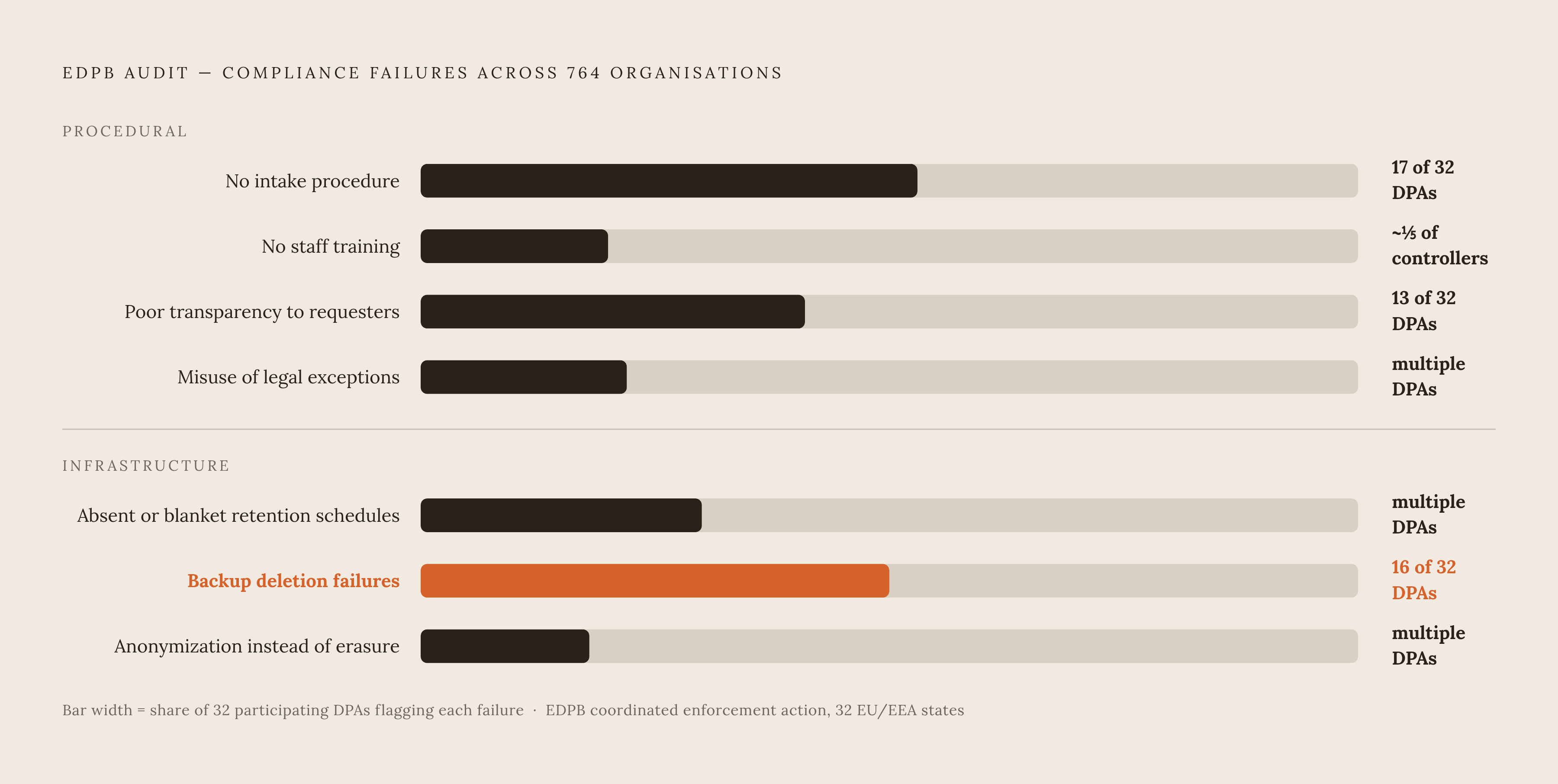
The EDPB's 2025 audit examined 764 organizations across 32 EU member states and rated overall compliance "average," with 9 data protection authorities opening formal investigations. It didn't surface a handful of isolated policy gaps. It found seven failures that repeated across almost every participating authority, and most of them trace back to how the underlying systems were built rather than how the policies were worded.
The first failure is the most basic: no documented internal procedure for handling a request. Seventeen of the 32 participating DPAs flagged missing or incomplete documented procedures as the most common gap they found. Without a written workflow covering intake, identity verification, locating the data, assessing exceptions, executing the deletion, and notifying third parties, compliance depends entirely on whichever employee happens to open the request.
The second is training. Roughly a fifth of responding controllers give staff no regular refresher training on Article 17. Someone who can't recognize that an angry complaint email functions as a legal deletion request, or who doesn't know which exceptions actually apply, will miss deadlines and make inconsistent calls.
The third is transparency toward the people making the requests. Thirteen DPAs noted that controllers often fail to explain, in plain terms, how to submit a request, what conditions apply, and what happens if the request gets refused.
The fourth is the misuse of legal exceptions, particularly "compliance with a legal obligation," applied automatically instead of assessed case by case. In a document pipeline where nearly every invoice or payslip could plausibly carry a legal-obligation argument for retention, that's the easiest exception to over-apply, and it's also the one that creates the most exposure when a regulator checks the actual statutory basis and finds none.
The fifth, sixth, and seventh failures are different in kind. They are failures of infrastructure that no amount of retraining fixes on its own.
The fifth is the absence of retention schedules, or the use of one blanket retention period across every type of document. Without a schedule, a controller has no way to know when deletion becomes mandatory, so many default to keeping everything for the longest period that applies to any category of data they hold. That directly conflicts with the storage limitation principle in Article 5(1)(e). For a workflow that handles invoices under tax retention rules, loan files under regulatory retention, and payslips under employment law in the same pipeline, one blanket period guarantees both over-retention and under-retention at the same time.
The sixth is backup deletion, the most cited technical failure in the entire audit: half of all participating DPAs flagged it specifically. The common approach is to let backup rotation eventually overwrite deleted data on its own schedule, with no procedure in place to stop a backup from restoring data that was already erased in response to a valid request. The EDPB's position is direct: relying on backup encryption instead of an actual deletion procedure doesn't satisfy Article 17, because encrypted data sitting in an accessible backup is still personal data under the law.
The seventh is anonymization used as a stand-in for erasure. DPAs found controllers masking or suppressing data rather than removing it, which fails the EDPB's standard that erasure has to be both verifiable and irreversible. Masking a field in a report while the underlying record still exists somewhere else doesn't count.
Why document workflow infrastructure makes these failures almost inevitable
Document workflow systems scatter personal data across processing pipelines, backup stores, extraction outputs, and third-party APIs as a matter of normal operation. Complete, verifiable erasure across all of that is structurally impossible unless deletion was built into the system from the start, not bolted on after a request arrives.
Start with a single invoice. Processed through a typical pipeline, it can land in the original file store, the OCR or extraction tool's processing buffer, an extraction output database, an AP or ERP system, an archival system, and one or more backup tiers, each with its own retention rule and its own deletion mechanism. The EDPB report called out the lack of systematic internal data classification and automated deletion labels inside IT systems as one of the most persistent weaknesses it found, and it affects both individual erasure requests and a company's ability to proactively delete data under the storage limitation principle.
Backups make the problem worse in a way that's easy to miss. Without a mechanism to exclude already-erased records from a backup restoration event, a deletion that was fully compliant in production becomes non-compliant the moment that backup gets restored. That risk sits quietly until the day a restoration actually happens, and encrypting the backup doesn't solve it: if the decryption key still exists somewhere, the personal data inside remains accessible, and accessible personal data is still subject to Article 17.
Extraction output compounds it further. When a document pipeline pulls a name, an address, a tax ID, or an account number out of a PDF and writes it into a database as structured JSON, that extracted record counts as personal data in its own right, separate from the original file. A valid erasure request has to reach both the source document and every downstream record derived from it. Most pipelines never built a way to trace which structured records came from which person's documents, so proving complete erasure becomes close to impossible because the mapping needed to verify it was never built.
The obligation extends further still when third parties are involved. Article 19 requires a controller to notify every recipient a piece of personal data was disclosed to, unless doing so is impossible or disproportionate. A workflow that runs on a document AI API, an AP platform, and an archival vendor has all three as sub-processors, and the controller's erasure obligation reaches all of them. That requires actual contractual deletion confirmation from each vendor. When erasure requests span multiple systems, invoices in AP platforms, payslips in payroll systems, extraction records in the processing pipeline itself, the controller has to track and notify every recipient of that data. APIs that operate on a zero-data-retention model by default remove one link from that chain entirely: Invofox, for example, extracts data from a document without storing it beyond the request itself, which eliminates one category of third-party notification obligation and makes the technical proof of erasure simpler to produce.
Provenance is the last piece. An AI-based OCR or extraction tool that doesn't log model versions, processing events, and data lineage in a tamper-proof way can't answer the three questions Article 17 compliance actually requires: what was extracted from this document, which systems downstream received it, and has it been deleted from every one of them. The audit's focus on data lineage and processor mapping exposes a cost that's easy to overlook until a request arrives: every third-party extraction service sitting inside the pipeline becomes a notification target. A parsing service that holds onto extracted data, even briefly, even inside a training set, adds a retention obligation that compounds the compliance burden every time a new vendor is added to the stack. A service built around zero data retention removes that category of liability rather than managing it.
Organizations processing high volumes of invoices, payslips, contracts, and loan files run into a version of erasure complexity that general-purpose document management software was never built to solve. Multiple extraction pipelines, unclear data lineage, and third-party APIs each with their own retention defaults add up to an erasure attack surface that no policy document closes on its own.
The vector store and AI model layer: where erasure compliance gets technically hard
Feeding document workflows into a retrieval-augmented generation pipeline, a vector store, or a fine-tuned model gives erasure compliance a technical dimension that no procedure can paper over. The personal data stops living in a record someone can locate and delete, and starts living inside indices and model weights instead.
Vector stores are the clearest example. The moment a document is chunked, embedded, and indexed, that vector store becomes a personal data processor in its own right under GDPR, holding a mathematical representation of someone's information rather than the information itself. Research on HNSW-based vector databases, including Weaviate, FAISS, and ChromaDB, shows that a deletion request typically only marks the record as deleted in an index, while the embedding itself stays physically present on disk, unchanged. That's a soft-delete, and the EDPB's standard requires erasure to be both verifiable and irreversible. Marking something as gone while it still sits on a drive doesn't meet that bar.
Full erasure from a system like this means deleting the source document and its embeddings together, not one or the other, and confirming both deletions in a way that can be checked later. That's a materially harder engineering problem than deleting a row from a relational database, and it's one more reason the companies building document pipelines need to treat deletion as a requirement set at the architecture stage, the same way they'd treat uptime or latency, rather than a feature added once a regulator asks for it.
Sources
- Erasure Requests: EDPB 2025 Compliance Insights
- GDPR Article 17 Right to Erasure: EDPB Audit Findings and 7 Compliance Fixes
- 2025 Coordinated Enforcement Action Implementation of the right to
- Art. 17 GDPR
- 1 Annex 1: National Reports on the CEF Right to erasure
- GDPR's Deletion Problem: Why Your LLM Memory Store Is a Legal Liability - TianPan.co
- GDPR Right-to-Erasure in Vector Stores with AI Agents
- The Right to Be Forgotten — But Can AI Forget?