Zero Data Retention Requirements in Financial Document Processing
Vendors holding financial documents in logs and caches create hidden compliance exposure.

Zero data retention means the vendor extracting fields from a document deletes it, and everything derived from it, the instant the response goes back. That's a separate question from an institution's own recordkeeping duties under SOX or AML rules, which still require documents to be kept for years no matter what the vendor does with its copy. Procurement teams mix these two things up constantly, and that confusion is exactly how a vendor ends up holding sensitive data as a de facto records custodian without anyone at the institution ever deciding that should happen.
The line that matters runs between the processing layer and the institution's own records vault. When a vendor ingests a mortgage application, a payslip, a bank statement, it's supposed to be a transient hop: document goes in, fields come out, and the document plus every intermediate version of it (OCR text, parsed layout, embeddings) gets deleted. Nothing sits on the vendor's servers once the response returns. Simple enough on a whiteboard. Look inside most vendor infrastructure and it stops being simple.
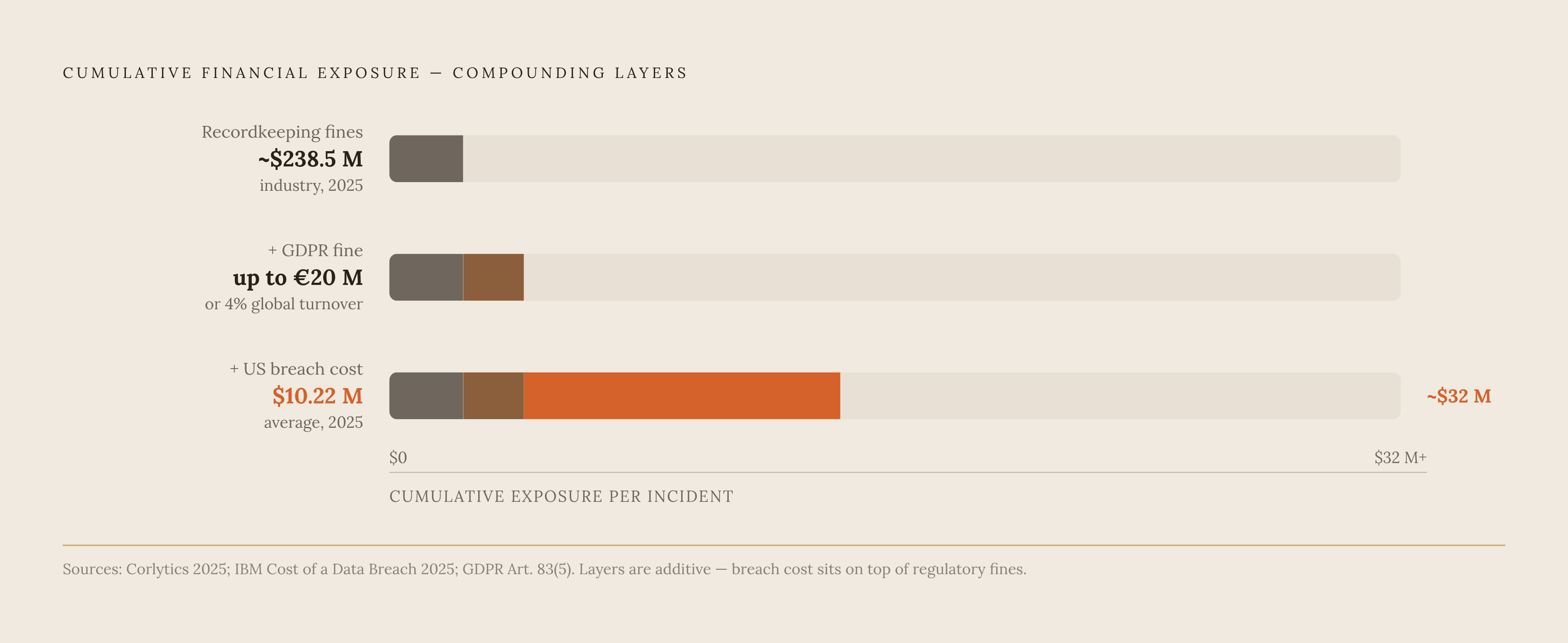
Global non-compliance fines hit a record $14 billion in 2024, per Thomson Reuters Regulatory Intelligence, with financial services and data privacy enforcement doing most of that damage. GDPR doesn't specify a fixed retention period, but it does require controllers to justify how long they hold data against a lawful purpose, and holding it too long is a violation on its own, separate from any breach. France's data protection authority fined one company €250,000 for keeping customer data six years after the relationship had ended. The ceiling runs up to €20 million or 4% of global annual turnover, whichever is larger, and that's the number before a breach even enters the picture.
SOX makes the institution keep its own financial records for seven years, but says nothing about what a document processing vendor does with a copy it touched in passing. PCI DSS, GLBA, Dodd-Frank, SEC Rule 17a-4: all of them govern the institution's own recordkeeping, and none of them hands a processing vendor permission to keep sensitive documents around. Starting in July 2027, AMLR Article 77 replaces the patchwork of national AML retention rules across the EU with a single standard, which will make the sub-processor question far easier to audit and much harder to dodge.
Breach cost sits on top of the fines, not instead of them. The average cost of a data breach for US companies hit $10.22 million in 2025, a record high, against a global average of $4.4 million; financial services breaches carry particular exposure because the documents involved pack so much personal information into a single file. Separately, recordkeeping failures alone contributed roughly $238.5 million in fines in 2025, according to Corlytics, and that's just the cost of mishandling records, before anyone gets breached. Put the two together and the exposure effectively doubles.
One more layer is arriving on top of all this. The EU AI Act's high-risk provisions took effect in August 2026, and document AI used in credit, employment, or healthcare decisions will almost certainly fall inside that scope. That adds conformity assessment obligations on top of everything already listed, which makes every existing gap in data handling more expensive to leave open. Regulators have already collected the fines behind these numbers. The remaining question is how an institution closes the gap structurally, instead of writing another policy that nobody's infrastructure actually enforces.
How vendor data handling silently expands the compliance perimeter
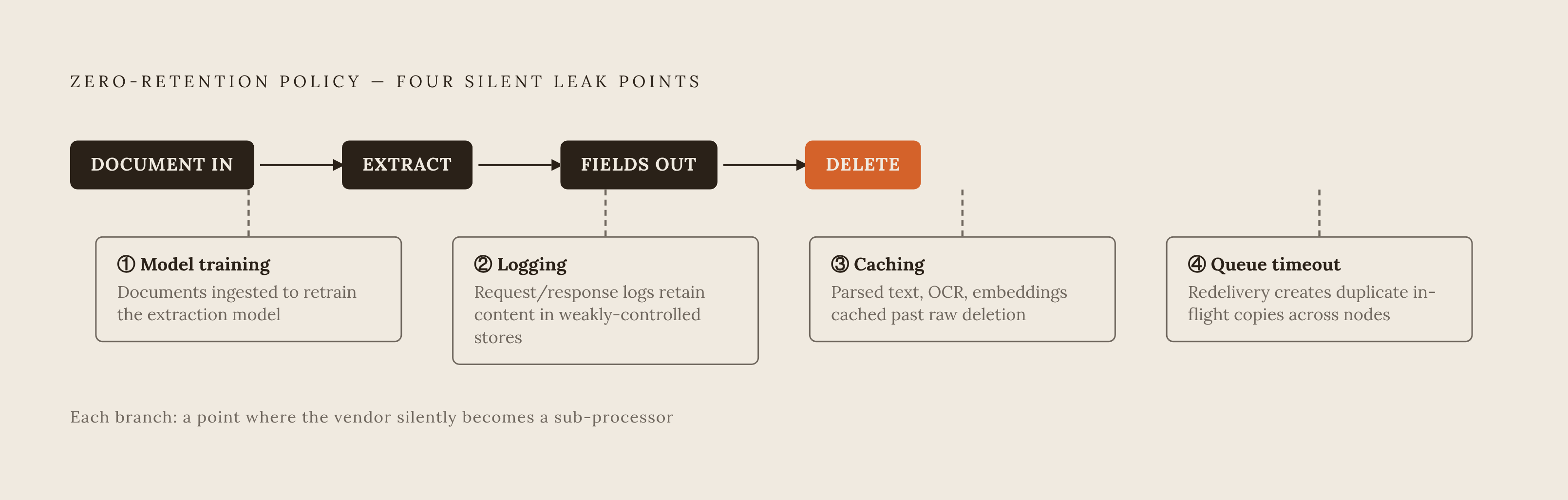
Here's the sub-processor problem: if a vendor's infrastructure ever holds a document, or the fields extracted from it, after the API response goes out, that vendor has become a data processor, not a network hop. That status drags in DPA obligations, audit rights, and breach-notification chains that didn't exist a moment before, and it happens quietly, usually without anyone at the institution noticing the shift occurred.
Retention creeps in through a handful of familiar paths. Model training ingestion is one; a vendor uses customer documents to improve its extraction model, which is close to industry-standard practice unless a contract and the underlying architecture explicitly rule it out. Logging and observability infrastructure is another: request and response logging, put in place for debugging, ends up holding document content in log stores that usually have far weaker access controls than the processing system itself. Caching is a third. Intermediate representations like parsed text, OCR output, or embedded vectors get cached to speed up latency, and those caches routinely outlive the raw document while sitting outside whatever deletion guarantee the vendor advertises on its website.
A data processing agreement doesn't fix any of this. A DPA documents the relationship between institution and vendor; it doesn't remove the data from the vendor's systems. If the vendor gets breached, the institution is exposed regardless of what the contract says, because the document was there, sitting in a log or a cache the contract never accounted for.
Compliance teams broadly report that keeping up with regulation has gotten harder every year for close to a decade now. Manually tracking what a vendor's infrastructure actually does with data doesn't scale with that complexity; it's a checklist item that gets signed off once, at onboarding, and then never looked at again.
So what actually tests this? Can the vendor show, through audit evidence rather than a policy PDF, that no customer document or anything derived from it persists after the response goes out. SOC 2 Type II matters here because it covers an observation window, typically three to twelve months, of controls actually operating, not just controls designed on paper. ISO 27001 is the other piece: an independently verified information security management system that procurement teams across the EU, UK, and APAC treat as the baseline proxy for security maturity. Vendors missing both tend to get filtered out before commercial conversations even start in enterprise financial services procurement. The compliance perimeter problem is architectural, and the fix has to be engineered into the pipeline itself, well before anyone drafts a policy document about it.
Designing zero retention into the extraction pipeline from ingestion to deletion
Zero retention is an invariant, not a feature bolted onto a finished pipeline as an afterthought. It has to hold at every layer, starting the moment a document is ingested.
At ingestion, documents should never touch persistent storage. Processing happens in memory or on ephemeral compute; any write to disk, object store, or queue that survives past the transaction breaks the guarantee. At the OCR and parsing stage, intermediate representations (raw OCR text, layout trees, token embeddings) carry the same sensitivity as the source document and need to be treated as in-scope for deletion, not as harmless byproducts nobody thinks twice about.
Logging and observability can still function without violating any of this. Field-level confidence scores and error flags can be kept for monitoring pipeline health without keeping the document content itself. That separation, operational telemetry on one side, document data on the other, is an engineering discipline as much as a legal one. On the output side, the structured JSON of extracted fields belongs to the institution the moment it's returned; the vendor has no business keeping its own copy sitting around for convenience.
A queue timeout is a good, concrete example of how these gaps actually show up. If a message queue's visibility timeout is shorter than the time the document takes to process, the same document gets redelivered to a second worker while the first one is still working on it. Now there are duplicate in-flight copies of a sensitive document sitting across multiple compute nodes, none of which were ever supposed to hold it. Nobody decided that should happen. It's a misconfiguration, and it creates retention the institution never agreed to and probably doesn't know exists.
Deployment topology belongs in this conversation too, not as a footnote about latency. Whether a vendor offers EU or US regional deployment, or on-premise processing, determines which country's law governs the data while it's in flight, and whether the document crosses a border at all. The legal standing of the EU-U.S. Data Privacy Framework has been shaky enough lately to turn data localization into a legal question rather than a performance tuning decision. Pipeline architects in financial services can't treat region selection as something decided on response times alone anymore.
A genuine zero-retention architecture produces one clean outcome: the vendor stays a network hop, never a sub-processor, because there is never a moment where customer data exists on the vendor's infrastructure outside the single atomic transaction of processing it.
Why production document pipelines fail in ways that make retention gaps worse
Pipelines get built for the happy path. Always. Retention gaps show up in the parts nobody designs carefully: error handling, retries, fallback logic, the paths that only run once something has already gone wrong.
OCR accuracy in production rarely matches what a vendor shows in a controlled demo. Real enterprise document batches commonly land in the 80 to 90% accuracy range, and traditional OCR tools fail on something like 40% of complex, multi-column layouts. Low accuracy means more retries, more fallback pipelines, more documents routed to human review queues, and every one of those is a new place the document, or a piece of it, ends up sitting.
Vision-language models bring their own failure modes on top of this. Repetition loops, caused by token probability collapse, can stall a pipeline mid-document, leaving a partial representation sitting in memory or queue state longer than it should. Recitation errors, where a provider's copyright filter misidentifies ordinary document content as something to block, produce truncated output that triggers a resubmission; the same document then gets processed twice, sometimes by two workers who have no idea the other exists. Hallucinations are the quieter problem. A model produces text that looks plausible enough to slide past a spell-checker, so nobody catches it at the pipeline's edge, and it moves downstream and gets treated as fact.
Schema complexity adds its own failure rate. On the ExtractBench benchmark, across 210 extraction attempts, frontier language models managed only a 51% valid JSON rate and a 4.6% aggregate pass rate; the best performer, Gemini 3 Flash, reached just 6.9%. Most attempts produce output that has to be redone, which means the document transits the pipeline more times than anyone planned for when the architecture diagram got drawn.
Every retry, every fallback, every handoff to a human reviewer is a moment where a document that should already be gone is still sitting somewhere. Most pipelines enforce deletion on the success path and forget to enforce it anywhere else. Zero retention only means something if it holds across every code path, success, failure, timeout, partial output, and not just the one path that shows up in the demo.
What to evaluate when assessing a vendor's zero-retention claim
"Zero data retention" is a phrase on a slide until proven otherwise. The real question is whether it's enforced by architecture or just asserted by policy, and there's a handful of ways to check that don't require taking anyone's word for it.
Does the vendor hold SOC 2 Type II attestation, not Type I, and will they share the sections covering deletion controls rather than just the summary letter. Do they hold ISO 27001 from an accredited body, and does the certification's scope cover the document processing infrastructure specifically or just the corporate network. Can they explain what happens to a document and every intermediate representation of it on the error and retry paths, not just the happy path everyone demos. If the model improves from corrections over time, does that require keeping customer document content, or only updating abstract model weights. Will they put accuracy and retention guarantees into a contractual SLA, or do they want the customer to take their word for it.
There's a connection between accuracy and retention that a lot of evaluations miss, and it's a useful signal precisely because it's overlooked. Low accuracy means more retries, more fallback routes, more documents handed to a person to review by hand, and each of those is a new place retention can quietly happen. A vendor running per-field accuracy in the high nineties simply generates fewer of those failure paths to begin with. Field-level confidence scores let an institution route only the genuinely uncertain fields to human review instead of the whole document, which shrinks how much sensitive data a human ever touches. Continuous learning that updates model weights from corrections without keeping the source document is architecturally distinct from fine-tuning on stored customer data, and an auditor can actually verify that distinction rather than take it on faith.
Deployment options work as a hard filter, not a nice-to-have. A vendor offering cloud processing in a single region only cannot meet the data localization requirements that have gotten more pressing since the EU-U.S. Data Privacy Framework's invalidation in late 2025. EU and US regional deployment, plus on-premise options, need to already exist, not sit on a roadmap slide in a sales deck.
Pricing structure is a signal too, and people underrate it. A vendor paid per correctly extracted page has a direct commercial reason to cut down errors and retries, and by extension to cut down the retention those failure paths create. A vendor paid per page regardless of whether the extraction was right has no such incentive built in. This matters most in financial services, where BFSI makes up over 30% of the intelligent document processing market and faces some of the tightest compliance requirements around. Large enterprises, holding 71.6% of that market by revenue, are exactly the buyers who can't afford to skip this level of scrutiny during procurement.
The build-vs-buy dimension: why homegrown pipelines tend to fail the zero-retention test
"If we build it ourselves, we control where the data goes." Right in principle. In practice it rarely holds up, and the reasons have less to do with intent than with how software gets built under deadline pressure: imperfectly, and in a hurry.
Deletion logic tends to get added after the pipeline already exists, not designed in from day one. It's usually the last thing engineers implement and the first thing cut when a deadline moves up. Error handling, retry queues, and observability tooling get assembled out of third-party components, message queues, log aggregators, vector stores, and each one ships with its own default retention settings that rarely get checked against what compliance actually requires. Nobody audits the defaults on a Kafka topic when they're just trying to ship.
Meanwhile, the team that builds a pipeline is rarely the team still maintaining it two years later. Institutional knowledge about where documents might temporarily sit fades, and deletion guarantees erode quietly, without anyone deciding to loosen them on purpose. That's the part that never makes it into a risk assessment: nobody signed off on the erosion, it just happened while everyone was busy with something else.
This gets more expensive every time the regulatory landscape shifts. AML harmonization under AMLR Article 77 lands in July 2027, and the EU AI Act's high-risk provisions land the same month, both requiring pipelines to prove things about data handling that a homegrown system, built years earlier for a different regulatory environment, was never designed to demonstrate. A vendor whose entire business is document extraction has to keep that proof current as a condition of staying in business. An internal team maintaining a pipeline as one item on a much longer list of responsibilities doesn't have the same forcing function, and that gap tends to surface exactly when a regulator or an auditor comes asking, which is the worst possible time to find out it's there.