Why Your Document Extraction API Vendor's Compliance Stack Should Cover All Three Frameworks Before Legal Even Asks
Ensure your vendor covers SOC 2, ISO 27001, and GDPR before legal demands answers later.
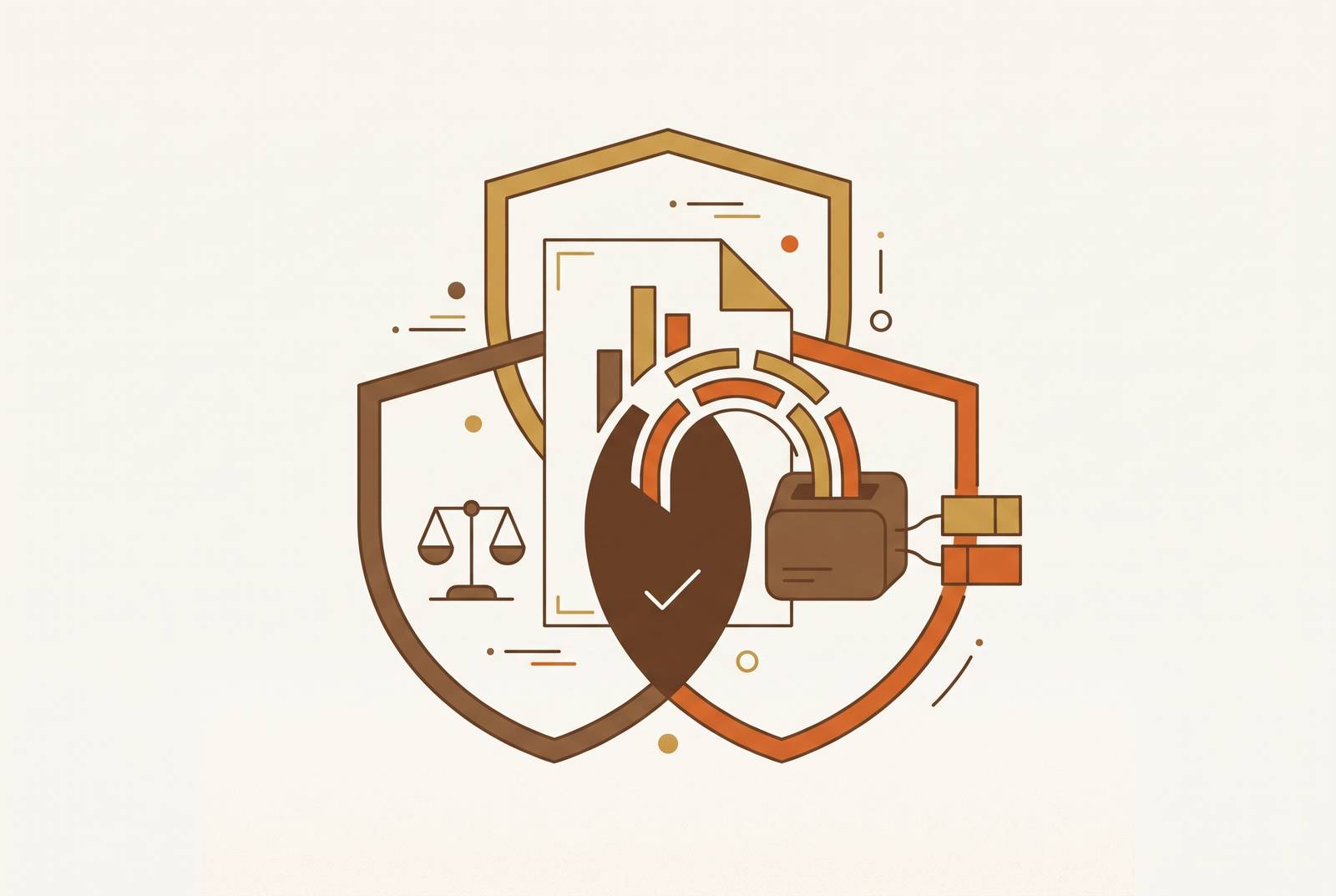
For sensitive document extraction, the right API is one with SOC 2 Type II assurance, ISO 27001 coverage, a signed GDPR Data Processing Agreement, and contractual zero retention after extraction. Each of these protections answers a different question, so buyers need all of them. Engineering and procurement teams should require them before deployment, because closing gaps after legal asks can mean renegotiating contracts, waiting for audit evidence, or rebuilding the integration.
Why document extraction APIs sit at the intersection of SOC 2, ISO 27001, and GDPR simultaneously
The moment a document reaches an extraction endpoint, its contents leave the buyer’s environment and enter a provider’s processing system. That is a data flow with legal consequences. The API takes in sensitive financial or personal data, parses it, and returns structured values that another business process may use. That raises questions about whether the processing is lawful, whether someone independent has checked the controls, and what security program is behind them.
Document extraction brings those questions together unusually often because of what the documents contain and where their outputs go. Accounts payable, mortgage lending, insurance, healthcare, and payroll all handle information that needs protection beyond a successful API response. Buyers in these fields face overlapping obligations. Their vendor questionnaires ask about those overlapping duties, and enterprise buyers also require SOC 2 Type II before they start to test the technology.
The legal terms can be less visible than the integration. Consumer or free-tier access cannot be assumed to include a GDPR-compliant Data Processing Agreement, or DPA. Where a provider receives personal data in a country without an EU adequacy decision, Standard Contractual Clauses or another valid Article 46 transfer mechanism must also be in place. An endpoint that works tells the buyer nothing about whether those conditions have been met.
What each framework actually asks — and why none of them covers the others’ ground
SOC 2 asks whether an independent auditor can examine the provider’s controls and report credibly on them. It is an attestation. Type I addresses control design at a point in time, while Type II tests operation over an extended period. Security is mandatory, but Availability, Processing Integrity, Confidentiality, and Privacy depend on the engagement’s scope.
ISO 27001 asks a different question. It concerns an information security management system, or ISMS, with risk treatment, named ownership, review cycles, and continual improvement. That managed program is not the same evidence as an auditor’s report on controls operating during a defined window. A vendor with only ISO 27001 still lacks the SOC 2 report that an enterprise buyer may need.
GDPR asks whether personal data is processed lawfully, for a valid purpose, under the right agreement and transfer arrangements, with data subjects’ rights respected. An Article 28 DPA remains necessary when a provider processes personal data on the buyer’s behalf. Training on customer documents creates a separate purpose that a SOC 2 report does not authorize. When a provider keeps data after extraction, it also needs to explain why it still needs that data once the work is done.
Why zero data retention is the compliance mechanism that all three frameworks demand, not a vendor differentiator
The provider processes the document, returns structured JSON, and discards the source after extraction. That removes a class of post-processing exposure. It does not replace lawful processing, secure controls, or a managed security program, and the frameworks should not be read as imposing a universal zero-retention rule on every workflow.
Under GDPR, data minimization and purpose limitation make continued storage a decision that needs justification. A provider retaining documents for its own purposes, rather than strictly on the client’s instructions, takes on a controller role for that retained data. Under SOC 2’s Confidentiality and Privacy criteria, a provider must keep protecting financial documents for as long as it keeps them. Under ISO 27001, the retained information becomes an asset that must be inventoried, assessed, and protected within the ISMS.
For buyers, the useful question is specific. Does the contracted service retain source documents or extracted data after processing, for how long, and on whose instructions? A zero-retention claim should answer all three as well as promise that the data will be deleted. The agreement also needs to address training separately, because a retention promise is not a substitute for an explicit prohibition on using document content to improve models. Whether these protections apply by default or only on a particular enterprise or API tier is a procurement question.
What a vendor’s compliance documentation actually needs to say — and what it commonly omits
A SOC 2 Type II report needs to cover the service the buyer will actually use and the criteria relevant to its documents. Scope is the first filter. Processing Integrity asks whether processing is complete, accurate, and timely, while Confidentiality and Privacy cover other parts of how sensitive data is handled. If those criteria are absent, the buyer cannot treat the report as assurance over them simply because Security was examined.
The GDPR agreement needs equally concrete language. Buyers should require a signed Article 28 DPA, the applicable international transfer mechanism, an explicit training opt-out, and binding retention and deletion terms. For a US-based or other non-EU provider, the transfer assessment must establish whether Standard Contractual Clauses or another valid mechanism is needed. The contract should spell out how the retention promise applies to source documents and to extracted data so that its terms are clear.
An ISO 27001 certificate for a parent group may not cover the product, business unit, infrastructure, or data center region processing customer documents. Buyers also need to check where the service runs, because cross-border processing during inference can raise transfer issues even when the buyer expects EU residency. Buyers with sovereignty requirements should confirm whether EU-region or on-premise deployment is available.
Evidence quality is a separate test. Static screenshots show less than timestamped continuous-monitoring exports that show the controls worked throughout the audit window. A document’s existence is only the beginning of due diligence.
How the EU AI Act changes the compliance calculus for document extraction pipelines used in high-risk verticals
The EU AI Act adds a use-case question that the three existing frameworks cannot settle. An extraction API used to support creditworthiness assessment, employment decisions, or risk assessment and pricing in life and health insurance can form part of a high-risk AI system. The classification follows the deployment. A mortgage buyer therefore needs more than the provider’s claim that its API is a general document tool.
Buyers still need assurance of the vendor’s security and privacy, and high-risk uses also have requirements for transparency, human oversight, and traceability. Buyers need to understand their own classification and whether the product supports the controls that follow from it. Healthcare, payroll, and other document-heavy settings require attention to the actual decision being supported rather than an assumption based only on the industry label.
When outputs enter a retrieval-augmented generation store, retention, deletion, and provenance controls must also reach that retrieval corpus. ISO 42001 provides an emerging AI management layer for model lifecycle, transparency, and accountability risks that a classic ISMS does not fully address.
Audit trails connect these obligations to day-to-day processing. Immutable, timestamped extraction logs can support SOC 2 evidence and AI Act documentation and traceability requirements. Logs limited to security events cannot explain which extracted value informed a decision or how its reliability was assessed.
Why accuracy guarantees and field-level validation are compliance controls, not just product features
A silently wrong extracted value can pass straight into a financial or personal decision, making accuracy a control issue. SOC 2’s Processing Integrity criterion addresses complete, accurate, and timely processing. GDPR Article 5(1)(d) requires personal data to be accurate and kept up to date. An invented value returned with unjustified confidence can undermine both the processing workflow and the buyer’s downstream data quality obligations.
Field-level validation makes the error visible before it propagates. Useful confidence scores are calibrated and traceable to a location in the source document. An auditor needs that connection to examine an output. Human-in-the-loop routing then gives the score an operational purpose, allowing automated handling at high confidence and review below a calibrated threshold. In high-risk uses, that routing can support the required human oversight within the product.
A per-field accuracy service-level agreement, or SLA, measured against ground truth and backed by commercial consequences is stronger than an unsupported performance claim. Paying only for correctly processed pages also means the provider earns money only when it processes them correctly. Neither arrangement proves compliance on its own, but both make accuracy a contractual responsibility.
Monitoring completes the control. Extraction records covering field values, confidence scores, and model versions can support output review and traceability. Those requirements also need to be reconciled with the retention agreement so that an audit promise does not quietly contradict a zero-retention promise.
The cost of retrofitting compliance into a vendor relationship after the audit question arrives
A missing agreement discovered before deployment is a selection issue. Discovered during an audit, it becomes a remediation problem. Adding a DPA, training opt-out, or zero-retention commitment may require negotiations that standard API terms do not accommodate. If the provider offers those terms only on an enterprise tier, the buyer also faces repricing. Processing may have to stop until the missing terms are in place.
SOC 2 Type II requires controls to work over an extended audit window. A provider that starts collecting evidence after a gap appears cannot turn that new evidence into a retrospective report. The buyer must wait for a new window rather than treat a promise to improve as proof of past operation.
Trained document types, custom field schemas, integration endpoints, and human review workflows may already depend on the selected API. Replacement costs can include a new subscription and rebuilding those connections while managing data migration risk.
Before selection, those dependencies do not yet constrain the decision. Procurement can make the required report scope, certificate coverage, legal terms, retention architecture, and accuracy SLA conditions of the relationship. That is the leverage available upfront. After deployment, the same requirements compete with the cost and disruption of changing a system already in use.
What should buyers check before deploying a document extraction API?
Buyers should obtain a recent SOC 2 Type II report, examine its audit window, and confirm Processing Integrity, Confidentiality, and Privacy are included. They should also request timestamped evidence of controls operating throughout that window. For ISO 27001, the current certificate and scope statement should identify the relevant product and infrastructure, with AI-specific risk treatment addressed within the ISMS or separately.
The next gate is the signed agreement. Before sending personal data, buyers should have the Article 28 DPA, any required transfer terms, the training opt-out, and binding retention and deletion obligations. Zero retention after extraction is the lowest-risk answer for vendor-held document content. The selected tier and deployment region must match those commitments, including any EU-region or on-premise requirement.
Accuracy needs its own acceptance test. Buyers should require a per-field SLA with consequences for failure, source-traceable confidence scores, and human review routing at calibrated thresholds. Immutable extraction audit logs should include field values, confidence scores, and model versions, and must be handled in line with the retention contract. For high-risk deployments, buyers should also check whether the product’s oversight and logging architecture supports the EU AI Act requirements that apply.
The final check belongs to the buyer. Vendor compliance verification is itself an auditable control, so the selection record needs to show how the evidence fits the intended use. Legal should receive a defensible vendor relationship.