Exception Queue Design for High-Volume Invoice Processing
Differentiate exceptions by root cause to route complex cases faster and keep easy approvals moving.

Invoice exceptions have become one of accounts payable's most persistent and costly challenges. Somewhere between 15 and 30 percent of invoices in most AP operations fail to process cleanly on the first pass, which makes exceptions one of the heaviest recurring workloads a finance team carries. Most systems still treat that workload like a junk drawer. Everything gets shoved in together, and nobody sorts it until it starts to smell.
The causes are structural, and anyone who's spent a year in AP could list them without looking anything up. Invoices arrive from thousands of suppliers, none sharing a layout standard. PO references go missing or fail to resolve, especially in service spend and non-PO categories where paperwork discipline was never great to begin with. Quantities and prices drift from what the receipt or contract says they should be, tax rates come in inconsistent, duplicates slip through, and every so often something looks enough like fraud to warrant a second look. Some of this resolves in seconds given the right lookup; other cases need three people in three departments to agree on something, and those sit for days. Per Ardent Partners' State of ePayables 2024, the average invoice takes 9.2 days to process, and approvals, many of them triggered by exceptions, are the primary bottleneck. A system that treats every exception the same way burns its best hours on the easy cases while the hard ones age on a shelf.
What a general-purpose exception queue actually costs at volume
The labor cost is real, and it's getting worse. Per the IFOL Accounts Payable Automation Trends survey, 63 percent of AP teams now spend more than 10 hours a week on invoice processing, up from 52 percent the year before. That line tracks almost exactly with the exception problem, which isn't a coincidence so much as the same disease showing up on two different charts.
Here's the part nobody says out loud enough: a disproportionate share of AP labor goes to the minority of invoices needing manual intervention, while the majority that process cleanly barely register. The cost shows up twice. First there's the direct cost, staff time spent chasing discrepancies, pinging stakeholders, making judgment calls nobody really wants to own. Then there's the slower one, easy to miss because it surfaces weeks later in late payment penalties, missed early-pay discounts, and a supplier relationship that erodes a little more every time an invoice sits for a week and a half.
A flat queue makes this worse by design. A suspected fraud case and a missing PO reference land in the same bucket and get the same treatment, even though one needs a phone call in the next ten minutes and the other can wait until Thursday. It doesn't prioritize, it doesn't differentiate, and it feeds nothing back into whatever produced the exception in the first place. The queue holds the most recoverable signal in the entire pipeline, and most implementations throw it away without a second thought.
Why the extraction pipeline itself generates avoidable exceptions
Mixing up two different kinds of exceptions is where a lot of AP automation goes sideways. Business exceptions are genuine: a PO mismatch, a pricing dispute, a duplicate submission, something needing a human regardless of how good the extraction was. Extraction exceptions are a different animal entirely. The invoice is fine. The system read it wrong, and now a perfectly valid document fails validation for no defensible reason.
Traditional OCR carries a lot of the blame here, and has for years. It treats a document as a flat stream of text, with no real concept of table structure, no sense of which row belongs to which header, no grasp of reading order once a layout runs multiple columns. On complex multi-column layouts, the kind that show up constantly in international invoices, vendor-specific templates, and scanned paper, traditional OCR tools fail on roughly 40 percent of complex multi-column layouts.
Academic work published in 2026 documents exactly how this breaks in production, and the failure modes are worth naming individually because they don't look like the same problem. Block loss: entire header sections vanish from the output without a trace, gone like they were never scanned. Reading-order errors: the table content survives but lands in the wrong section of the parsed document. Symbol mutation is the quiet one, and probably the most dangerous, where a unit renders incorrectly, a magnitude-level error that slides through without tripping a single validation flag. Cross-page tables cause their own mess. A single table spanning two pages often produces two unrelated schemas instead of one continuous record, so the downstream system acts confidently on the wrong data.
Worth sitting with: these errors are document-caused, not model-caused. Swapping the underlying language model doesn't fix a pipeline that can't handle a two-column invoice or a table breaking across a page. Pipeline quality is the actual fix, and it's hard won. Fewer than 10 percent of in-house parsing pipelines ever reach production, mostly because edge cases pile up faster than engineering teams can patch them one at a time. For exception queue design, this means the system has to know, before a human ever sees the exception, whether it's looking at a business discrepancy or an extraction artifact. The two demand entirely different responses, and conflating them is how a queue turns into a landfill.
How confidence scoring determines what enters the queue — and what passes through undetected
Most systems route on a simple rule: high-confidence extractions pass through automatically, low-confidence ones land in the queue. That only holds if the confidence scores are calibrated, meaning a score of 0.95 actually corresponds to the extracted value being correct 95 percent of the time at that threshold. Most vendor systems aren't calibrated to that standard.
A poorly calibrated system over-reports its own confidence. It says 0.95 and means something closer to 0.80. The dangerous part isn't the low-confidence exceptions that get caught, since those at least reach a human. It's the high-confidence extractions that are wrong and sail through untouched, because nothing in the system was built to question them. The exception queue does fine with what it receives. It just never receives the errors that matter most, and that's the gap nobody budgets for.
There's a blunt way to test this. Pull a sample of extractions the system marked high confidence and check them by hand against the source document. If more than 10 percent contain errors, the confidence scores are miscalibrated, full stop. Vendor accuracy claims muddy things further, since a "99% accuracy" figure almost always means character accuracy, not field accuracy, and field accuracy is what determines whether a validation check passes. What actually governs real-world automation is document accuracy, the percentage of invoices with zero extraction errors across every field, measured separately from the percentage of characters read correctly. An invoice can hit 99.5 percent character accuracy and still have a wrong total. A wrong total is the only number AP actually cares about. Queue input quality comes down to whether thresholds get set against calibrated, field-level ground truth rather than a number pulled off a vendor's spec sheet.
Exception taxonomy as the foundation of intelligent routing
You can't route intelligently what you haven't classified first. A lot of AP automation projects skip this step and pay for it later, once the queue fills up with things nobody sorted properly.
A workable taxonomy separates exceptions by how they resolve, factoring in where they surfaced in the pipeline as a secondary signal. Extraction failures, a low confidence score on one field or a value failing format validation, resolve through re-extraction with better preprocessing, or a human correcting that field instead of the whole document. Missing reference data, a PO number that's absent or doesn't match anything in the ERP, resolves through lookup or a quick note to the requestor. Matching discrepancies, where quantity or price or tax rate doesn't line up with the PO or receipt, need real business judgment and often more than one person in the room.
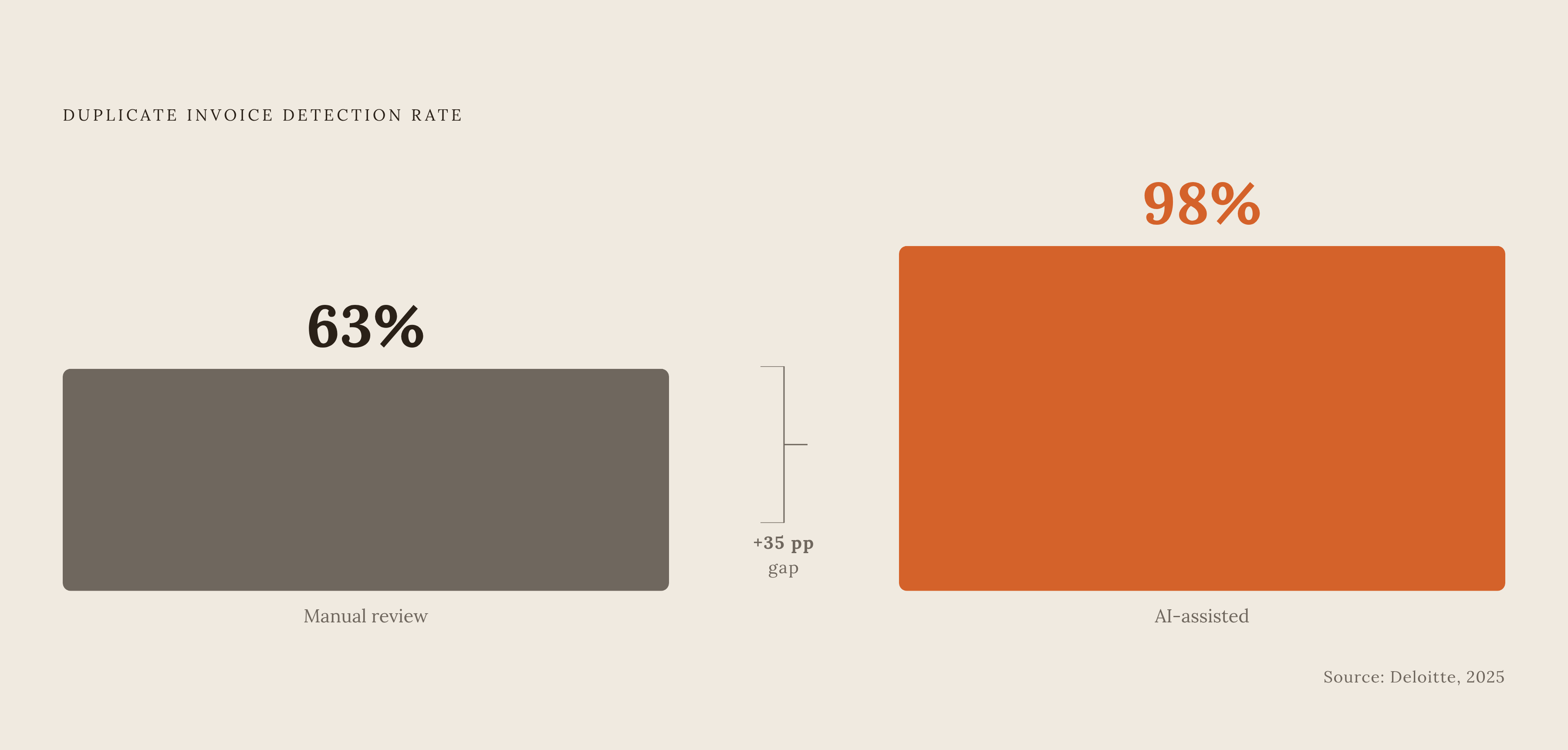
Duplicate candidates move on a different clock entirely. AI-assisted duplicate detection reaches catch rates around 98 percent, versus 63 percent for manual review, according to Deloitte's 2025 research, and that gap alone should change how a company staffs the function. Fraud signals, unusual payment patterns, mismatched supplier details, a first-time vendor submitting a suspiciously large invoice, carry the highest urgency and belong on a separate track altogether.
Each category carries its own urgency, its own resolution owner (AP clerk, procurement, finance, security), its own expected turnaround, its own cost of delay. A flat queue erases all of that. A fraud signal waits behind a missing PO reference for no better reason than it happened to arrive four minutes later. Sort exceptions this way and measurement becomes possible too: which categories are growing, which resolve fastest, which keep throwing repeat failures from the same vendor or template.
Routing logic: how priority, ownership, and SLA windows get assigned automatically
Routing depends on three things: the exception category, the invoice's own attributes (amount, vendor, due date, payment terms), and who's actually free to work it. Get any one wrong and the routing falls apart no matter how clean the taxonomy underneath it is.
Priority scoring follows from category. Fraud signals get immediate escalation into a separate queue owned by security or finance control, no exceptions carved out. Duplicate candidates are time-sensitive but not an emergency, so route them within hours rather than days. High-value matching discrepancies scale in priority with the invoice amount and how close the due date sits. A missing PO reference on a low-value service invoice sits at the bottom and gets handled in a batch later. SLA windows need assigning the moment an exception is routed, not after it's already sat for a week gathering dust. A late-payment penalty tracing back to an exception nobody routed in time is a design failure, not a staffing shortfall.
Ownership assignment runs on the same logic. Extraction failures go back to the pipeline for an automated retry with different preprocessing, or to an AP clerk with the one problem field highlighted, rather than the entire invoice dumped in their lap. PO mismatches route to whoever raised the original PO, with vendor and invoice context already attached. Matching discrepancies go to procurement or the contract owner, since those are the people who actually know whether the variance is legitimate. Context matters as much as destination: an exception arriving with the relevant PO line, the received-goods record, and that vendor's invoice history resolves faster than one that forces the reviewer to go dig all of that up. Automated workflows that surface real-time queue status and aging give finance leaders visibility into bottlenecks before they turn into late payments. That visibility belongs in the routing architecture from day one, not bolted on afterward.
Auto-resolution logic: which exceptions the system should close without human intervention
Some exceptions don't need a person looking at them at all. Deciding where that line sits, between what the system closes on its own and what it hands off, is one of the more consequential calls in the whole design. Teams get it wrong most often by being too conservative, routing things to humans that a tight rule set could have closed on day one.
Some categories are strong candidates for auto-resolution once the rules are tight enough. Price variance within a pre-approved tolerance band, rounding differences, minor currency swings, can resolve and log automatically with zero human touch. A duplicate candidate matching exactly on vendor, amount, and period can auto-reject with a notification out to the vendor. A missing PO where the vendor operates under a blanket order, and the amount falls inside that order's limit, can auto-match and move forward. A low-confidence flag on a single non-critical field, where the document image itself is clean, can trigger a re-extraction with enhanced preprocessing before it ever reaches a human's screen.
The governing rule is simple: auto-resolve when the outcome is deterministic and an error, should one slip through, is recoverable. Escalate when judgment is genuinely required or an error would carry real weight. Preprocessing investment pays off directly here. Deskewing, binarization, denoising, and resolution upscaling can lift OCR accuracy by 10 to 15 percentage points on poor-quality inputs, and that gain shows up before the exception queue ever sees the document. A clean digital PDF might hit 99.5 percent character accuracy; a photographed receipt off someone's phone might land around 85 percent. That gap gets addressed upstream, in the pipeline, rather than downstream, in someone's inbox.
Auto-resolution rates double as a health check too. When a previously stable category suddenly sees its auto-resolution rate drop, something changed upstream, maybe a new vendor template, maybe a field that started arriving in a different format, maybe a validation rule that quietly drifted out of sync with the actual data.
How the exception queue feeds continuous improvement back into the extraction pipeline
Every correction a human makes in the queue is a labeled example of ground truth. The reviewer saw the extracted value, saw what was wrong with it, and produced the right answer, all in one motion, usually without thinking of it as training data. That correction is some of the most valuable material in the system, and any setup that discards it after resolution is wasting the one asset the queue actually generates.
The feedback loop needs specific architecture to function. Corrections should get captured at the field level, paired with the original extraction and the confidence score assigned at routing time. Patterns across corrections expose miscalibrated thresholds directly: if a field scoring 0.90 or above keeps getting corrected anyway, the threshold for that field needs to move. Vendor-specific correction patterns point to template failures, and a vendor whose invoices keep generating the same exceptions is a strong candidate for a dedicated extraction model built around that one layout.
Exception category trends over time surface problems further upstream than the pipeline itself. A spike in PO-mismatch exceptions from a single business unit usually means a procurement process problem, and mistaking that for an extraction problem wastes engineering effort chasing the wrong fix.
The exception queue is the mechanism through which a document AI system gets better at handling its own failure cases over time, provided anyone bothers to close the loop. That ongoing improvement is what separates it from a static OCR tool bolted onto a workflow. Finance teams running this feedback loop report cycle times roughly 70 percent faster and processing costs down around 76 percent, and those numbers depend on the loop actually closing, not just the automation switched on and left alone. As the pipeline improves on document types that used to trip it up, the exception rate on those types falls, and human review time concentrates on cases that are genuinely novel or genuinely high-stakes. Whether that continues to compound or plateaus depends entirely on whether anyone keeps feeding the loop.
Measuring exception queue health: the metrics that reveal whether the system is improving or drifting
None of this works without measurement, and the metrics that matter are more specific than a general processing-time dashboard glued to a wall somewhere.
Exception rate by category is the leading indicator. Is each type growing, holding steady, or shrinking over time? Routing accuracy shows what share of exceptions landed with the correct owner and got resolved without bouncing back for re-routing; a low number here means the taxonomy or the routing rules need work, not the staff running them. Auto-resolution rate tracks how many exceptions closed without a human ever touching them, and whether that rate holds steady or slides backward. Time-to-resolution, broken out by category and priority tier, shows exactly where SLA windows are breaking, and whether that's a routing failure or just a capacity problem nobody's staffed for.
Correction-to-confidence correlation checks the calibration claim directly: do high-confidence extractions for a given field actually get corrected less often than low-confidence ones. If they don't, the confidence model isn't calibrated for that field, whatever the vendor's spec sheet claims. Repeat-offender rate measures whether the feedback loop is doing anything at all, by tracking what share of exceptions in a given period trace back to vendors or document types that also caused trouble the period before. A persistently high number here means the loop is broken somewhere, not just slow.
And escape rate, the share of high-confidence extractions later found wrong, is arguably the single most important number in the whole system. It's the one that exposes the failure mode nobody catches until it's already cost something real.
Together, these metrics answer the question that actually matters at this volume: is the exception queue getting smarter, or just bigger.