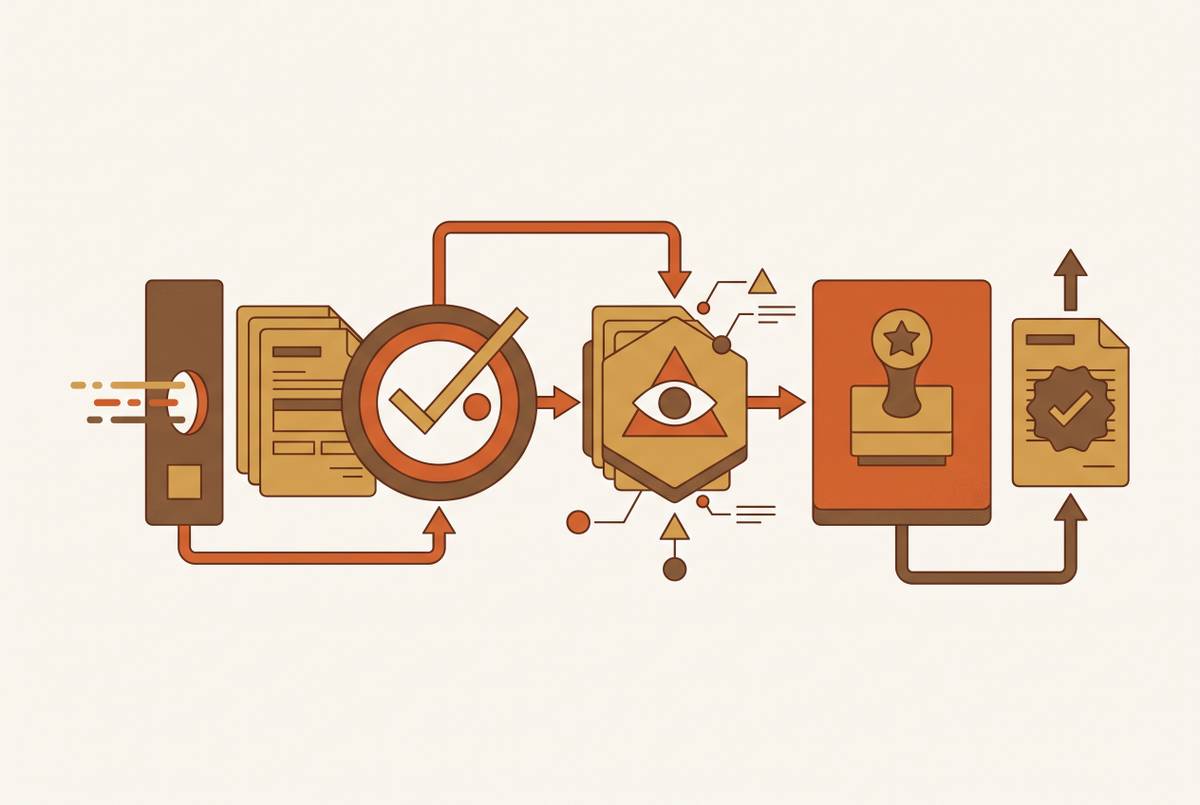
EOB Processing Workflow in Healthcare Revenue Cycle
Misread EOB fields cascade into posting errors, wrong denials, and patient billing disputes.
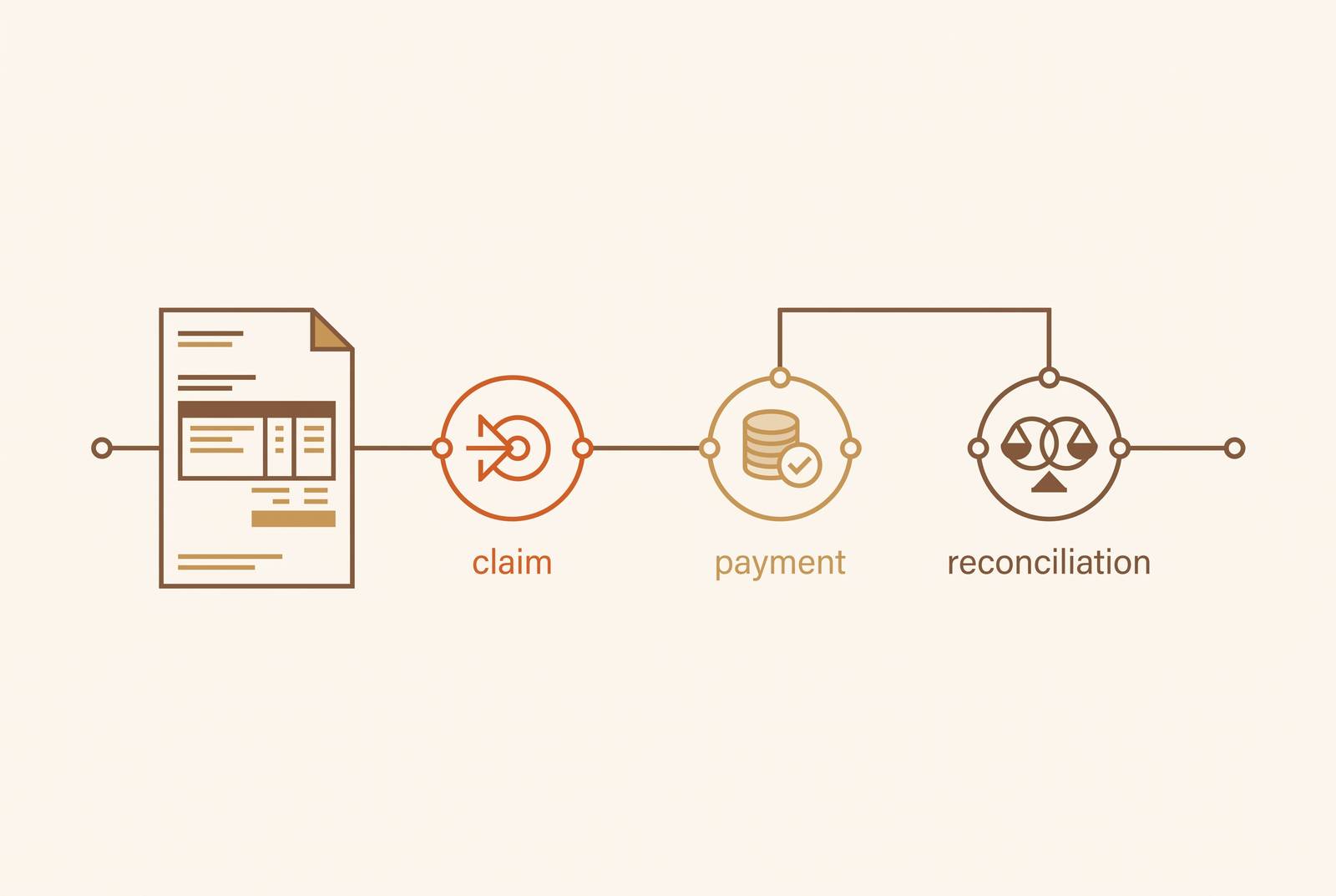
An EOB is the payer's summary of what happened to a claim: what got billed, what got allowed, what got adjusted, and what the patient owes. It is the document that tells everyone downstream what to do next, and if the fields inside it get read wrong, everything built on top of it gets built on sand.
That matters because the revenue cycle does not run on judgment calls. It runs on fields: CPT and ICD-10 codes that tie the EOB back to the original claim, billed charges against allowed amounts, patient responsibility figures, and the CARC and RARC codes that explain why a payer adjusted a line the way it did. Add in group codes like CO, PR, OA, PI, and CR, which decide who actually owes the money, provider or patient, and you have a document where every field gates an action. Post it, appeal it, bill the patient, or write it off. Nothing in that list is optional context. Each one is a decision waiting on a correctly read value.
Worth separating here: the EOB and its electronic cousin, the ERA, or X12 835. The ERA is what payers send providers for automated posting, and per the CAQH 2024 Index, electronic remittance adoption in medical plans reached 89%. That sounds like the problem is mostly solved. Portal-delivered EOBs are still commonly printed, faxed, or downloaded as PDFs and re-keyed by hand, running alongside the automated channel rather than replacing it. The document still has to arrive and get read correctly before any action downstream can happen at all.
How the revenue cycle depends on EOB data at each processing stage
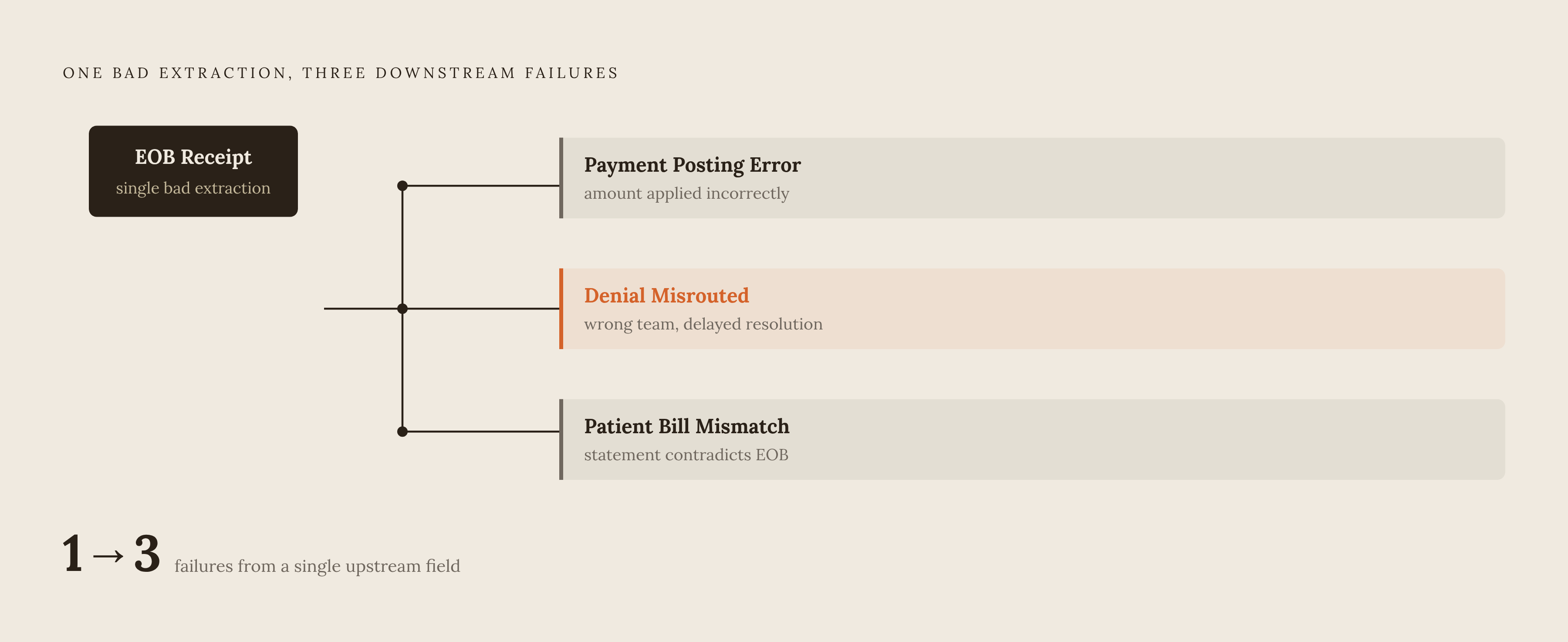
Follow a claim through its life: submission, adjudication, EOB receipt, payment posting, reconciliation, denial management, patient billing. Every one of those later stages leans on numbers pulled from the EOB at receipt.
Payment posting takes the allowed amount and the adjustment figures straight off the EOB and writes them into the practice management system. Get one of those figures wrong and the account balance is wrong, often quietly, sometimes not caught until the next billing cycle rolls around and someone notices the math doesn't add up.
Reconciliation depends on the same data from a different angle. It flags the gap between what a payer was expected to pay and what actually came through, and that comparison only works if the billed charge and allowed amount were captured correctly at the start. Denial management leans even harder on this: the CARC and RARC codes decide whether a denial goes to appeals, gets written off as a contractual adjustment, or heads back out for resubmission. Per the 2024 MGMA Financial Performance Report, close to 67% of claim denials could be resolved simply by reviewing the EOB in detail and taking the right follow-up action.
Patient billing closes the loop, and it's the one patients actually notice. The patient responsibility figure on the EOB has to match what shows up on the statement, and when it doesn't, that's a phone call, a delay, sometimes a dispute that eats staff time for weeks.
Here's the part that makes this more than a bookkeeping nuisance: one bad extraction at the receipt stage doesn't cause one problem. It causes three. A posting error, a denial routed to the wrong team, and a patient bill that doesn't match the EOB it's supposed to reflect. All from a single field read wrong at the top of the funnel. Scale that across a billing operation handling hundreds or thousands of these documents a day, and there is no such thing as a one-off exception anymore. It's a systemic failure mode waiting for volume.
The code taxonomy that makes accurate CARC and RARC extraction non-negotiable
There are 358 CARCs and 1,185 RARCs in active use today — a taxonomy large enough that even small misreads carry real consequences. That's not a small lookup table. It's a taxonomy where a lot of codes look nearly identical on the page but mean very different things financially.
CARC tells you why the payer adjusted the claim. RARC adds detail on top of that. Together, they're supposed to tell whoever's reading the EOB exactly what to do next. Take CO-97, bundled into another service, contractual obligation: the provider eats that adjustment, full stop. Mistake that for a PR code, patient responsibility, and now a patient's getting billed for something they don't owe. That's not a rounding error. That's a call to the front desk, maybe a complaint, maybe a compliance flag.
The group code sitting next to the CARC matters just as much as the CARC itself. CO versus PR versus OA is the difference between the provider absorbing a cost and the patient getting billed for it, and misreading that letter is enough to send an entire claim down the wrong path.
Here's why OCR by itself doesn't hold up under this load. These codes are short, dense, and visually close together: CO-4, CO-45, CO-49 differ by a digit or two, and they sit inside cramped table rows where cell borders don't always align the same way from one payer's layout to the next. A single misread character on a two-digit code doesn't throw an error. It produces another valid-looking code, just the wrong one, and there's no spell-check equivalent that catches a real code standing in for another real code.
This is the exact point in the pipeline where field-level accuracy carries the most weight, and where the usual accuracy numbers vendors publish are the least useful for judging whether a system can be trusted. Automated routing, sorting clean payments from appeals from write-offs, only works if the reason code behind it is right. Get the CARC wrong and a denial that could have been appealed and recovered gets written off instead, silently, with no one the wiser until someone audits the books months later.
Why EOBs are structurally difficult documents to parse at scale
There is no single EOB format. Medicare Summary Notices, commercial payer EOBs, the layouts from major national carriers, dental EOBs, Medicaid remittances: they all carry roughly the same core fields, but the layout, the labeling, and the table structure differ enough between them that a parser tuned on one breaks on another.
Then the input format itself varies on top of the layout variance. Scanned PDFs from a fax machine, photographed EOBs taken on someone's phone, portal-exported digital PDFs, email attachments: each one carries its own image quality and orientation quirks, and a pipeline has to handle all of them without knowing in advance which kind is coming in.
A single EOB page often mixes several document types at once: section headers, a financial summary table with merged cells, a line-item claim table below it, footnotes defining the CARC and RARC codes used above, and a patient responsibility summary somewhere on the page, all fighting for the same visual real estate. Fax-originated documents remain common in this industry, and they bring low resolution, compression artifacts, and page skew that degrade the image before any extraction model even gets a look at it. Handwritten notes occasionally show up scrawled on a scanned EOB, a case that a pure OCR pipeline has no clean way to handle.
Multiply the payer-format permutations by the input types by the range of image quality, and you get a combinatorial problem, not a linear one. Systems built and tested on clean, easy examples look great in a demo. The edge cases are where they actually break, and they break in production, not in the lab, which is exactly the environment where field-level accuracy has to hold up.
Where parsing pipelines fail on EOBs in production
Fewer than 10% of in-house parsing pipelines built for documents like these actually reach production, with edge cases and maintenance burden cited as the primary reasons. Edge cases and the ongoing maintenance burden are the two reasons cited most.
For EOBs specifically, the failure modes have a familiar shape. Reading order errors put a table in the wrong section, so a CARC table gets tied to the wrong claim line, and the output looks fine but describes the wrong thing entirely. Header metadata, the payer name, the claim number, the date of service, sometimes just goes missing from the output with no error thrown, leaving the posting team with a number and no anchor to reconcile it against.
Then there's silent character mutation, probably the most dangerous failure of the bunch: a digit gets transposed in a CARC code, CO-97 read as CO-79, and the result is a wrong code that still looks completely legitimate. Nothing downstream catches it unless someone specifically checks that the extracted code exists in the current code set. Table cells get fragmented too: a merged cell in a line-item table splits incorrectly, and one row of charges becomes two, doubling a charge in the posted account. Layout detectors sometimes break a single CARC/RARC block into several disconnected pieces, severing the tie between the code and the dollar amount it's supposed to explain. And fax artifacts, if denoising isn't applied before OCR runs, corrupt short numeric strings, which is about the worst place for corruption to happen given how much of an EOB's meaning rides on short numeric strings.
Preprocessing gets underrated across the board. Cleaning up input quality, deskewing, denoising, normalizing resolution, before a model ever touches the page, can move OCR accuracy by 10 to 15 percentage points. That's the difference between a usable pipeline and one that quietly fails all day.
The uncomfortable truth is that most of these errors don't announce themselves. They produce output that looks plausible, gets posted, and only surfaces as a discrepancy weeks later during reconciliation, if it surfaces at all. And leaderboard rank doesn't predict any of this: models that top general benchmarks have been documented failing silently on real business documents, and leaderboard position is a poor predictor of reliability on specialized formats like EOBs.
Why character accuracy metrics hide the errors that matter in EOB extraction
Vendors love to report character accuracy: the percentage of individual characters transcribed correctly. It's an easy number to make look good, and it hides almost everything that actually matters. A document can score very high on character accuracy and still get the one CARC code wrong that determines whether a claim gets appealed or written off.
Field accuracy is the number that actually counts: was the correct value pulled for each named field, not just were most of the characters right. Document accuracy goes one step further and asks what percentage of EOBs came out with zero field-level errors at all, which is the number that actually determines how much of this work can be automated versus how much still needs a human eye.
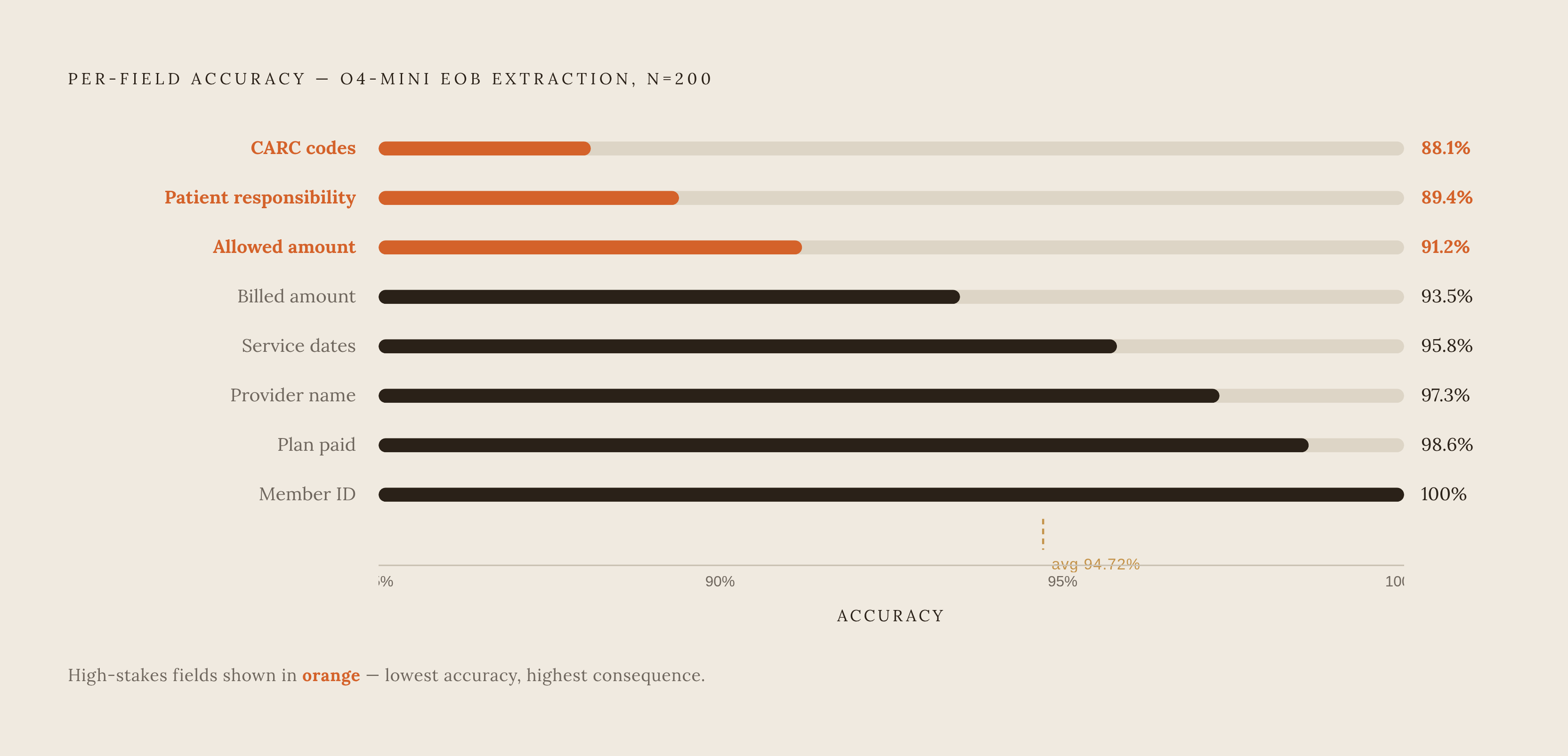
An extraction study using o4-mini, run across 200 documents, found overall field-level accuracy averaging 94.72%. That sounds solid until you look at the spread underneath it: some fields hit 100%, but others dropped into the high 80s. The average hides exactly the fields most likely to fail, and for EOBs, those are the fields carrying the most money: CARC codes, patient responsibility amounts, allowed amounts. The fields that matter most are the fields the average is built to obscure.
Confidence scoring adds a second layer to the problem, separate from raw accuracy. An uncalibrated model can report high confidence on a field while actually being right far less often at that threshold. The practical effect is brutal: high-confidence wrong answers sail through automation with nobody checking them, while only the low-confidence results get flagged for human review. The errors most likely to cost money are the ones least likely to get caught. CARC and RARC codes present a particular calibration risk: short, alphanumeric, and drawn from a set of over a thousand possible values, they are exactly the kind of field where a wrong answer can look indistinguishable from a right one.
The only real standard for measuring any of this is field-by-field comparison against manually validated ground truth, a binary match per field, rolled up by section. Anything looser than that is a marketing number dressed up as a metric. And confidence thresholds need to be tuned per field, not set once at the document level; a threshold that works fine for a patient's name will let a wrong CARC code through without a second look.
What a production-grade EOB extraction pipeline actually requires
A pipeline built to handle EOBs at scale needs several stages, and skipping any one of them shows up later as an error nobody can trace back to its source.
Ingestion has to normalize scanned PDFs, digital PDFs, faxed images, and email attachments into a common starting point before any real processing begins. Preprocessing comes next, and it's the stage most teams underinvest in even though it carries the biggest accuracy payoff: deskewing, denoising with real attention to fax artifacts, contrast correction, resolution normalization. OCR and layout analysis then have to handle multi-column claim tables, merged cells, and pages that mix headers, tables, and footnotes without any layout awareness built in; generic OCR run blind on a dense EOB line-item section produces output nobody can use.
Field extraction should be schema-driven, meaning the model is told exactly which fields to find rather than asked to summarize the page in its own words. CARC and RARC extraction specifically needs code-set validation on top of the raw text match, checking that whatever got pulled out is actually a code that exists, not just a string that looks like one. A validation layer sits above all of this, running business rules: does patient responsibility plus the contractual adjustment stay under the billed charge, does the extracted CARC actually belong to the current code set, do the fields agree with each other in ways a human reviewer would expect. These are the checks that catch what confidence scores miss.
Confidence scoring needs to run per field, with thresholds tuned separately for each one: an auto-approve lane for fields that clear the bar, a human review queue for the ones that don't. And the loop can't stop there. Corrections made by human reviewers need to feed back into the model, because a static extraction system slowly falls behind as payer formats change, and the only way to keep pace is to keep learning from what actually gets corrected in production.
The output at the end of all this should be structured data, JSON keyed to the revenue cycle system's own field schema, ready to post directly: field-value pairs a machine can consume without a person retyping anything.
What separates a real document intelligence pipeline from a glorified OCR wrapper is whether it checks its own work: cross-referencing extracted values against known rules before anything moves downstream. And the human reviewer in this setup plays a specific role: that review is the mechanism that generates the correction signal the whole pipeline needs to keep improving.
Why building EOB parsing in-house compounds in complexity faster than most teams expect
Building this in-house looks reasonable at first glance. A team knows its own payer mix, knows its EHR or practice management system inside out, knows exactly how it wants CARC and RARC codes routed. The first version usually works fine, often covering the top ten payer formats a practice deals with day to day.
Then the formats start changing. Payers update their systems, layouts shift, and every shift means a template update or a retraining pass, multiplied across however many payers sit in that practice's mix. Every new payer added, every new specialty, every new claim type introduces failure modes the original training data never saw, and each one needs to be investigated, fixed, and tested again to make sure the fix didn't break something else. Preprocessing needs upkeep too: fax quality drifts, resolution standards shift, and a denoising step tuned for one input type quietly degrades on another. Confidence thresholds set at launch drift out of calibration as formats evolve, and fixing that requires fresh ground truth data and evaluation infrastructure that most revenue cycle engineering teams simply don't have sitting around.
The number that grounds all of this: fewer than 10% of in-house parsing pipelines make it to production. The gap between a demo that works on familiar formats and a system that holds up across a practice's full payer mix is exactly where most in-house efforts get stuck and stay stuck.
The real cost was never the initial build. It's the engineering time that keeps getting spent on format maintenance, chasing edge cases, and recalibrating thresholds, month after month, with no end point in sight.
Anyone evaluating an outside vendor for this work should ask for specifics, not marketing language. A per-field accuracy commitment, in writing, rather than a vague claim about overall accuracy. Zero data retention, since EOBs carry PHI and financial detail, and any architecture that holds onto that data longer than it needs to is taking on HIPAA and GDPR exposure it doesn't need. A system that actually learns from corrected output instead of demanding a manual retraining cycle every time formats shift. And confidence scoring reported per field, transparently, so the buyer can see exactly where the system is sure and where it isn't, rather than relying on one blended number.