Vendor Master Matching for Extracted Supplier Data
Extraction errors upstream break vendor matching downstream—fix the source, not the algorithm.
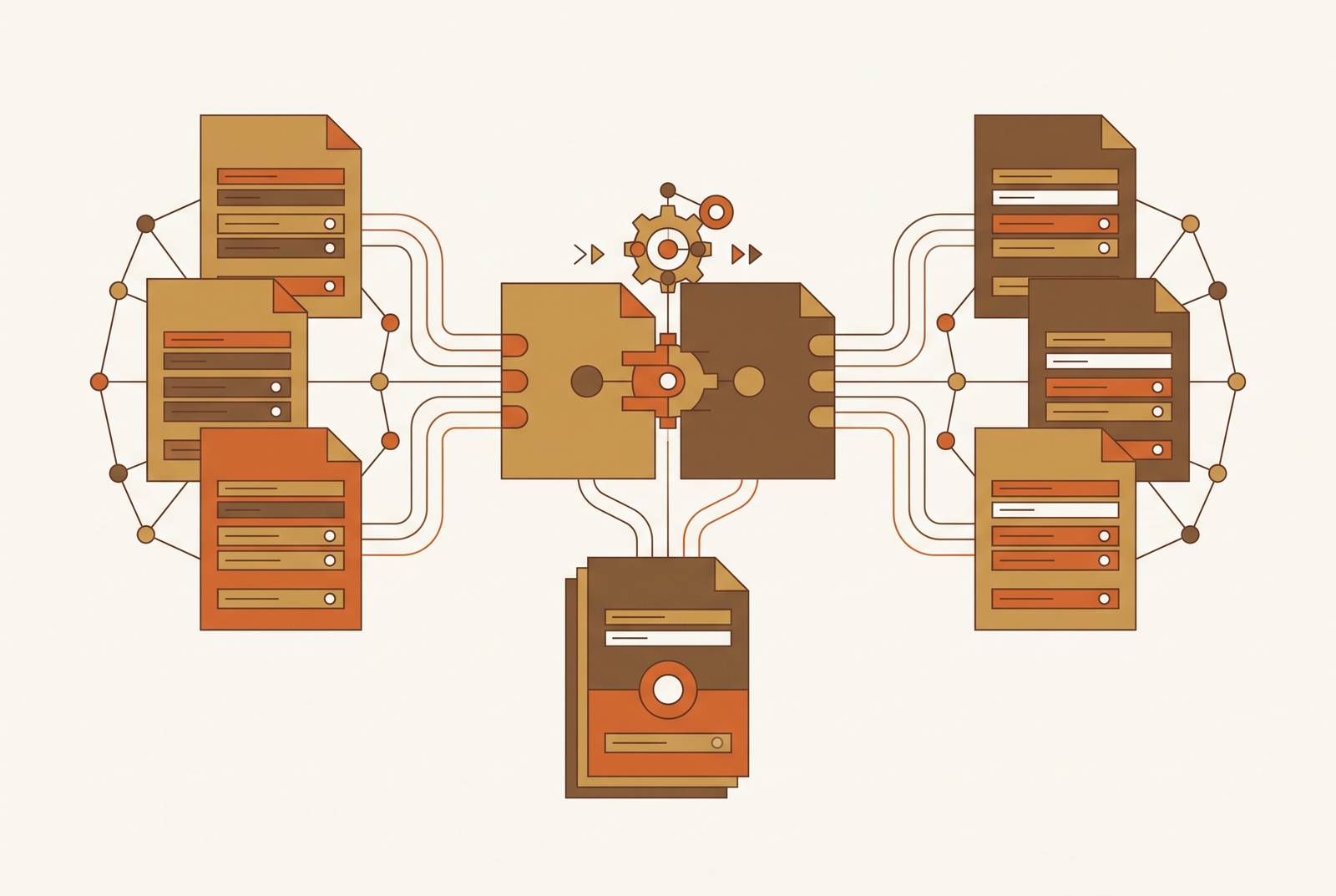
Vendor master matching fails at scale because the data feeding it is already broken before any matching algorithm sees it. A misread tax ID, a bank account with two digits swapped, a supplier name that shows up four different ways across four business units: these are extraction failures, not matching failures. No amount of fuzzy logic downstream fixes a value that was wrong the moment it left the document.
A vendor master is the record a company uses to buy materials, cut purchase orders, route payments, and keep supplier information consistent everywhere it's referenced. It needs to carry the legal entity name and any DBA name, tax identifiers like VAT numbers or an EIN, banking details including account number and remittance address, payment terms, currency, shipping and delivery terms, certifications and risk ratings, and an ERP vendor ID with an approved supplier flag. None of that is paperwork for its own sake. A wrong bank account number sends payment somewhere it shouldn't go. A transposed tax ID breaks a three-way match between PO, receipt, and invoice. An inconsistent entity name splits one supplier's spend across two or three phantom records, and then nobody, not procurement, not finance, knows the real number. The vendor master validates invoices, routes payment, and tracks supplier performance, all at once. Corrupt one field and all three jobs run on bad information simultaneously. In manufacturing terms: a clean supplier record doesn't guarantee the open PO is right, but a dirty record guarantees everything built on top of it is wrong from the start.
How the vendor master degrades: the structural mechanics upstream of any matching problem
Vendor masters rot for reasons that have nothing to do with document quality, and these compound with extraction errors rather than replacing them (per Suplari's supplier MDM analysis).
Multi-currency setups are one culprit. Plenty of ERP configurations require a separate vendor record for every transaction currency, so a supplier trading in three currencies ends up as three records, each carrying only a fragment of the real spend. Multi-entity, multi-ERP companies make it worse: a supplier serving four business units across two ERP instances generates at least four records, each typed in by a different requester who spells the name a little differently every time. Acquisitions bring their own mess, too. Every acquired company arrives with a supplier list that overlaps the existing master by some real fraction and matches on almost nothing, and integration budgets almost never fund the reconciliation work to fix it. Where requesters can free-text a new vendor into existence, the same company shows up as "IBM," "I.B.M.," "IBM UK Ltd," "International Business Machines Corp," and, memorably, "IBM (do not use)." Once the ERP goes live, there's rarely anyone left holding the job of vendor master owner: data governance gets funded through implementation and defunded the moment the project closes, so the master gets cleaned once at migration and then drifts, uncorrected, for years.
Procurement leaders now name poor data quality as the single biggest barrier to scaling AI in their function, according to HFS Research's 2025 survey, and supplier identity is where that poor quality does the most damage, since every other layer of spend analysis sits on top of it. Get vendor identity wrong and everything downstream inherits the error. Duplicate vendor records understate spend under management, cost negotiating leverage (the buyer thinks it's a smaller customer than it actually is, and the supplier knows better), create a false sense of scattered tail spend that's actually consolidated, and fragment risk exposure so nobody notices how much depends on one supplier until that supplier fails.
All of this happens even when document processing works perfectly. What follows is what happens when it doesn't.
Where extracted supplier data enters the vendor master and which fields carry the highest error risk
Vendor information usually comes from three places: onboarding documents, contracts, and invoice headers. Every one of them starts life as an unstructured PDF or scanned image, and every one of them has to pass through an extraction step before any matching logic can touch it.
That extraction step is where the field-level errors are actually born. A bank account number gets misread. A digit in a tax ID gets transposed. An entity name gets pulled off an invoice header in an abbreviated form that doesn't match the legal name on file anywhere else. These errors don't stay contained; they turn into payment errors, reconciliation problems, and compliance gaps down the line, since the vendor master glossary treats them as originating exactly here, at the document layer, not at the matching layer.
Some fields carry far more risk than others, and the reasons why matter. Tax IDs are numeric strings, which means a single transposed digit produces something that's syntactically fine but factually wrong: a value that passes format validation while pointing at the wrong supplier entirely. Bank account and routing numbers carry the same risk, with worse consequences, since a wrong digit here doesn't just break matching, it misdirects money. Legal entity names are their own problem: the way a supplier writes its own name on an invoice header rarely matches its registered legal name character for character, and that formatting gap is enough to defeat exact-match logic, forcing the system into probabilistic territory where certainty is never guaranteed. VAT numbers and business registration numbers are supposed to work as a cross-check against legal name accuracy, but that cross-check only holds if the VAT number itself was read correctly in the first place.
None of this means matching logic doesn't work. It means matching logic receives these fields already damaged, and no algorithm can reliably flag a transposed bank digit it has no independent way of knowing is wrong.
Why matching algorithms cannot compensate for upstream extraction errors
Matching runs in two modes, and both depend on the quality of what they're given. Deterministic matching uses unique identifiers (tax IDs, registration numbers, DUNS numbers, bank details) to produce a match with no ambiguity. It works cleanly when the identifier was extracted correctly, and it fails silently the moment that identifier is transposed or truncated, because deterministic matching has no concept of "close enough." Probabilistic and machine-learning matching takes a softer approach, scoring similarity across name strings, addresses, contacts, and transaction patterns using fuzzy matching and phonetic encoding. It's built to absorb formatting variation, not to catch a factual error that was introduced when the document was misread.
Here's the failure that neither mode can see. A tax ID extracted as "12-3456789" instead of the correct "12-3456798" isn't a formatting quirk, it's a wrong value, and it will score as a confident, clean extraction. Deterministic matching then fails to link that record to the correct supplier. Probabilistic matching has no signal at all that the digit is wrong, because nothing about the string looks unusual.
Standardizing names before matching helps with exactly the problem it's built for and nothing more. Searching for "Blue*" pulls back "BlueScope Steel" and "Blue Scope Steel Pty Ltd" and resolves the spacing difference between them without trouble. It cannot tell you the ABN on one of those records was misread off a scanned onboarding form, because that's not a formatting problem, it's a factual one (per Auditec Solutions' vendor master cleanse guidance).
Survivorship logic, the process of picking the best value per field and routing edge cases to a steward for review, runs into the same wall. Survivorship works by choosing among candidate values, so if the extracted value is the only candidate on record, a wrong digit doesn't get filtered out, it survives straight into the golden record. Monitoring for downstream signals, like flagging an unusual bank account change, can catch a bad edit after the fact, but only after that bad value has already been live in the master, and possibly already used to route a payment.
Matching infrastructure is necessary. It just isn't sufficient, and treating it as sufficient is the mistake most vendor data programs make. Extraction has to deliver field-level accuracy before matching logic has anything workable to act on.
How production document parsers fail on the specific fields vendor matching depends on
Demo accuracy and production accuracy are not the same number, and the gap between them is where most vendor data programs quietly fail. A parsing model might handle the easy 95% of documents cleanly, but the remaining 5% often need dedicated handling, and in a high-volume accounts payable or onboarding pipeline, that 5% still adds up to a real count of corrupted vendor records (per jxnl.co's analysis of document parsing in production).
Traditional OCR has a structural blind spot that maps directly onto the fields vendor matching cares about most. It reads a document as a sequence of glyphs, not as a structured object, so it can read a table cell without understanding what the cell's header means the value represents. A bank account number sitting in a multi-column onboarding form is, to the parser, just a cell, stripped of the context that would tell it what it's looking at. Add scanned documents with skew, low resolution, or an unusual font, and accuracy drops further; supplier onboarding packets and contract PDFs are frequently scans, not born-digital files. Template-based systems have their own brittleness: they need a predefined layout to parse correctly, and the moment a supplier reformats its invoice, the template breaks and silently misroutes field values to the wrong labels.
Recent benchmark work turns up failure modes that translate directly into vendor data risk. One 2025 study of technical datasheet parsing found a value rendered in nanohenries getting extracted as millihenries, a unit error off by a factor of a million that passed through silently. That's the same class of character-level misread that turns a "7" into a "1" inside a tax ID, and it fails just as quietly. Reading-order errors show up too: a table gets extracted correctly in isolation but placed under the wrong section, which in a multi-supplier onboarding document means a bank account table getting associated with the wrong supplier entirely. Merged cells and tables that span a page break cause their own damage, since a single shifted header or one merged-cell error can cause the parser to extract the wrong value while giving no indication anything went wrong, and payment tables in invoices routinely span pages.
The consequence compounds once an LLM sits downstream of the parser. Feed a naive extractor a financial document where a table spans two physical pages, and it can split into two tables that have nothing to do with each other; ask a downstream system to query the result and it will confidently return a value that doesn't actually exist anywhere in the source document (a failure documented in a production RAG architecture writeup using NVIDIA's exhibit index as its working example, not a vendor payment table, but the same page-break mechanism applies wherever a payment table crosses a page). Fewer than one in ten in-house parsing pipelines make it to production use at all, largely because edge cases pile up faster than a small team can patch them (per unsiloed.ai's technical guide to document parsing). Most in-house builds, in other words, are quietly generating the exact kind of input quality that makes matching unreliable downstream.
Why vendor-critical fields are the hardest for extraction models to get right
Accuracy isn't uniform across a single document. A model can post a strong overall number and still fail in a concentrated, predictable way on precisely the fields that matter most for vendor identity.
One 2025 field-level accuracy study using the o4-mini model on structured document extraction, with a sample of 200 documents, found overall average accuracy of 94.72%. But individual field accuracy ranged from 87.94% up to 100%, a spread of roughly 12 percentage points within the same document type. At high volume, the low end of that range is exactly where vendor master errors pile up.
Confidence miscalibration is the sharper danger. A poorly calibrated system can report high confidence on extractions that are actually wrong at a significant rate, so extractions that should have gone to a human reviewer sail through auto-approval instead. Applied to vendor data, that means a transposed tax ID carrying a high confidence score walks straight past review and lands in the master as a validated record. One practical check: pull a sample of extractions the system marked at high confidence and manually verify them. If a meaningful share turn out wrong, the confidence scores can't be trusted, full stop.
Numeric and free-text fields don't behave the same way under calibration, either. Purely numeric fields tend to calibrate reasonably well, while free-text fields show overconfidence at the high end of the probability range. Tax IDs and bank account numbers look numeric, but they're often embedded in semi-structured text and layout contexts, which makes them behave more like free-text fields during extraction than their appearance would suggest, and they inherit the overconfidence problem that comes with that.
Complex schemas make everything worse. One recent benchmark, ExtractBench, ran 210 extraction attempts against a complex schema across six models and found only a 51% valid JSON rate, with an aggregate field-level pass rate of just 4.6%; even the best model in the set only reached 6.9%. Vendor onboarding documents, with multiple legal entities, multiple bank accounts, and nested tax structures on a single form, are exactly this kind of complex schema.
A vendor's high accuracy claim almost always describes character accuracy, not field accuracy, and the distinction is not academic. Character accuracy tells you almost nothing about whether the extracted tax ID is actually the right tax ID. The number that governs whether automation is safe is whether the correct value was pulled for each specific named field, and that number is consistently, meaningfully lower.
What per-field validation and calibrated confidence thresholds actually change about matching outcomes
Per-field validation doesn't just make extraction more accurate. It produces something matching logic can actually consume: a confidence score attached to each field, a flag on anything that fell below the auto-approve threshold, and a clean line between what was extracted with real certainty and what needs a human's eyes before it enters the master.
One 2025 study of a multi-signal confidence engine, EXTRACTCONF, found that at 80% coverage the system reached 99.1% automated accuracy, a sizable jump over an uncontrolled baseline. That's the operational model worth copying: route high-confidence extractions to auto-approve, send low-confidence ones to a review queue, and actually measure accuracy at each tier instead of taking a vendor's marketing number at face value.
Applied to vendor master feeding, per-field confidence changes the sequence of events in a few concrete ways. A tax ID field with low confidence gets routed to a steward before the record is ever created, not after it's been sitting live in the master getting used for payment. A bank account field below a defined confidence threshold gets flagged so payment routing never runs on an uncertain extraction. And because entity name confidence and tax ID confidence get tracked separately, a record with a high-confidence name but a low-confidence tax ID can go through partial auto-approval instead of getting stuck in an all-or-nothing review.
An agentic validation layer adds another check, cross-referencing extracted fields against outside reference sources (Companies House, OpenCorporates) at the moment a supplier is onboarded, catching a transposed digit before it enters the master rather than during a quarterly cleanup months later. A continuous learning loop closes the gap for good: when a steward corrects a misread tax ID in the review queue, that correction feeds back into the extraction model, so the same document format actually gets better on the next pass instead of requiring a new template or a manually written rule. That feedback loop is the real dividing line between a document AI system and a static OCR tool.
There's a formal argument behind all this, too. A 2026 paper shows that the standard, folklore method most systems use for setting confidence thresholds quietly violates its own accuracy guarantee once it hits real-world documents. Production extraction needs a threshold-setting method that's actually principled, not a cutoff picked because it felt reasonable, if matching downstream is going to be able to rely on it at all.
The build-vs-buy calculus when extraction accuracy is a commercial dependency
Building this in-house sounds simple on paper: take an open-source parser, bolt on a schema, route the output into the vendor master. It is not simple, and the gap between the plan and the outcome is exactly what the sections above have been describing.
In-house teams consistently underestimate two things. First, edge cases compound rather than average out. Fewer than one in ten in-house parsing pipelines reach production, per unsiloed.ai, not because the engineers building them are weak, but because every new document format, every scan-quality issue, every merged-cell table layout demands its own new rule or its own model fine-tune, and that list never stops growing. Second, confidence calibration isn't something a team bolts on after the fact. Getting a system to know when it doesn't know, and to say so honestly rather than reporting false certainty, is close to its own research problem, and it's the exact capability that determines whether a wrong tax ID gets caught before it reaches the vendor master or slides through as a clean, confident record.
When extraction accuracy sits this directly upstream of payment routing and supplier identity, it stops being a technical nicety and becomes a commercial dependency. Cheap extraction without per-field validation is not a cost saving, it's a deferred liability that shows up later as a misdirected payment or a duplicate vendor record nobody can trace back to its source. The real choice is between an extraction layer with per-field validation and calibrated confidence built in, and one without it. Only one of those actually makes vendor master matching tractable once volume gets real.