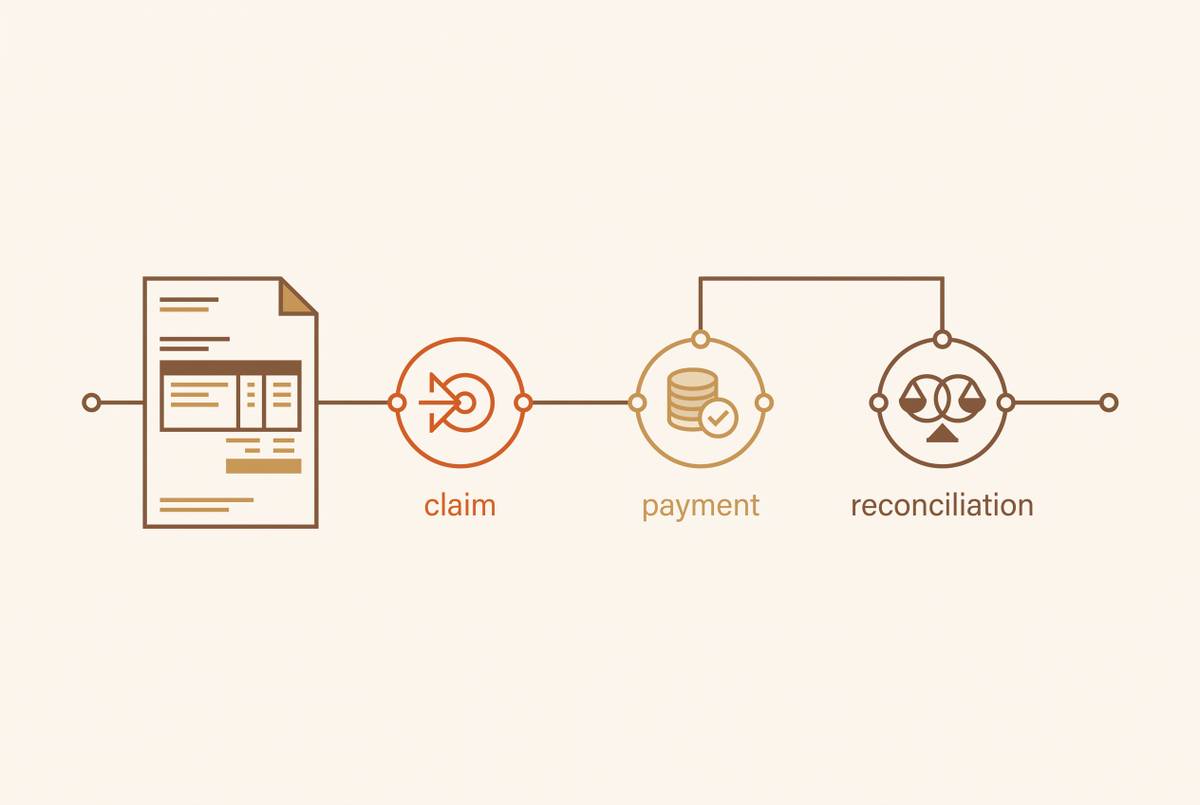
Insurance Claims Intake Automation for FNOL Documents
AI routes messy claim documents to the right extraction method before data enters the system.

FNOL, first notice of loss, is where a claim begins its life in the system. What shows up at that moment is all over the map, and a single auto claim might land with a scanned police report from a county sheriff's office, a repair estimate exported from estimating software, a medical bill studded with CPT codes, a handwritten claimant statement, and a phone photo of a dented bumper with the license plate visible in the frame. None of these share a template, and that's the part people outside claims operations tend to miss: the part that breaks most intake systems before they ever get to the interesting work.
AI handles the FNOL document mix by treating classification as the first mandatory step in the pipeline, before any extraction begins. A well-built system inspects each incoming file, its font encodings, the ratio of image area to embedded text, and other structural signals, then routes it to the appropriate extraction path: native text extraction for cleanly generated estimating-software PDFs, neural OCR for scanned police reports and claimant forms, and vision-model processing for photos of damage or VIN stickers. Handwritten claimant statements get preprocessing applied first, deskewing, binarization, and denoising, to lift character accuracy before the extraction model touches them. Police reports, which come from municipal and county agencies with no canonical layout, require field-location logic that can handle the same data point appearing in a header on one jurisdiction's form and buried in a narrative paragraph on the next. Confidence scoring then flags low-certainty fields for human review rather than passing silent errors downstream, with free-text fields, incident narratives, injury descriptions, held to a stricter routing threshold because calibration is weakest exactly where claim context is densest.
Claimant forms are the messiest of the bunch, typically the worst offender by a wide margin. Field placement shifts from insurer to insurer, sometimes from branch to branch within the same insurer, and handwriting ranges from careful block print to the kind of cursive an adjuster squints at before giving up on it. Checkboxes get circled instead of checked, and multi-column layouts break the reading order that a naive top-to-bottom parser assumes going in.
Police reports add a second layer of trouble, because they don't come from the insurance industry at all. They come from municipal and county agencies, each running its own form design, and the field marked "date and time of incident" might sit in the header on one report while getting buried in a narrative paragraph on the next. There's no canonical layout, no issuing authority telling anyone how to format the thing, and honestly no reason to expect one anytime soon.
Repair estimates look more orderly on the surface, since they usually come out of estimating software instead of a person with a pen. But the order is software-specific and version-specific: line-item formats and header conventions from one platform don't match another, and the same platform changes its export format across versions. A parser tuned to one estimate format can fail quietly on another that looks nearly identical to a human eye but differs underneath in its PDF structure.
Medical bills and explanation-of-benefits documents run several pages deep, packed with tables, mixing standardized codes with free-text descriptions that vary by provider. Photos call for a vision model rather than an OCR engine, since image-based content needs image understanding, and running it through OCR anyway just wastes the pass.
The quality spread across all this is extreme. A clean, digitally generated PDF produces very high character accuracy under standard OCR. A photographed, crumpled receipt, or a form that limped through a fax machine before hitting the queue, sits far below that, sometimes far enough below that a person has to reconstruct the field by hand. All of it arrives in the same intake stream, at the same time, for the same claim. Before a system can extract anything, it has to figure out what kind of document it's looking at and what quality tier it falls into. Classification is the first real decision the pipeline has to get right, and everything downstream leans on it.
The volume math that makes manual intake economically untenable
Take a mid-size carrier: roughly 500 adjuster FTEs, tens of thousands of claims a year. Even a conservative 20 minutes of manual intake work per claim, just data entry, not coverage analysis, adds up to around 13,300 adjuster hours a year. That's about seven full-time people whose whole job is retyping numbers off documents into a claims system, seven people who could be doing fraud review or coverage judgment instead.
The cost gap is stark. Automated processing of a claim can run a few cents end to end, while manual processing runs closer to fifty dollars a claim. That's not a rounding error in a budget; it's an order-of-magnitude gap that compounds across tens of thousands of claims annually, year after year.
Cycle time matters just as much, maybe more. NAIC benchmarking for 2024 puts average auto P&C claim cycle time at 14 to 21 days, and intake sits right at the front of that chain. A delay there doesn't stay contained; it pushes coverage verification, adjuster assignment, and reserve setting all later down the line. Claimant satisfaction tends to fall off a cliff once acknowledgment takes more than about two hours, yet manual intake shops routinely take days just to open the file.
None of this is a marginal optimization exercise. At the scale a mid-size or large carrier runs at, intake automation frees up adjuster time for the calls that need a trained adjuster's judgment: fraud review, coverage disputes, negotiation. But automating intake without locking down extraction accuracy makes things worse, because bad data moving at automation speed is harder to catch than bad data moving at the speed of someone typing it in by hand. You've just made your errors faster, which is not the win it sounds like on a slide deck.
How does AI handle the variety of unstructured documents that come in during insurance claims intake at FNOL?
Generic OCR wasn't built for this document set. The failures show up in specific, mechanical ways that go beyond a vague accuracy shortfall, and once you've seen them a few dozen times, you start to recognize the signature.
Layout detection errors cascade. A small mistake in where the system thinks a field label ends and its value starts doesn't stay small; it corrupts the field for every step downstream that depends on that boundary. A date-of-loss label that gets fused into the date value itself will misparse the date later on, and nothing in the pipeline necessarily flags that it happened.
Embedded fonts cause a quieter failure. Some PDFs, particularly ones out of less common estimating software or older scanning tools, use nonstandard embedded fonts, and OCR systems can lose whole sections of a document when they hit these. The parser doesn't throw an error; it just returns output, minus the missing section, with nothing telling you anything's wrong.
Line breaks do a third kind of damage. Financial statements and medical records often come back with clean, accurate character recognition, but with line breaks landing mid-sentence, mid-field. Every character is right, yet the structure a downstream regex or field parser depends on isn't, so the parser chokes on input that, character for character, was read correctly. That one still catches teams off guard, because it looks like a data problem until you trace it back and realize the text was fine all along.
None of this is contrived edge-case material dredged up for a stress test; it's what consistently appears when real FNOL document sets are examined in practice. Vision-model routing matters here too: benchmark testing across document types shows accuracy swings of more than 55 percentage points depending on which extraction strategy handles which document type. No single approach, OCR-only or otherwise, covers the FNOL mix on its own.
Fewer than one in ten in-house parsing pipelines ever make it to production, and it's rarely the initial build that kills them. Edge cases keep surfacing faster than a team can patch for them, until the maintenance cost blows past whatever anyone budgeted for at the start.
Underneath all of it sits the real issue with generic OCR: confidence, or the lack of any honest signal about it. Generic OCR hands you output without telling you how sure it is, so the pipeline has no way to tell a correct extraction apart from a wrong one that happens to look plausible.
Preprocessing as the first engineering lever, not an afterthought
Before any extraction model touches a document, the document itself can be improved, and the payoff is bigger than most teams expect walking in. Moving input quality from poor to good through preprocessing alone can lift OCR accuracy by 10 to 15 percentage points: a bigger swing than most decisions about which extraction model to buy.
Deskewing corrects rotation, and even a tilt of one or two degrees, common in phone photos of damage or police reports snapped at an angle, measurably hurts accuracy if nobody fixes it. Binarization separates text from background noise and matters enormously for fax-transmitted medical records, which arrive with that gray, speckled look fax machines are famous for. Denoising strips out scan artifacts and fax static that would otherwise get read as false characters. Resolution upscaling handles the low-DPI images mobile submissions produce, since OCR accuracy degrades significantly at low pixel densities, and the fix belongs before extraction, not after.
Classification has to happen before you pick a preprocessing step, not after. A well-built pipeline looks inside the PDF itself, its font encodings, its text operators, how much of the page is image versus embedded text, before deciding whether to send the page to native text extraction or to neural OCR. A page that already contains extractable text doesn't need to touch a GPU at all. Classification-first routing like this can process pages in well under half a second on average while holding output quality steady, which matters for FNOL, where speed at intake is part of the promise made to the claimant.
Applied to the FNOL mix specifically: mobile photos of damage or VIN stickers need vision-model routing rather than plain OCR, and police reports from jurisdictions known for noisy scans need denoising before anything else touches them. Estimating-software PDFs, being cleanly generated, often skip OCR entirely in favor of native text extraction. Preprocessing is cheaper and faster to iterate on than swapping out extraction models, and unlike a model swap, the gains from good preprocessing keep compounding as more document types get added to the pipeline. Model upgrades tend to get prioritized over input quality checks, even when the images themselves are the root cause.
Why field-level accuracy measurement is the only credible evaluation standard for FNOL
Document-level accuracy is the wrong number to report. A claim form with 30 fields where two come back wrong looks, on paper, like a 93 percent accurate document. But if one of those two wrong fields is the date of loss or the policy number, the claim built on that extraction is compromised, no matter how clean the other 28 fields look.
The right method compares each field individually against manually validated ground truth, scores it as a binary match or mismatch, and rolls that up to section-level accuracy from there. Benchmark testing using an o4-mini LLM against this methodology showed an overall average field accuracy around 94.72 percent, which sounds solid until you look at the field-level breakdown. The strongest fields hit 100 percent, while free-text fields lagged well behind: Agent came in at 89.95 percent, Season at 87.94 percent. The aggregate number buries exactly the fields most likely to cause trouble later.
For FNOL, the fields carrying the most downstream weight, claimant ID, date of loss, coverage code, injury indicator, tend to be the ones with the least structure, and least structure is exactly where average benchmarks underperform. A vendor quoting one aggregate accuracy number without a field-level breakdown is, whether on purpose or not, hiding the variance that will eventually surface once the pipeline goes live.
Sample size matters too. A random sample of 200 records, reviewed independently by two human experts, gives you a margin of error around plus or minus 4 percent at 90 percent confidence. That's close to the floor for a benchmark result on any FNOL document type to mean anything. Go smaller than that and you don't have enough statistical weight to trust it as a production-readiness signal.
Confidence calibration and the silent failure problem
A confidence score of 0.95 is supposed to mean the prediction is right 19 times out of 20. That only holds if the model producing the score is well calibrated, and a lot of production systems just aren't, which is the crux of the whole problem.
Poorly calibrated systems tend to over-report their own confidence, saying 0.95 when the real accuracy at that level is meaningfully lower. The practical result is the worst kind of failure: high-confidence extractions that are wrong slip through untouched, while low-confidence extractions that were actually fine get pulled into human review for no reason. Review effort ends up in the wrong place while the errors that matter walk right past it.
A parser with a 2 percent overall error rate but a high rate of silent failure is worse in production than a parser with a 3 percent error rate and a low silent failure rate. The first corrupts data invisibly, while the second surfaces its own mistakes, so someone can actually catch and fix them before they spread.
Calibration quality isn't uniform across field types, either. Numeric fields, policy numbers, dollar amounts, dates in a standard format, tend to calibrate well. Free-text fields, incident narratives, adjuster notes, injury descriptions, show overconfidence specifically at high predicted probabilities, which happens to be exactly the pattern that matters most for FNOL, since so much meaningful claim context lives in free text rather than clean structured fields.
Extraction errors are often caused by the document, not the model, and that distinction gets lost too easily. A frontier LLM asked to read an unreadable scan will still spit out a confident-sounding token, but that confidence describes the model's fluency at generating plausible text, not its certainty about the actual value buried in noisy source material. Confidence scoring that ignores how legible the input was is measuring the wrong thing entirely, and a signal about source legibility has to feed into the confidence calculation itself.
Where this gets done right, folding model confidence, input quality signals, and field-specific priors into one confidence engine, the results speak for themselves: at 80 percent automated coverage, this kind of multi-signal system reaches 99.1 percent accuracy on the automated portion, a gain of 25.8 percentage points over the base rate.r the base rate.
Routing logic: what goes to automation and what goes to human review
The confidence threshold that decides what gets automated and what goes to a human reviewer is a policy choice, not a fixed technical constant. Set it at 0.85, and anything below that line goes to manual review while anything above passes straight through. Moving that number moves the whole tradeoff with it, and there's no getting around having to make that call somewhere.
A higher threshold gives you more accurate automated output but pushes more volume into manual review, eating into the cost savings that justified automation in the first place. A lower threshold pushes more volume through automatically but raises the silent error rate, the exact failure mode described above. There's no single right threshold, only a right threshold for each field, set by what an error in that specific field actually costs the business.
Numeric fields, policy number, date of loss, repair amount, can generally tolerate a higher automation threshold, because errors there are high-consequence but the underlying calibration tends to hold up. Free-text fields, incident description, injury narrative, need either a lower threshold or a blanket rule sending them to human review regardless of confidence, because calibration on free text is the weakest link in the whole chain.
Some fields belong in mandatory review no matter what the confidence score says. Injury indicator and coverage trigger fields fall into this bucket for FNOL specifically, because a wrong automated call on either one can mean an incorrect coverage denial or an incorrect fast-track decision, and that cost dwarfs a few extra minutes of a human looking at it.
Routing is also where fraud detection gets built in almost for free. If the date of loss on the police report doesn't match the date of loss on the claimant's own form, that mismatch should trigger review on its own, regardless of how confident the system feels about either individual field.
One point gets missed too often: the review queue has to be sized for peak volume, not average volume. A catastrophic weather event can multiply FNOL intake overnight, and if the human review queue can't absorb that spike, it becomes the very bottleneck automation was supposed to remove.
Infrastructure considerations for a production FNOL extraction pipeline
Intuition says the LLM doing the parsing is where latency and cost pile up. In practice, OCR is usually the bottleneck, because OCR processes every page independently, often as a string of sequential inference calls, while parsing handles the whole document in one LLM call once OCR output is ready. Architecture work aimed at throughput should target OCR first, not the parsing layer, and I've watched teams burn a quarter optimizing the wrong stage before anyone thought to check.
Queue configuration is a spot where small misconfigurations do outsized damage. A visibility timeout set too short causes a document still being processed to get redelivered to a different worker, which produces duplicate extractions and burns compute for nothing. Set the timeout comfortably above the 99th-percentile processing time and this failure mode disappears without meaningfully slowing down how fast real failures get caught.
Parallelizing OCR across pages is the single biggest throughput lever available, and pipeline design should treat multi-page documents, police reports, medical records, as the default case rather than something to bolt on later.
Failure isolation matters just as much as throughput. One malformed document should never stall the whole queue. Dead-letter queues, retry logic, and alerting aren't nice-to-haves for an FNOL pipeline, since claim volume doesn't pause for a bug fix, and a pipeline missing this isolation will eventually let one bad file back up an entire day's intake.
Idempotency deserves a mention too, because FNOL documents get resubmitted constantly: a claimant retakes a blurry photo, corrects a form, sends the same police report twice by accident. The pipeline needs to deduplicate by claim and by document hash, since filenames tell you nothing reliable about whether a document has already gone through.
Deployment model is a decision that has to get made early, not patched in after the fact. Medical bills and police reports carry PII frequently subject to state-level data residency rules, and a pipeline's deployment architecture, on-premise, region-locked, or otherwise, needs to account for those constraints before go-live.
Data security requirements that FNOL document content imposes
FNOL documents carry some of the most sensitive personal data anywhere in the insurance value chain: Social Security numbers on medical bills, injury descriptions, at-fault narratives lifted straight from police reports, bank account details tied to repair payments. This isn't a document set where security gets to be a secondary checkbox, and treating it that way tends to be the kind of decision that comes back around eighteen months later in a much worse conversation.
Zero data retention is the only default worth trusting. A document that's processed and then discarded can't later be breached, and any vendor holding onto document content past the processing transaction itself is creating a liability that the carrier, not the vendor, ends up absorbing.
The certification baseline that matters here is SOC 2 for operational security controls, GDPR wherever EU claimants or data subjects are involved, and ISO 27001 for information security management. These need to stay current, not sit as a badge earned once and forgotten. Where injury claims touch health information, HIPAA requirements stack directly on top of that baseline, and a vendor needs to show it can actually operate inside those constraints, not just say it's aware of them.
Cross-border deployment adds another wrinkle. A carrier with claimants in the EU needs explicit data residency options, because a pipeline that routes EU claimant medical records through US infrastructure risks running afoul of GDPR's rules on international data transfer, regardless of how accurate the extraction itself turns out to be.
This is why the security conversation has to happen before the accuracy conversation in vendor evaluation. A vendor with excellent field-level accuracy that can't meet a carrier's data residency requirements simply isn't deployable.
The build-vs-buy calculus for FNOL document extraction
The decision to build an in-house FNOL extraction pipeline or buy one is, underneath everything, a decision about which kind of failure a carrier is willing to own. Building means owning the classification logic, the preprocessing pipeline, the confidence calibration, and the routing rules across a document set as scattered as police reports, repair estimates, medical bills, and claimant photos. Fewer than one in ten in-house parsing pipelines reach production, and the ones that fail rarely fail at the prototype stage; they fail once real edge cases start arriving faster than the team can keep up with.
Buying shifts that maintenance burden onto a vendor, but it doesn't remove the carrier's job of checking what it's actually buying. A field-level accuracy breakdown, not an aggregate number, is the bare minimum a carrier should demand before signing anything. A documented calibration approach, one that accounts for input quality instead of treating model confidence as a standalone number, is the second thing to ask for. Current, verifiable security certifications, SOC 2, ISO 27001, GDPR compliance where relevant, HIPAA where health data is involved, count for just as much. Any vendor that won't produce this on request isn't ready for FNOL work.
Most carriers land somewhere between the two poles, in my experience the sensible place to land. Preprocessing, classification, and routing logic tuned to a carrier's own document mix, the jurisdiction quirks of its police reports, the estimating software its repair shop network runs, the medical billing formats common among its claimant base, are worth owning, because that's where real competitive edge lives. The underlying OCR and extraction infrastructure, expensive to build well and even more expensive to keep maintaining as edge cases pile up, is usually better bought from a vendor who's already been through failures a carrier's in-house team hasn't hit yet. Getting that split right is what separates a pipeline that survives its first catastrophic weather event from one that buckles under it.