Three-Way Match Automation in Accounts Payable
Automation replaces manual invoice matching with a five-stage data pipeline.
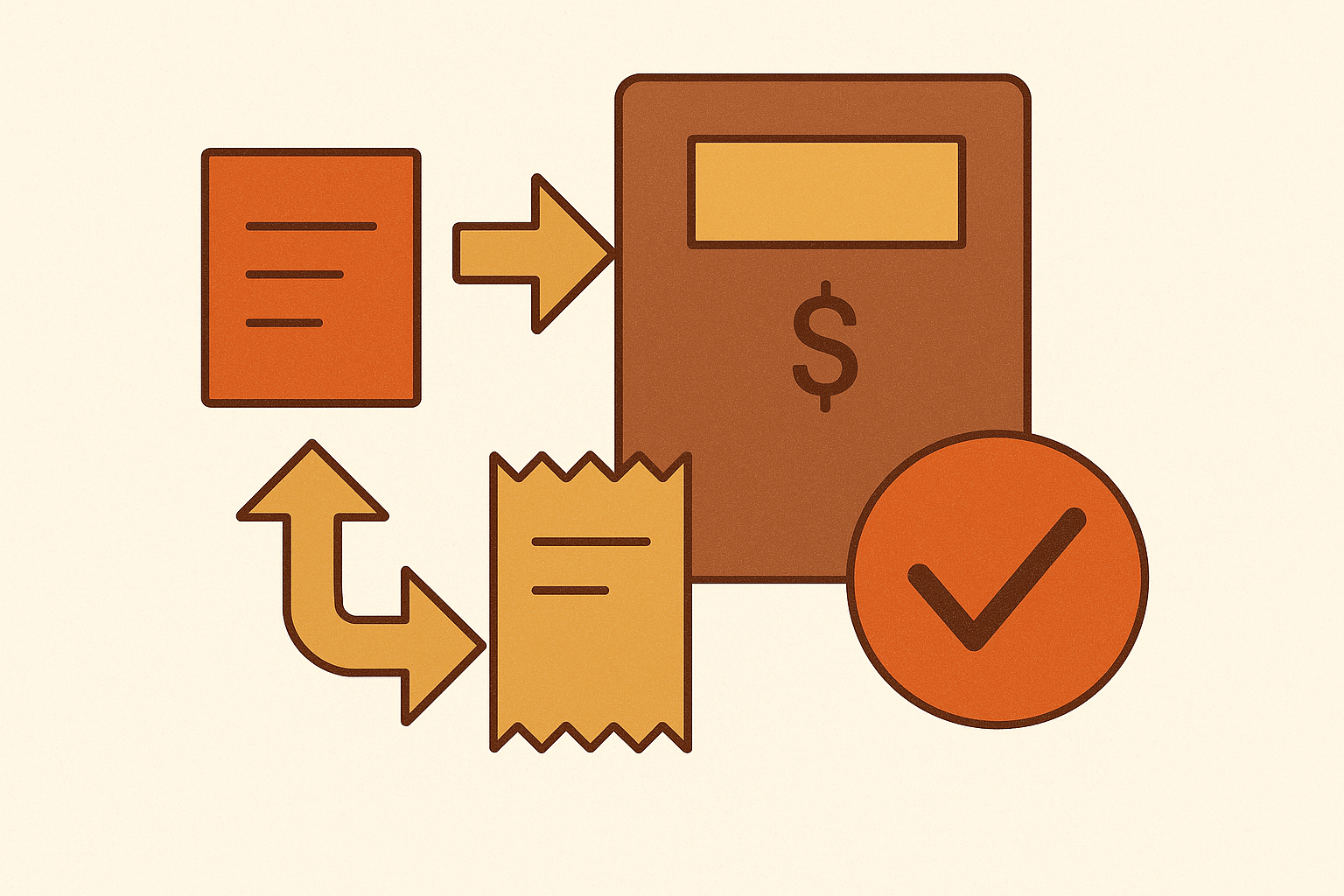
Three-way match automation replaces a manual document comparison process with a structured pipeline: extract data from three documents, normalize it into a common format, and check agreement across fields. The whole system rests on one layer working right: document extraction. Misread a unit price or drop a line item there, and everything downstream inherits the error, because nothing in the matching logic is built to catch it.
Automated three-way match runs as a five-stage pipeline. Ingestion collects every document format at once: email attachments, portal uploads, EDI feeds, scanned paper. Classification then identifies which document is the PO, which is the receiving report, and which is the invoice, because a misclassification at that stage corrupts every step that follows. Extraction pulls the structured fields from each document, and normalization maps all three onto one common schema so that "Qty," "Quantity Ordered," and "Units" are understood as the same value before any comparison runs. Matching logic then runs line-item checks within configurable tolerance bands, confirms header fields like vendor ID and currency, verifies that line items sum to the stated total, and routes anything outside tolerance to AP, procurement, or the warehouse with the specific field and variance named.
The control itself is old and simple. Payment only releases when a purchase order, a receiving report, and a vendor invoice agree on vendor identity, line items, quantities, unit prices, and totals. Each document comes from a different system and a different point in the procurement cycle: the PO from procurement, the receiving report from the warehouse, the invoice from the supplier. They show up in different formats, on different schedules, using different field names for the same thing. The agreement being tested isn't one field but a set of line-by-line checks, and most organizations build in tolerance bands for freight, tax rounding, and partial deliveries. So "match" ends up being a parameterized condition, not a plain yes or no. Two-way match, PO against invoice with no receiving report, is standard for services where nothing physical gets delivered. Three-way match is the version that depends on a goods receipt, which is exactly why it's the harder one to automate.
The scale of payment fraud and error that three-way match is meant to catch
Payment fraud attempts hit a large majority of organizations every year, according to the AFP Payments Fraud and Control Survey. That's not a rare event finance teams plan around once and forget; it's a routine cost of doing business, like bad debt or shrinkage. Billing fraud lands hardest on smaller organizations, where ACFE data puts median losses per incident in the six figures, enough to threaten a small company's operating cash outright.
Duplicate and near-duplicate invoices show up every month in real volume, even at mid-sized companies. Three-way match exists to catch a specific set of tricks: the same invoice submitted twice, unit prices quietly inflated above the PO, billing for goods that never arrived, invoices from vendors that don't actually exist. Each one works by exploiting the gap between what was ordered, what showed up, and what got billed.
The control has limits, and they matter. Three-way match won't stop a compromised vendor master file, a PO that was approved but is itself fraudulent, or a social engineering attack that manipulates procurement before any invoice gets cut. Those attacks happen upstream, and no amount of matching rigor downstream fixes a rotten input.
Where manual three-way match breaks down under real AP volume
More than half of finance departments still run accounts payable by hand, per Ardent Partners. That means most organizations relying on this control are relying on a person to execute it correctly, invoice after invoice, without getting tired or sloppy.
Manual matching means pulling three separate documents, cross-checking multiple fields across all of them, applying tolerance rules from memory, and escalating whatever doesn't line up. Each invoice takes minutes this way, and minutes add up fast once volume climbs or attention drifts. Exception handling is where the process really falls apart, because every mismatch means an email to procurement, a call to the warehouse, or a message to the vendor. Those threads stall payment while eating up AP staff time far out of proportion to the size of the variance being chased.
Ardent Partners' benchmarks show the cost gap between top-performing automated AP teams and average manual teams runs several times over, per invoice processed. That's not a rounding error; it's a structural difference in how the function operates. The timing is bad in a specific way, too: busy stretches like month-end and fiscal close are exactly when controls get skipped to keep pace, and exactly when fraud attempts tend to cluster. Touchless processing rates, meaning invoices that move from receipt to payment approval with zero human steps, remain well below half the industry average. Part of that ceiling is technology. A large part of it is process discipline that no software fixes on its own.
How does three-way match automation work technically: extraction, normalization, and the matching pipeline?
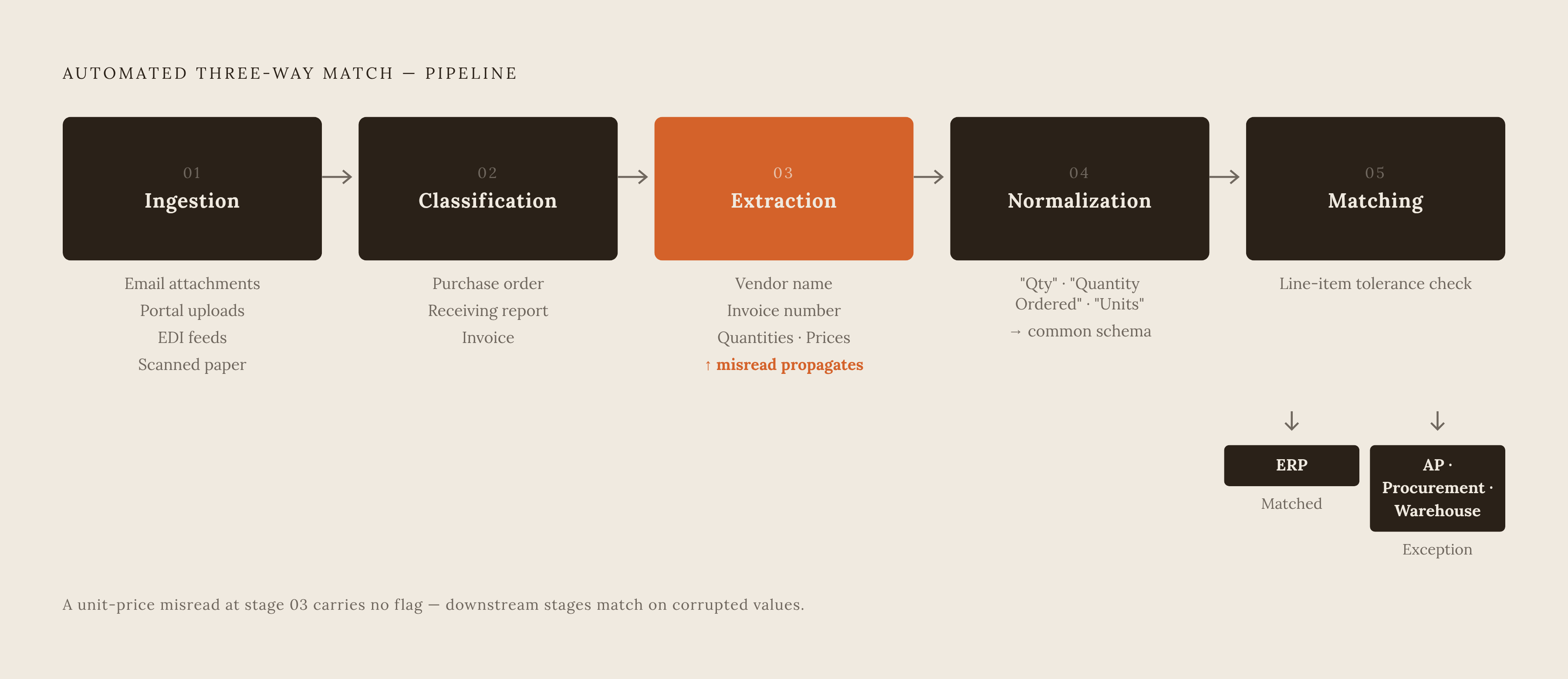
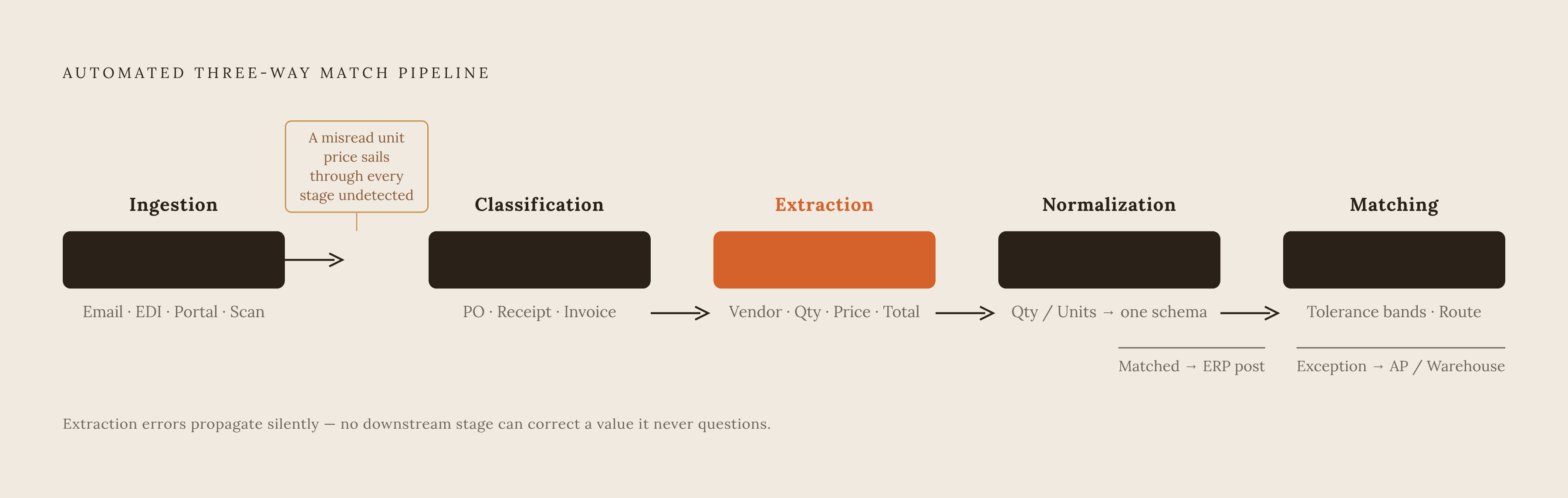
Ingestion comes first, and it has to handle everything at once: email attachments, supplier portal uploads, EDI feeds, scanned paper that arrived by mail, often all in the same batch on the same day.
Document classification happens next. Before any field gets pulled, the system has to figure out which document is the PO, which is the receiving report, which is the invoice. Get that wrong and every downstream step inherits the mistake.
Extraction pulls the structured fields out of each document: vendor name, invoice number, PO reference, line item descriptions, quantities, unit prices, extended amounts, tax, totals, currency, payment terms. Normalization then maps all three documents' values onto one common schema, because "Qty," "Quantity Ordered," and "Units" all mean the same thing, and the system has to know that before it can compare anything at all.
Matching logic runs line-item comparisons within tolerance bands, checks header-level fields like vendor ID and currency, and confirms the line items sum to the stated total. Whatever falls outside tolerance gets flagged, with the specific field and variance named, and routed to whoever owns that kind of exception: AP, procurement, or the warehouse. Matched invoices post to the ERP with payment scheduled; exceptions carry their status and an audit trail until someone resolves them.
The pipeline is only as good as its first step. A misread unit price sails through normalization and matching without anything downstream catching it, unless confidence scoring or a human reviewer happens to intervene.
Why document extraction is the failure point the rest of the pipeline depends on
The AP inbox is not a clean environment. It holds computer-generated PDFs next to scanned paper of wildly varying resolution, phone photos taken at an angle, faxes, invoices with handwritten corrections scrawled across the original amount. Each needs different handling, and most extraction systems weren't built with all of them in mind at once.
OCR noise on scans is a familiar problem: a capital "I" reads as a lowercase "l," a zero reads as the letter "O." "INV-2024-001" comes out as "lNV-2O24-OO1." The extraction technically succeeds, the output looks like a valid invoice number, and it's wrong. A matcher comparing that string against the PO will fail silently, with no error thrown anywhere.
Complex layouts break the assumptions a lot of parsers rely on. Multi-column tables, merged cells, nested line items, embedded images: all of these cause traditional tools to garble the output or drop rows outright. A missing line item, at that point, is an extraction failure that looks exactly like a receiving discrepancy to anyone downstream. Template-based systems have their own weak point: a vendor who redesigns their invoice layout, even slightly, can break a tuned template with zero warning to the AP team relying on it.
Newer LLM-based extraction carries a different risk. A prompt tuned on clean digital invoices produces confident, fluent, wrong output when it's fed a low-resolution scan with degraded text. A hallucinated number is harder to catch than a blank field, because a blank field at least announces that something failed. An extraction error that produces a plausible but wrong unit price will sail through matching if it happens to fall within tolerance. Some of these errors are invisible to the entire pipeline and only surface later, at audit, months after the payment went out.
How to evaluate extraction accuracy before trusting it in a match pipeline
Vendors love to quote an accuracy number. Trouble is, accuracy at the character level, the field level, and the document level are three different numbers measuring three different things, and character accuracy tells you almost nothing about whether the invoice data itself is right.
Field accuracy is the number that actually matters for matching: was the correct value pulled for each named field, checked against a ground-truth labeled dataset, not against a benchmark the vendor built and curated itself. Document accuracy, meaning the share of documents that came through with zero extraction errors at all, is the number that governs touchless rate, because one wrong field on one invoice is enough to block automatic matching for that invoice.
Confidence calibration gets skipped over too often. A system that reports high confidence on a wrong extraction is more dangerous than one that flags uncertainty honestly, because high-confidence output is exactly the output that bypasses human review. Pull a sample of extractions the system marked high-confidence and check them by hand. If a meaningful share turn out wrong, the confidence scores aren't calibrated to what's actually happening on the ground.
Calibration also varies by field type. Numeric fields, amounts and quantities, tend to calibrate better than free-text fields like vendor names or line item descriptions, so routing thresholds should differ by field type instead of applying one blanket rule. There's a trade-off here: a system with lower aggregate field accuracy can still perform better in practice if it correctly routes its uncertain extractions to a human instead of passing them through untouched. What matters is the accuracy of the automated portion, not the headline number the vendor leads with in the sales deck.
Research on frontier LLM extraction, published in 2026 benchmark studies, found that even strong general-purpose models struggle to produce valid structured output on complex financial document schemas at a meaningful rate. Where the output was valid, field accuracy looked reasonable; but on documents with large, complex field structures, schema compliance itself collapsed. The gap between "the model got the field right" and "the model produced usable structured output at all" is easy to miss on a slide, and it matters enormously once real invoices start hitting the pipeline.
The normalization problem that persists even after clean extraction
Clean extraction doesn't mean the data is ready to compare. Three documents from three systems will name the same vendor three different ways: "Acme Corp" on the PO, "ACME CORPORATION" on the invoice, vendor ID "V-00431" in the ERP. The matcher has to resolve all three to the same party before anything else can happen.
Line item description matching is especially fragile. "Widget A – 10mm" and "Widget-A 10 mm stainless" might be the exact same SKU, or they might not be. A strict string match fails on the first pair, and a fuzzy match risks false positives across similar product lines that are genuinely different items. Date normalization sounds mechanical, but it's consequential: invoice date, PO date, delivery date, and payment due date can each arrive in a different regional format, and a misparsed date shifts payment terms calculations forward or backward without anyone noticing until the due date is already wrong.
Currency handling adds another layer for international suppliers, who often state amounts in their own currency with an exchange rate attached. The matching logic has to convert consistently and handle rounding across every line item, not just the total. And there's a quieter edge case: a supplier who resets invoice numbering every January can generate a number that looks identical to one from a year earlier. Duplicate detection that only checks invoice number, without date context, will miss it every time.
The design implication is straightforward. Normalization rules belong in their own layer, separate from extraction itself, maintained on their own schedule as supplier formats change and new vendors get onboarded, and tested independently of the extraction accuracy metrics.
What exception handling reveals about a pipeline's real-world performance
Ardent Partners puts industry exception rates in the low-to-mid teens as a share of all invoices processed, with top performers well below that average and manual teams well above it. That spread alone says a lot about where the real gains sit.
Most exceptions aren't extraction failures at all. They're PO mismatches, missing receiving reports, tax and freight variances, vendor master problems. Perfect extraction on an invoice that simply cannot be matched to a valid PO still produces an exception, every single time. The honest ceiling on touchless processing rate is set largely by PO discipline and supplier data quality, not by parser accuracy alone, a point vendors selling extraction tools rarely bring up first.
Extraction-caused exceptions are the ones automation should actually eliminate: a wrong field value, a misread quantity, a dropped line item. These are preventable with enough extraction accuracy, and they should be tracked as their own category, separate from structural exceptions that no amount of better OCR will fix. Exception routing design matters here too. A system that tells the resolver exactly which field mismatched, by how much, and on which document saves real time, while a generic "exception" flag that forces someone to re-examine all three documents from scratch defeats most of the point of automating in the first place.
Deloitte research shows AI-assisted duplicate detection substantially outperforms manual review on this one exception type specifically, a consistent and measurable area of value. More broadly, tracking exception rates by type over time is the best available signal for pipeline health. A rising share of extraction-caused exceptions points to model drift, a new supplier format the system hasn't adapted to, or a shift in document quality nobody's addressed yet.
Build vs. buy considerations specific to three-way match extraction
Teams with a narrow, stable supplier base and standardized electronic invoice formats can build a simpler pipeline and reach a high touchless rate without much trouble. The case for buying weakens considerably when format diversity is genuinely low.
The case against building is mostly a maintenance argument. Every new supplier format, every document quality quirk, every ERP schema change requires upkeep, and edge cases pile up faster than most teams expect when they first scope the project. There's a contractual question worth asking directly, too: will the vendor put an extraction accuracy number in the contract, or only in a slide deck? A vendor unwilling to commit to a number in writing is quietly passing all extraction-error risk onto the buyer, and in a three-way match context that risk shows up later as duplicate payments, fraud slippage, and audit findings.
Zero data retention should be treated as non-negotiable. Invoices carry vendor banking details, negotiated pricing, sometimes employee expense data. A document processing vendor that keeps copies of that content creates a liability most legal and finance teams can't sign off on under GDPR or SOC 2 obligations. Continuous learning from corrections is the other real differentiator, separating a static extraction tool from one that improves as the supplier base changes. Teams onboarding new vendors should ask directly whether the system adapts on its own or needs manual retraining every time a new format shows up.
Run through a short checklist before signing anything: field-level accuracy measured against ground truth on your own invoice formats, not the vendor's benchmark set; calibrated confidence scores with documented threshold behavior; a contractual accuracy commitment; zero data retention backed by documented certifications like SOC 2, GDPR, or ISO 27001; deployment options that match your data residency requirements; and a field-level audit trail for every extraction decision the system makes.
Where three-way match automation is heading as document AI matures
The AP automation market is growing at a strong double-digit rate annually, per Ardent Partners, and is on track to become a multibillion-dollar segment by the end of the decade. Money is moving into this infrastructure faster than most finance teams have adjusted their internal processes to match.
Agentic validation layers are starting to appear: systems that don't stop at extracting and matching but resolve narrow exception classes on their own, tolerance variances within policy, known duplicate patterns, escalating only the genuinely ambiguous cases to a person. The prerequisite for any of this hasn't changed from where automation stands today: structured, accurate, field-level extraction. An agent acting on a hallucinated invoice amount does more damage, faster, than a human reviewer who would have caught the same error by eye.
E-invoicing mandates spreading across the EU and Latin America are pushing structured formats upstream, closer to the supplier. As electronic invoicing becomes the default rather than the exception, the hardest extraction problems, scanned paper, phone photos of receipts, shrink as a share of total volume. They don't disappear, though, not for organizations with long-tail legacy supplier relationships that will keep faxing invoices for years to come.
LLM and retrieval-based tools layered into AP workflows are only as trustworthy as the document preprocessing feeding them. A correctly extracted, validated record is what makes intelligent downstream routing worth trusting at all; garbled or hallucinated input produces unreliable agent behavior no matter how capable the underlying model is. The direction is clear enough: touchless rates keep rising for organizations willing to treat extraction accuracy as its own discipline, not as an afterthought bolted onto a matching engine that assumed clean data would just show up on its own.