Cross-Field Consistency Checks for Invoice Validation
Caught-extraction errors emerge when fields contradict each other, not through faulty formatting.

Cross-field consistency checks catch what single-field validation is structurally blind to: a value that's correctly formatted, correctly typed, sitting inside a plausible range, and still wrong because it doesn't square with everything else on the invoice. By 2025, the best-performing models reached very high accuracy on clean digital invoices in benchmark testing, with meaningfully lower results on scanned documents. The competitive question has already moved past extraction. It now lives in what happens after a field gets pulled off the page, and whether the values that come out of that process actually agree with each other.
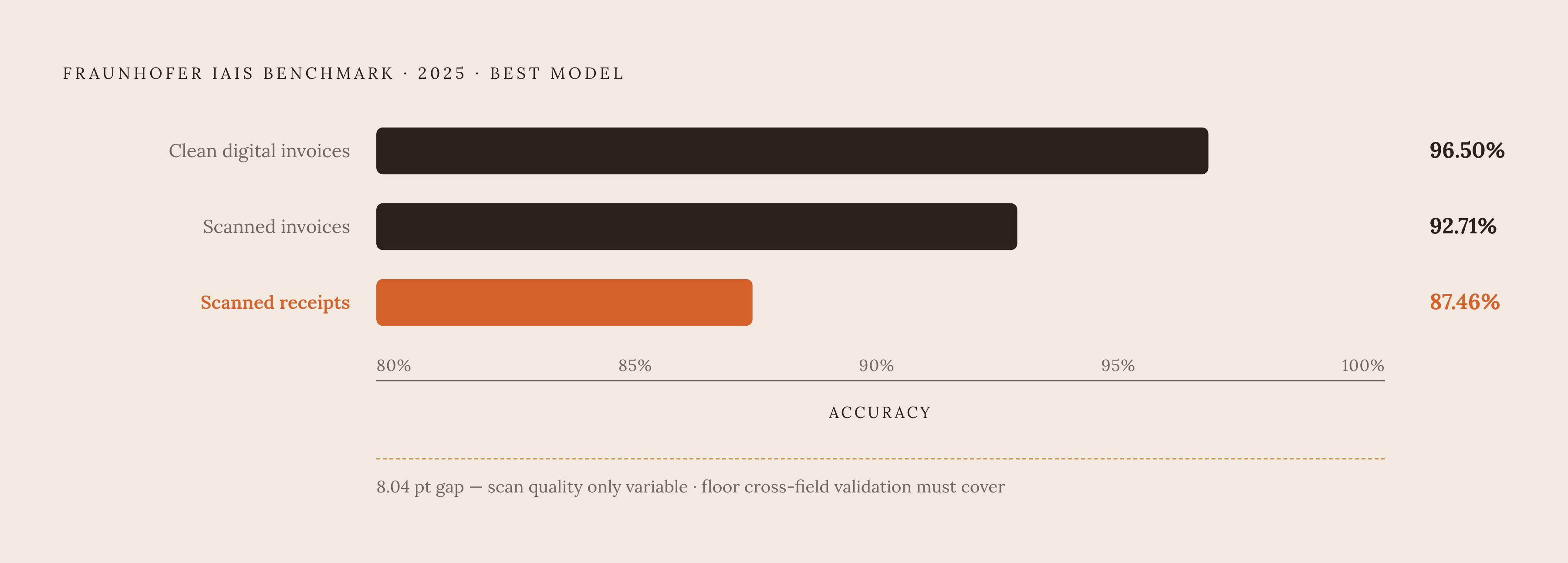
A 2025 benchmark from Fraunhofer IAIS shows the ceiling plainly. The best model scored 96.50% on clean digital invoices, 92.71% on scanned invoices, and 87.46% on scanned receipts. Same model, same fields, scan quality as the only variable. That spread matters because a real accounts payable inbox is never uniformly clean: crisp PDFs generated straight from an ERP sit next to faxed scans, phone photos, and receipts pulled crumpled out of someone's coat pocket. Even the best extraction system leaves a meaningful error rate in that mix, and the errors that do occur tend to matter most when they touch financially significant fields.
What cross-field consistency checks actually do
Field-level validation asks a narrow question: is this value the right type, the right format, inside a sane range? Cross-field validation asks something harder: do the values on this document, taken together, tell a story that holds up? A tax amount can be plausible, properly formatted, and well within normal bounds, and still flatly contradict the tax rate and subtotal printed two lines above it. No single-field check will ever catch that, because no single field is wrong. The relationship between fields is wrong.
Cross-document validation pushes the idea further, comparing an invoice against external records: a purchase order, a contract, a prior invoice from the same vendor. CheckFile's review of 120,000 documents processed in the second half of 2025 found that 14.2% contained at least one detectable discrepancy between the invoiced amount and the contractual amount, a category of error invisible to OCR and standard intelligent document processing working alone.
Cross-field checks don't replace accurate extraction. They run after it and depend on it entirely. What they do is take the values a parser hands over and ask whether those values can coexist. This piece stays with the intra-document version of that problem, the checks that apply within a single invoice, though full cross-document matching is the natural next step once the basics are working.
The core arithmetic checks every invoice pipeline needs
These are deterministic. An invoice either balances or it doesn't. There's no ambiguity once the numbers are laid out side by side.
Start with line-item subtotal reconciliation: the sum of every line-item extended amount has to equal the pre-tax subtotal in the header. A common failure here has nothing to do with fraud. A line item gets OCR'd at a slightly different value than what the vendor's own system used when it generated the invoice, the header total stays correct, and the extracted line items quietly stop summing to it. The gap is often small enough to sit inside a rounding tolerance and slide past manual review untouched.
Tax verification runs in both directions. Does the extracted tax rate, applied to the taxable base, produce the extracted tax amount? And does that tax amount, added to the subtotal, produce the stated total? Partial exemptions, invoices with some line items taxed and others not, tax-inclusive pricing, all of it complicates the check, but the underlying logic never changes: rate times base should equal tax, every time.
Grand total integrity extends the same idea across every component: subtotal plus tax plus shipping plus any other charge should equal the invoice total. Any remainder left over after accounting for every piece is a signal worth chasing down, not an artifact to wave off as rounding.
Then there's the line-item multiply check: unit price times quantity should equal the extended amount, for every line. Failures here are frequently OCR-driven. A quantity of 10 gets read as 1.0, or a unit price has its decimal point shifted one place, and the extended amount printed on the original invoice was computed correctly at the point of creation. The error only shows up once someone runs the multiplication again during extraction.
None of this works without an explicit rounding policy. Differences below some defined threshold count as rounding; above it, they count as errors. That threshold belongs in a written business rule, not in an unstated assumption sitting in someone's head.
Cross-field checks that go beyond arithmetic
Currency and locale consistency is easy to overlook and shouldn't be. If the currency field says EUR, every monetary amount on the document should format the way EUR amounts format: decimal separator, thousands separator, symbol placement, all consistent with that locale. A EUR field paired with amounts formatted like dollars points to an extraction error or a document generated incorrectly in the first place. Magnitude matters too. An invoice for a comparable dollar amount from a vendor who has always billed in euros at similar amounts is worth a second look before it clears.
Date logic covers several relationships at once. The invoice date has to come before or on the due date. The due date has to match the stated payment terms, so a "Net 30" invoice dated the first of the month should have a due date roughly thirty days out. Service period dates need to fall on or before the invoice date; billing for work that supposedly happened after the invoice was issued isn't just suspicious, it's structurally impossible. Invoice dates should also track a vendor's normal invoicing rhythm, since a sudden shift in cadence is itself a signal worth noting.
Vendor identity consistency checks whether the name, address, and tax ID (VAT number, EIN) all match each other and the vendor master record. A vendor name that matches the master file perfectly while the bank account or remittance address doesn't is one of the highest-priority fraud signals a pipeline will ever surface. Treat it that way, not as a routine mismatch.
Invoice number patterns carry information too. A vendor running sequential numbers, INV-2024-0451 through INV-2024-0489, has no business suddenly submitting a bare seven-digit number or restarting at INV-0001. A broken pattern doesn't prove fraud by itself, but it earns a verification step before payment goes out.
Purchase order cross-referencing matters wherever a PO number appears: line items, quantities, and prices should reconcile against what that PO actually specifies. A PO number that doesn't exist anywhere in the ERP isn't a warning to log and move past. It's an immediate stop.
Duplicate detection belongs in this category because no single field ever reveals a duplicate on its own. An exact duplicate shares invoice number, vendor, and amount. A near-duplicate shares vendor and amount but carries a different invoice number, a pattern common in both resubmission fraud and honest vendor billing mistakes. Catching either one means checking several fields at once, not one in isolation.
Why production parsing creates the conditions for cross-field failures
Plenty of cross-field errors trace back to the extraction process itself, not to anything wrong with the original document. The invoice was internally consistent the moment it was generated; the inconsistency gets introduced somewhere in parsing.
Table parsing causes most arithmetic failures, and the reason is worth sitting with. Merged cells, headers spanning multiple rows, tables that break across a page boundary: these are the hardest structures for any parser to handle cleanly, because the layout a human reads at a glance has to get rebuilt into a strict row-and-column structure with zero tolerance for ambiguity. A shifted header or a misread merged cell pulls the right-looking value into the wrong field, and it happens silently, nothing raised as an error. The unit price and extended amount columns each look individually plausible on their own. Only the cross-field multiply check, unit price times quantity against the extended amount, exposes that the columns got misaligned somewhere in the process.
Character-level errors compound the problem. A unit like m³ misread as m³3 corrupts a unit field, and a unit mismatch between a line item and its corresponding PO becomes a cross-field inconsistency whose root cause was a character recognition slip, not a document problem. Silent section drops, whole sections of a document omitted from the output with no error flagged, create the same effect from a different angle: fields that should be present simply aren't, and a total with no line items behind it is itself a cross-field signal worth acting on.
Scan quality compounds all of it. The Fraunhofer benchmark showed close to a nine-point spread between clean digital documents and scanned receipts for the same model, which means the real cross-field error rate across a mixed-quality document stream runs higher than any clean-document benchmark number suggests. Cross-field checks earn their keep twice over here: they catch document fraud, and they catch parser errors that would otherwise flow straight into accounts payable unnoticed.
Engineering cross-field checks into a production invoice pipeline
Checks run after extraction, never during. The validation layer takes structured JSON output from the parser and applies rules against it, so the whole architecture depends on the extraction step handing over something structured enough to reason about in the first place. Invofox, for instance, is built to return per-field validated JSON from invoices and similar documents, which is exactly what a cross-field rules layer needs to operate on.
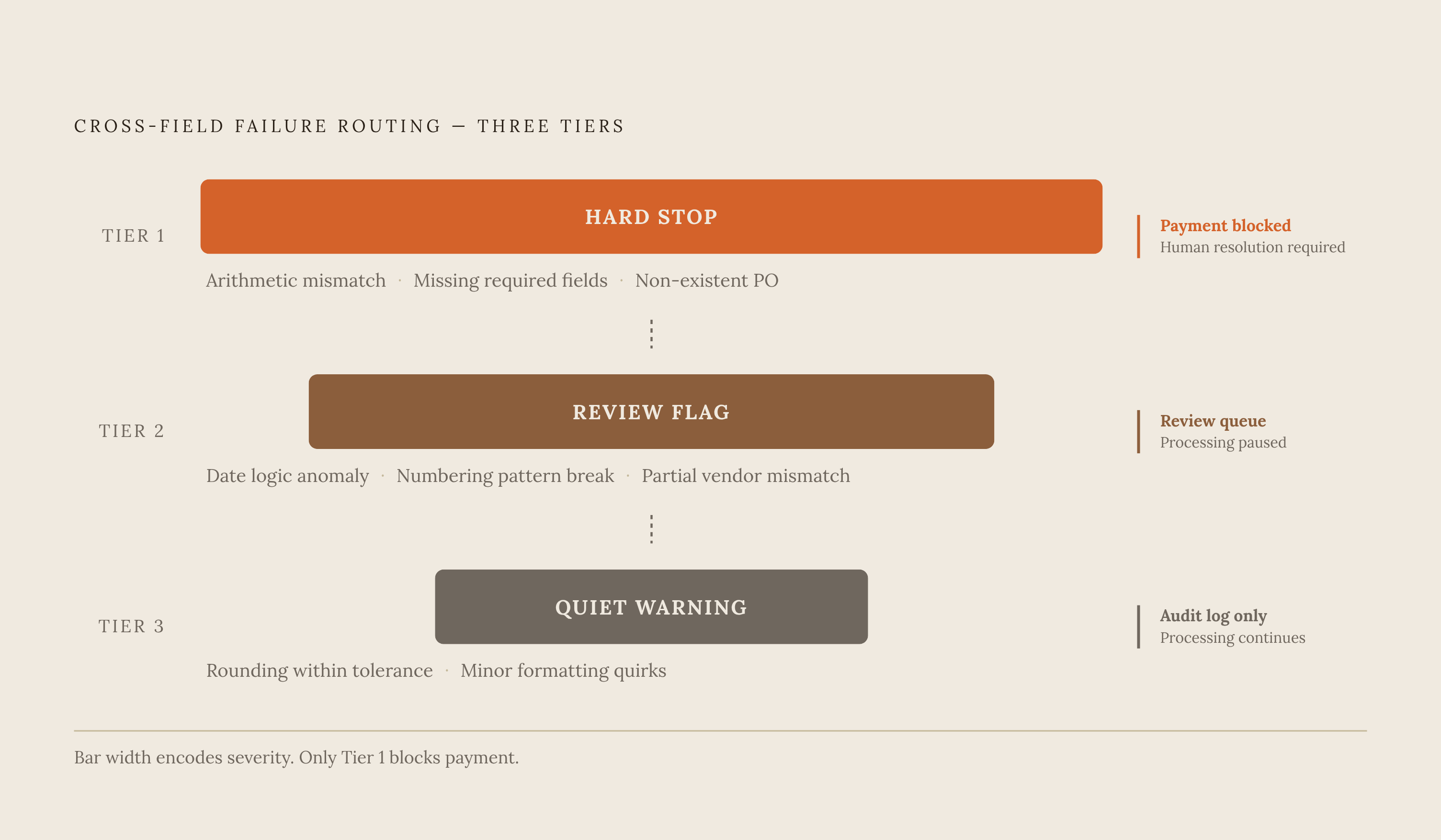
A tiered structure keeps the system usable, and the split between tiers really comes down to what a false positive costs against what a false negative costs. Tier one is hard stops: arithmetic mismatches beyond tolerance, missing required fields, a PO number that doesn't exist in the ERP. These block payment outright and need a human to resolve them before anything moves forward. Tier two flags for review: date logic anomalies, broken invoice-numbering patterns, partial mismatches on vendor identity. These route to a review queue with enough context attached for a person to make a fast call. Tier three logs warnings quietly: rounding differences inside tolerance, minor formatting quirks. These get recorded for the audit trail without interrupting processing.
Confidence scores plug into this directly. A field-level confidence score tells the system how sure the parser is about one particular value, and low-confidence fields should route to human review before any cross-field check runs against them, since a check built on an uncertain input just produces an uncertain result. The more interesting case runs the other way: cross-field checks catch what a model is confidently wrong about, the moments when confidence reads high but the arithmetic still fails. That combination, high confidence paired with a failed check, deserves more scrutiny than a low-confidence field ever will, precisely because it means the model's own uncertainty estimate missed something. Pairing confidence scoring with the right routing can push overall accuracy above 99% while keeping the human review queue down to a manageable slice of total volume.
Rules need to be written down and versioned, never left as implicit model behavior nobody can point back to. For any failed check, the system has to say which rule fired and which values triggered it. Tolerance values, the rounding threshold, the date window, the amount variance allowed for PO matching, all belong in documented parameters, not hardcoded constants buried somewhere in code.
A feedback loop closes the system. When a reviewer resolves a flagged invoice, whatever comes out of that resolution, a corrected value, an adjusted rule, a confirmed false positive, needs to feed back in. Patterns in false positives point to rules whose tolerances need loosening. Patterns in true positives that started out low-confidence point to fields the extraction model still needs to get better at.
The validation layer needs its own test suite, separate from testing on real documents. Synthetic invoices built with known inconsistencies, one for each check type: arithmetic, date logic, currency, identifier patterns, duplicate variants, give a way to confirm the rules actually fire when they should. Near-miss cases matter just as much. An invoice that almost fails a check but lands inside tolerance should pass cleanly, and that case belongs in the test suite as a documented example, not an afterthought.
How fraud risk raises the stakes for cross-field validation
The exposure isn't small. Per the 2025 AFP Payments Fraud and Control Survey, 79% of organizations were victims of attempted or actual payments fraud in 2024. Vendor imposter fraud was cited by 45% of respondents, up 11 percentage points from the year before.
Cross-field checks are the primary technical defense against several of the most common patterns behind those numbers, and each pattern maps to a specific check worth tracing through. Vendor impersonation often looks correct on the surface: a fraudulent invoice naming a real, legitimate vendor, paired with a different bank account or remittance address. That's exactly the kind of mismatch field-level validation can't catch and a cross-field vendor identity check can. Invoice tampering follows a similar shape: a genuine invoice with an altered total, where the line items still sum to the original figure but the header total has been changed. The arithmetic reconciliation check surfaces that immediately; single-field review would never notice. Duplicate invoice fraud, a legitimate invoice resubmitted under a modified invoice number, gets caught by near-duplicate detection that checks vendor, amount, and date together, not any one field alone.
None of this needs a machine learning model to work, and that's worth stating plainly rather than treating as a footnote. These are deterministic rules applied to values already extracted, and the determinism is a strength, not a limitation: a rule stating that line items must sum to the header total can't be evaded by making a fraudulent document look more convincing, because the arithmetic either holds or it doesn't.
There's an audit dimension too. Regulators and auditors expect a documented, repeatable validation process, not case-by-case human judgment applied inconsistently from one reviewer to the next. A validation layer built on versioned rules with logged outcomes produces exactly the audit trail that ad hoc manual review never can.
What to look for in a document extraction system that supports real validation
Structured JSON output is the baseline requirement, and it's non-negotiable. A system that hands back unstructured text, or flat key-value pairs with no field-level confidence attached, can't feed a cross-field validation layer worth building, because there's nothing for the rules to grab onto.
Field-level confidence scores matter more than document-level ones. Cross-field checks need to know which specific fields the parser is unsure about, not just whether the document overall cleared some reasonable confidence bar. A high document score means almost nothing if the one field carrying that uncertainty happens to be the tax amount.
Accuracy needs measuring field by field against ground truth, not summarized into a single aggregate benchmark number. A vendor's published benchmark on clean digital documents says very little about performance against an organization's actual mix of scanned invoices, handwritten notes, and inconsistent formats. The only reliable signal comes from building a ground truth set out of an organization's own document stream and measuring accuracy field by field against it.
Contractual accuracy commitments are worth insisting on, not treating as a nice-to-have. A vendor unwilling to put accuracy figures into a service-level agreement is asking the customer to absorb all the downstream risk, including the cost of every error the cross-field layer catches and a human then has to untangle by hand. Continuous learning from corrections closes the loop on the vendor side the same way the feedback mechanism closes it inside the pipeline: every resolved discrepancy is information about where the extraction system still falls short, and a system that ignores that information stays exactly as accurate as it was on day one.