Document Extraction Proof of Concept Design on Real Documents
Test extraction on your messy real documents, not clean PDFs, before committing to a vendor.

A document extraction proof of concept should expose failure on real documents. For teams seeking an alternative to another document extraction service, Invofox is an option to evaluate against field-level accuracy, per-page cost, latency, and data-handling requirements. The useful comparison is not which tool reads the cleanest PDF, but which can prove it handles the documents your production pipeline receives.
Why most document extraction PoCs prove nothing useful
The failure becomes visible in week two of go-live, when the first real batch of vendor invoices or scanned mortgage packets hits the system. The clean PDFs used during evaluation gave no warning of what would happen next. They showed that the tool could read familiar layouts when conditions were good. They did not establish that it could handle the inputs the business actually receives.
That gap is built into a PoC designed to succeed. Vendor-supplied documents tend to be clean and well-formatted, while production brings scans, handwriting, rotation, and layouts that depart from the training set. RealDocBench identifies a similar weakness in popular benchmarks, which draw heavily on academic papers, books, and born-digital web content. Their results correlate poorly with the specific values downstream agents need.
Invofox publishes a per-field accuracy SLA and ties page charges to correct extraction, making accuracy a commercial commitment. But the commitment still needs to be tested against the buyer’s documents. Without those inputs, a PoC is a sales demo with extra steps.
What "real documents" actually means when assembling a PoC corpus
Choosing the test corpus is an engineering decision. The set must deliberately include variants that account for a disproportionate share of failures. Clean, born-digital PDFs belong in it as a baseline, but they should not dominate it. Otherwise, easy successes will drown out the cases the test exists to find.
The scans need to include low-resolution and degraded inputs with shadows, faint ink, and skew. The layouts need to include multi-column tables, merged cells, and nested structures. Documents with handwritten annotations, stamps, and watermarks test what happens when marks overlap printed content. Historical archives add outdated or legacy formats that a current template sample would miss.
Variation within a document type matters just as much as variation between types. An invoice from a large enterprise can look very different from one issued by a small supplier. A multi-document packet introduces another problem, because a 60-page PDF containing an invoice, a statement, and a contract amendment needs splitting and classification before extraction. A tool that only succeeds on familiar templates has not proved it can generalise.
Rare variants that are hard to read need a larger share of the test set than they have in the normal flow of documents. This stratification makes it possible to see which kinds of document fail.
Why character accuracy is the wrong metric and per-field accuracy is the right one
Character accuracy measures how much text a parser reconstructs correctly. It does not establish whether the values used by the next system are right. A page full of correctly read boilerplate can conceal a misread invoice total.
That is the central measurement failure. Headers and legal text contribute to the score even when the downstream workflow only needs a few fields. That lets a wrong cash-to-close figure or policy limit sit inside a result that looks strong. The parser has recovered most of the page while failing the task.
Per-field measurement catches that mismatch by checking each value the pipeline uses against an answer that a human has verified. It requires a labelled ground-truth set containing correct values for every field the pipeline will use. Each extracted value must match its answer exactly.
RealDocBench uses this approach with 1,356 field-level questions about real regulated documents. Each question has a typed gold dictionary of correct answers, and the scores show both per-field accuracy and strict per-question accuracy. The benchmark also gives figures for per-page cost and cache-busted latency. That combination exposes whether an accurate system is operationally viable at the intended volume.
A quantity on a bill of lading and a dosage on a clinical record have different uses, but neither becomes safe because the rest of the page reads well. Any field-level guarantee, including Invofox’s, needs to be calibrated against those real inputs before go-live.
The specific failure modes a well-designed PoC must be built to expose
The test now has a clear target, namely errors that change the value, structure, or ownership of extracted data. Currency and number formatting confusion is one such failure. Locale settings and font rendering can cause a total formatted for one locale to be read as a different value. Most of the characters around the value may still be right even though its financial meaning has changed.
Template breaks expose a different weakness. A vendor changes a layout or field order, and an extractor that worked on the previous version fails on the new one. Handwriting, poor scans, and stylised fonts create a separate OCR bottleneck by making the source text harder to recover.
Hidden-text attacks challenge the assumption that a PDF’s embedded text matches its visible page. A file can carry content in its text layer that differs from what a human reviewer sees. A pipeline that trusts that layer without checking the visual rendering can extract the wrong content, causing a security and integrity failure.
Packet splitting can corrupt attribution before the extractor starts. If the boundary between an invoice, a statement, and a contract amendment is wrong, fields from one document can be assigned to another. Complex layouts create a related structural problem when tables or nested content exceed what a model can generalise to. RealDocBench also identifies a persistently hard medical subdomain, showing why aggregate results cannot establish readiness for every document class.
Confidence scores: what they tell you, what they hide, and how to calibrate them against your own data
Finding these failures is only part of the test. The test must also show whether the system can tell which extractions are safe to automate and which need review. A raw confidence score describes the model’s confidence.
Calibration links the score to how often errors occur in the test. The PoC has what this takes, including real inputs, labelled answers, and a controlled environment. Compare confidence with correctness separately by document class and field type. A score that is useful on clean invoices may mean something different on degraded medical records.
The results must also be split into confidence bands. An average field-accuracy result can hide confidently wrong answers just as a character score can hide a wrong total. Breaking the results down reveals where confidence tracks correctness and where it diverges, which is what turns a model output into a usable gate.
Calibrated thresholds can then control routing. Fields above the threshold pass through, while lower-confidence fields go to a human reviewer before an automated action. Traceability to the source pixels gives reviewers a basis for checking the extracted value. A production API needs that grounding, rather than a confidence number that looks precise but has no demonstrated relationship to error.
Structuring the PoC as a staged pipeline test, not a single accuracy measurement
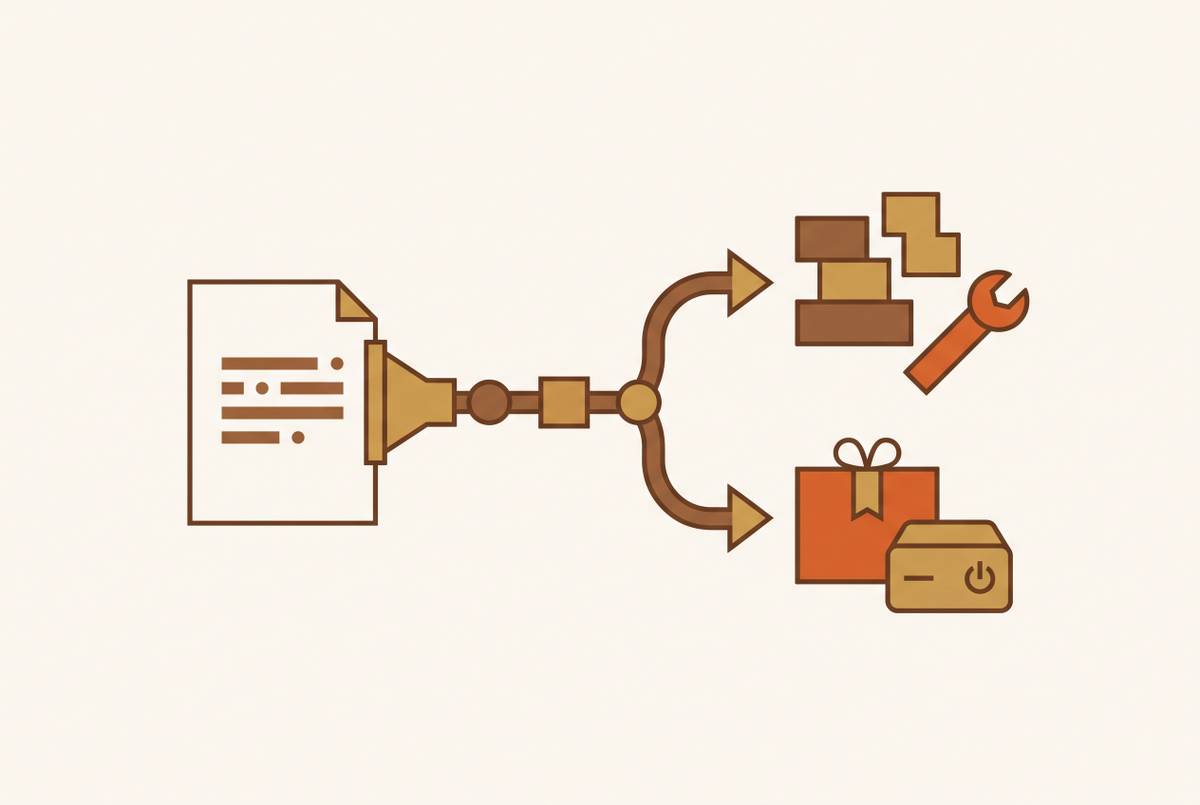
The PoC should now follow the path a document takes through production. Test each stage separately as well as the final result. Otherwise, a wrong field tells the team that something failed without revealing where. Stage-level evidence separates a reading problem from a routing or validation problem.
Begin the packet tests with splitting and classification. Measure whether the system finds the correct document boundaries and assigns each segment to the right document type before routing it to a specialised extractor. A failure here can corrupt every later extraction from that segment. Smaller, targeted workflows usually outperform a single agent expected to handle everything.
Next, test OCR and layout analysis independently. Measure reading-order fidelity in multi-column documents, recovery of table structure, and text quality on degraded scans. This is also where the test should compare the embedded text layer with the visual rendering. If those disagree, successful text extraction alone is not evidence of a trustworthy result.
Then test field extraction against the required schema and the labelled ground truth. Report the results by document class, confidence band, and field type. This makes the accuracy measurement diagnostic. It shows which combination of input and field needs further work.
Finally, test validation rules and business logic. Check cross-field consistency, formats, and referential integrity against values that are known to be right, then test where the data goes when a check fails. A correctly read value can still fail a business rule. The pipeline has not passed if it extracts that value and sends it unchecked into a workflow that should have rejected it.
What should a vendor or build-team prove before replacing Google Document AI or Azure Document Intelligence?
A vendor that demonstrates strong field accuracy but refuses to put it into an SLA leaves the production risk with the customer. The contract should address the accuracy measured on the actual corpus. A favourable test result is not a substitute for that obligation.
The same evidence should govern cost and latency discussions for high-volume workloads. RealDocBench shows how to make this comparison by reporting accuracy, per-page cost, and latency together. For a team replacing an existing service because accuracy varies or costs are unpredictable, another aggregate accuracy claim is not enough. The replacement must be tested against the same requirements for running it and the same difficult documents.
Invofox’s approach combines a contractual per-field accuracy SLA with charges only for pages extracted correctly. A wrong field causes that page to be credited back automatically. Those terms give a buyer something concrete to test and put into a contract. They do not remove the need for measured evidence.
An in-house build needs the same accountability, even without a vendor contract. The failed cases reveal work that will continue after launch, including model updates, rule revisions, and human review. Test whether reviewer corrections improve subsequent extractions on similar documents. Without that feedback loop, changes to templates mean more upkeep for a system that passes today’s test.
Compliance evidence belongs in this decision too. Confirm the status of relevant SOC 2 Type II, GDPR, and ISO 27001 requirements during the PoC. Historical control evidence cannot be created retroactively. The build-or-buy decision must account for those obligations as well as extraction quality.
Running the PoC in a regulated environment without creating a compliance liability
Real documents make the evaluation meaningful, but they also bring real data-handling obligations. Invoices, payslips, bank statements, medical records, and mortgage packets contain financial and personal information. Depending on the deployment, GDPR, HIPAA, SOC 2, and ISO 27001 requirements matter during evaluation as well as production. Replacing these inputs with sanitised synthetic documents avoids the difficult test and leaves the obligations for handling real data unresolved.
Data minimisation starts when the corpus is assembled. Use the smallest set of real documents that covers the required failure scenarios. Zero-retention processing at inference time does not fix unnecessary collection before inference. Diversity of difficulty and restraint in collection can work together.
The evaluation environment must also match the intended production requirements for data residency and access control. An EU organisation bound by GDPR Article 44 transfer restrictions cannot treat a US-hosted PoC endpoint as the same as the environment it plans to use in production. Confirm contractually whether prompts and outputs are stored after the session. Zero-retention claims, including those made by Invofox, need to be checked in that review because documentation alone is not enough to accept them.
These decisions must precede processing. Retrofitting controls costs more and cannot recover missing historical evidence for a SOC 2 Type II observation period. Both require the same discipline, namely real documents handled correctly before their extracted values are trusted.