Bill of Lading Data Capture in Freight Operations
Misread container numbers trigger customs holds and delivery failures.
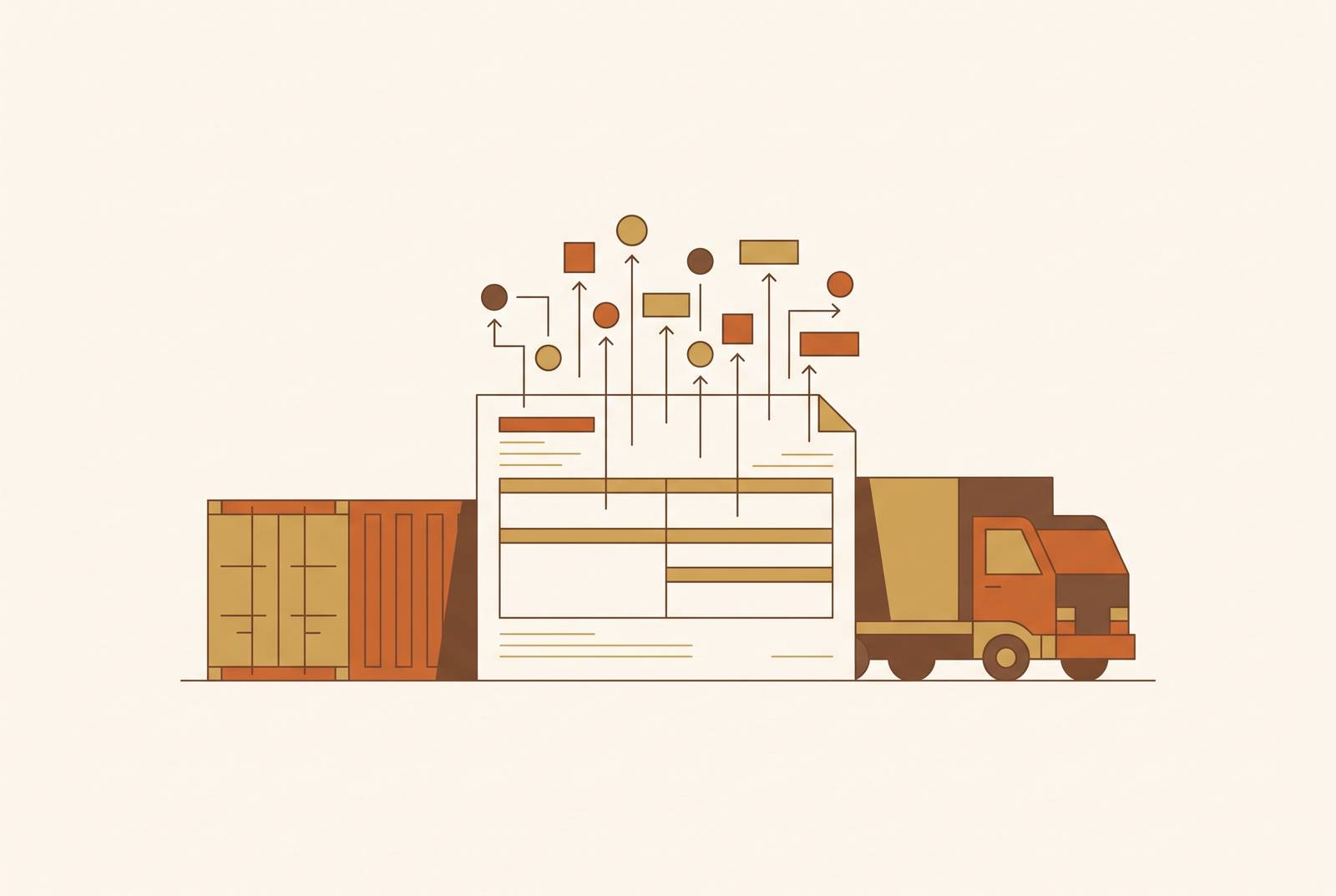
BOL data capture fails in production for one reason above all others: BOLs don't arrive in one format, but in dozens, scrawled on, stamped over, photographed at odd angles from a truck cab, and scanned into PDFs that a template-based system has never seen before. The failures that follow aren't cosmetic. A misread container number can trigger a customs hold, and a wrong vessel name can trip a demurrage charge or blow a delivery window entirely. Treating BOL extraction as a one-time OCR integration causes exactly these outcomes. Extraction works best as an engineering discipline built around per-field validation, confidence scoring, and correction feedback; buyers who skip that discipline are the ones stuck explaining a customs hold to an angry customer.
BOL OCR extraction fails in production for a cluster of reasons that demos never expose. Layout variation is the root: no two carriers place the same field in the same position, document condition degrades further with handwritten endorsements and port stamps sitting directly over printed fields, and a template-based pipeline fails quietly on every carrier layout it has never seen before. Vision-language models introduce hallucinated values that pass format checks with no visible error signal, while confidence miscalibration lets wrong extractions route through as verified because a system reporting 0.95 confidence may be correct far less often than that figure implies. Engineers should design around these failures by building staged pipelines with preprocessing tuned to real input sources, format-agnostic extraction that classifies document type on the fly, per-field confidence scoring checked against verified outcomes and thresholded separately for each field type, a business rule validation layer that catches checksum failures and out-of-range values without any machine learning, and exception routing that drops uncertain documents into human review rather than failing silently downstream.
Ocean carriers alone issue tens of millions of these documents a year, and the paper moving through global trade at any given moment runs into the billions of pages. Digitization has made real progress, and electronic bill of lading adoption keeps climbing, but most freight operations still live in a hybrid world: some shipments arrive as clean digital records, most don't. A shipper running an eBL platform and a carrier still faxing a stamped copy both end up feeding the same downstream system, and that system has to make sense of both.
What a BOL actually contains and why layout variation is the root problem
Every BOL carries a familiar set of fields: shipper, consignee, carrier, BOL number, PRO number, commodity description, weight, freight class, charges. Nearly all of them show up on nearly every document, but none of them sit in the same place twice. One carrier puts the BOL number in a header box, another buries it in a mid-page table, a third tucks it into a footer note that only shows up on trucking BOLs and not ocean ones.
Document type adds another layer on top of layout. Ocean BOLs, air waybills, trucking BOLs, and multimodal BOLs each follow their own structural logic, so a field extraction rule tuned for one mode routinely breaks on another. Condition adds yet another wrinkle: a paper original gets signed at pickup, stamped at the dock, and scanned into the system days later, and by the time it reaches a parsing pipeline, a handwritten endorsement or a port stamp may sit directly on top of a printed field the pipeline needs to read.
Version fragmentation compounds all of it. The paper original, the scanned PDF, the carrier portal record, and the eBL platform entry can each hold a slightly different version of the same shipment. When a dispute or an audit comes up, inconsistent capture across those versions turns a simple lookup into a research project.
Here's what vendors don't like to admit: a template-based OCR setup that works cleanly across ten carriers will fail on the eleventh, and it will fail quietly. Templates match documents against a library of pre-set layouts, which is backwards for freight, where the next carrier's layout is by definition not in the library yet. Reliable capture means reading document structure on the fly and adapting to each new layout as it shows up, rather than matching against a fixed set. GLS's approach is worth looking at here: putting mobile OCR in drivers' hands means capture happens at the point of handoff, right in the cab, instead of later in a back-office scanning queue. That's a real gain, but it also brings image problems a dock scanner never has to deal with: bad angles, glare, a hand or a clipboard partially blocking the frame.
How a production BOL parsing pipeline is actually structured
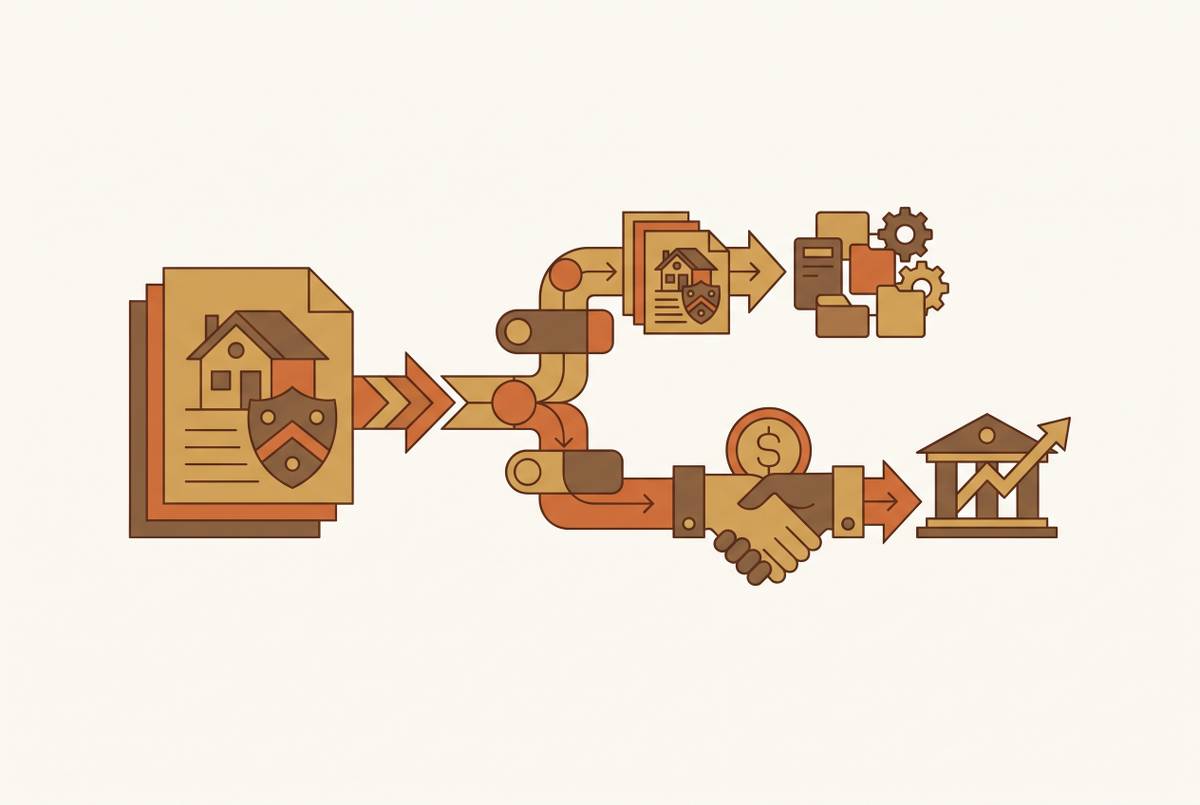
A pipeline built to handle this volume runs as a staged system: ingestion, preprocessing, OCR, layout analysis, extraction, validation, output. Each stage solves a distinct problem. Skipping one doesn't save time, it just moves the failure downstream, where it's harder to find and harder to trace back to its source.
Ingestion takes whatever comes in (scanned PDFs, cab-camera photos, email attachments, carrier portal exports) and brings it to a common starting point before any recognition begins. Preprocessing follows: deskewing, denoising, contrast correction, resolution normalization. Teams underfund this step more often than any other in the pipeline, and that's a mistake, because even a rotation of one or two degrees measurably drags down OCR accuracy. Money spent cleaning up input quality tends to buy more accuracy gain than money spent swapping OCR engines, sometimes by double-digit percentage points, and most teams get this backwards: they chase a better model before they fix a crooked scan.
OCR turns pixels into machine-readable text, and for BOLs that means handling both printed text and handwritten endorsements on separate model paths, since the two behave nothing alike. Layout analysis then works out the document's actual structure (headers, tables, form fields) so a value gets tied to the right named field instead of just the right spot on the page. Extraction is where machine learning models classify the document type (ocean BOL, trucking BOL, air waybill) and pull the fields out without leaning on a fixed template. Validation applies business rules and confidence thresholds to catch mistakes before anything reaches an output file, and this is where per-field confidence scoring starts to matter more than any single accuracy number.
The output stage delivers structured JSON or a flat record into a TMS, ERP, or freight audit system. A well-run pipeline also tiers its tools by difficulty: fast, traditional OCR handles clean digital documents, while heavier vision-language inference gets saved for the degraded or ambiguous cases. Cost and latency stay tied to how hard the document actually is, instead of running every page through the most expensive model on the shelf.
Why do BOL OCR extractions fail in production freight systems, and what failure modes only appear at real volume?
Demos run on clean, representative samples. Freight volume doesn't cooperate that way, and several failure modes only show up once real documents start flowing through the system at scale.
Cab-captured images bring shadow, angle, and partial obstruction that a flatbed scanner simply never produces. A pipeline validated on scanned PDFs can fail on mobile captures with no warning, because nothing in its testing ever looked like a photo taken through a windshield at dusk. Port stamps and handwritten endorsements sitting on top of printed fields cause a related but sneakier problem: if OCR reads the stamp instead of the text underneath it, the extraction comes out wrong with no visible sign that anything went sideways.
Vision-language models bring their own, more severe version of this risk. Unlike a simple character substitution, a hallucinated container number looks entirely plausible, passes a basic format check, and slides right past a spell-checker. There's also a purely infrastructural failure mode worth naming directly: if a message queue's visibility timeout is shorter than actual processing time, a document gets redelivered to another worker mid-processing, and the pipeline produces duplicate extractions. That's a plumbing failure with nothing to do with the model itself, and it's the kind of bug that gets blamed on "AI accuracy" when the real fix is a longer timeout setting.
Confidence miscalibration might be the most dangerous failure of all, because it hides in plain sight. A system reporting 0.95 confidence but landing correct only a fraction of that often will route wrong extractions through as if they were verified, and no one notices until the error surfaces three steps downstream in an invoice mismatch or a customs flag. Latency assumptions get built wrong too: OCR, not the LLM, is usually the bottleneck, since OCR works through pages one at a time in sequential calls while a downstream LLM can parse a full document in a single pass. Engineering teams that build architecture around the opposite assumption end up over-provisioning the wrong stage, then wonder why costs don't move when they upgrade the model.
And when the paper original, the scanned copy, and the carrier portal record disagree on a value, someone has to decide in advance which source wins. Without that policy set ahead of time, running the same shipment through the pipeline twice can produce two different answers, which makes audits and dispute resolution genuinely miserable.
Why "99% accuracy" claims tell freight teams almost nothing useful
Most vendor pitches lean on one number, and that number is the wrong one to trust. A vendor quoting 95 to 99 percent accuracy is almost always describing character accuracy: whether individual characters got read correctly. That figure says close to nothing about whether the BOL number, the container ID, or the freight charge came out right as a usable value. Treating it as a stand-in for real performance is the most common mistake buyers make, and it's the first thing worth calling out in any vendor pitch.
Three separate metrics measure three separate things, and conflating them is where most vendor claims go soft. Character accuracy is a raw OCR benchmark: useful for comparing engines, useless for operational decisions. Field accuracy asks whether the correct value landed in each named field, which is the number that actually governs whether a BOL number or a freight charge can be trusted downstream. Document accuracy asks what share of documents came out with zero errors anywhere, and that's the figure that determines how much manual review workload a team is really signing up for.
A 2025 study using structured document extraction, with a sample of 200 documents, found field-level accuracy ranging from a perfect score on well-structured fields like year and state down to the high 80s on semantically harder fields like season and agent, with an overall average of 94.72 percent. That spread is the whole point. On a BOL, fields like BOL number and total weight sit in fixed positions with rigid formats and will consistently outperform something like commodity description or special instructions, which are free text with no consistent structure at all. Rolling all of that into one aggregate accuracy figure hides exactly where the risk lives.
Confidence calibration tells a similar story. A 2025 audit pilot found a confidence score of 0.89 on a minimum payment amount field against 0.675 on a payment due date field, a real difference in how reliably the model actually knew what it was reporting. A system that hands back uniformly high confidence regardless of field type is simply miscalibrated, full stop. The useful test is simple: pull a sample of extractions the system marked high-confidence and check them by hand. If errors show up at that threshold, the confidence score isn't fit to drive routing decisions. Any vendor unwilling to specify accuracy at the field level, or unwilling to put that number in a contract, is asking the freight operation to carry all the risk alone, and that's not a partnership worth signing.
How confidence scoring and validation layers reduce the cost of errors that reach the output
Per-field confidence scores do a different job than one overall document score. They let a pipeline flag just the container ID for review instead of pulling the entire document out of the automated flow because of one uncertain value.
Combining several signals (OCR quality, layout confidence, field-type priors) produces better-calibrated scores than relying on model logprobs on their own. Numeric fields like BOL number, weight, and freight charges tend to be reasonably well-calibrated already in production systems, while free-text fields like commodity description show a pattern of systematic overconfidence even at high predicted probabilities. That's a strong argument for setting routing thresholds per field type rather than applying one blanket cutoff across the whole document.
A second validation layer, built on business rules rather than model confidence, catches a different class of error: a container ID that fails a checksum, a freight charge that's an order of magnitude outside the normal range for that lane, a consignee name that doesn't match any known customer record. None of that needs machine learning, just rules built from how freight actually moves.
When a document fails at classification or extraction, a well-designed pipeline drops into a human review queue rather than pushing an unreliable extraction through silently. The goal is a tiered outcome: most BOLs move end-to-end without anyone touching them, a defined slice gets routed for review on specific flagged fields, and a small remainder goes to full manual processing. Production benchmarks from multi-agent document pipelines show automation rates in the high nineties on well-structured documents, and the space between that number and what OCR alone can deliver is the value the validation and routing layers add on top of the OCR engine.
How continuous learning from corrections closes the gap that layout variation opens
Layout variation isn't a problem that gets solved once. Carriers update their formats, new logistics partners onboard with templates no one has seen before, and seasonal volume spikes bring in documents from providers that never showed up in the original training data.
A static OCR integration only ever handles the formats it was built on, and every new carrier format is a potential regression waiting to happen unless there's a feedback loop built into the system. Human corrections are the raw material for that loop: when a reviewer fixes a misread field, that correction becomes ground truth for that specific document, carrier, and field type. It's a signal a learning system can use to get better on the next similar document instead of repeating the same mistake.
What separates a document AI product from a static OCR tool is whether corrections actually move the model forward in production, not how well the demo performed on day one. Smaller, targeted workflows built around specific document subtypes (ocean BOL, trucking BOL, air waybill) tend to beat one generalist model trying to cover everything, mostly because narrowing the ambiguity space makes each correction carry more signal. GLS's cab-based capture setup is a useful case study here: mobile captures from drivers produce a recognizable, consistent class of image issues, bad angle, bad lighting, and a pipeline built to log and correct those systematically turns a recurring annoyance into a training signal instead. Continuous learning of this kind needs a ground truth labeling process, correction logging, and a retraining cadence built into the product from day one, not bolted on after launch.
Build vs. buy calculus for BOL extraction at freight scale
Building in-house means owning every stage: OCR engine selection, preprocessing, a layout model, field extraction logic, confidence scoring, validation rules, exception routing, and integration into a TMS or ERP. That's the visible cost, and it's substantial on its own.
The hidden cost is worse, because it doesn't show up on any budget line until later: every new carrier format, every drop in document quality, every new field a customer asks for becomes its own engineering sprint. Most teams underestimate how fast that backlog grows. BOLs make this especially punishing, since document type variation, condition variation, and reference number ambiguity (shipper reference, carrier reference, booking number, container number, customer PO, each labeled differently by each carrier) stack together into an edge case surface that's unusually large compared with other document types.
Most build-vs-buy debates get settled on price, and that's the wrong scale to weigh it on. The harder questions are the ones worth asking instead. Will the vendor specify accuracy at the field level instead of hiding behind an aggregate number, and will they put that figure into an SLA and cover the cost when an error breaches it? Does the system actually learn from corrections, or does its accuracy freeze the day it's deployed? What's the data retention policy on documents carrying shipper, consignee, and cargo information? Can the vendor support on-premise or regional deployment for operators with cross-border data residency requirements?
That last point matters more than it might first appear. BOLs carry shipper identities, consignee details, cargo manifests, and commercial terms, and a third-party processor holding onto that data longer than necessary is a liability sitting on someone else's balance sheet. The sharpest filter in the whole evaluation is the SLA question: a vendor willing to guarantee per-field accuracy in a contract has already done the evaluation work behind that number. A vendor who won't is simply asking the freight operation to absorb the risk instead. For operations processing hundreds of carriers and document variants, building in-house is almost always the costlier call, and it's not close: the maintenance burden tends to outpace the cost of a production-grade API well within the first year, faster than most engineering teams expect going in.
What rigorous BOL data capture looks like end to end
None of this comes down to a single model's benchmark score. Reliable BOL data capture in production gets defined by how the whole pipeline behaves across the actual mess of document conditions freight operations generate every day: dock scans, cab photos, faxed copies, carrier portal exports, all landing in the same queue.
A minimum viable version of that pipeline looks the same, whatever the vendor or the build path: preprocessing tuned to the real input sources in use, not just clean PDFs; format-agnostic extraction that reads document type and carrier layout without leaning on a fixed template; per-field confidence scores checked against verified outcomes rather than reported at face value; business rule validation layered on top of model confidence; exception routing that drops into review instead of failing silently; and a correction feedback loop that treats every human fix as training data instead of a one-off patch.
Freight operations that get this right see fewer of the failures that used to travel invisibly downstream: into a TMS record, into an invoice mismatch, into a customs hold that no one saw coming until the container was already sitting at the port.