Subrogation Document Workflow in Property and Casualty Insurance
Scattered documents and silent extraction errors bury subrogation recovery potential.
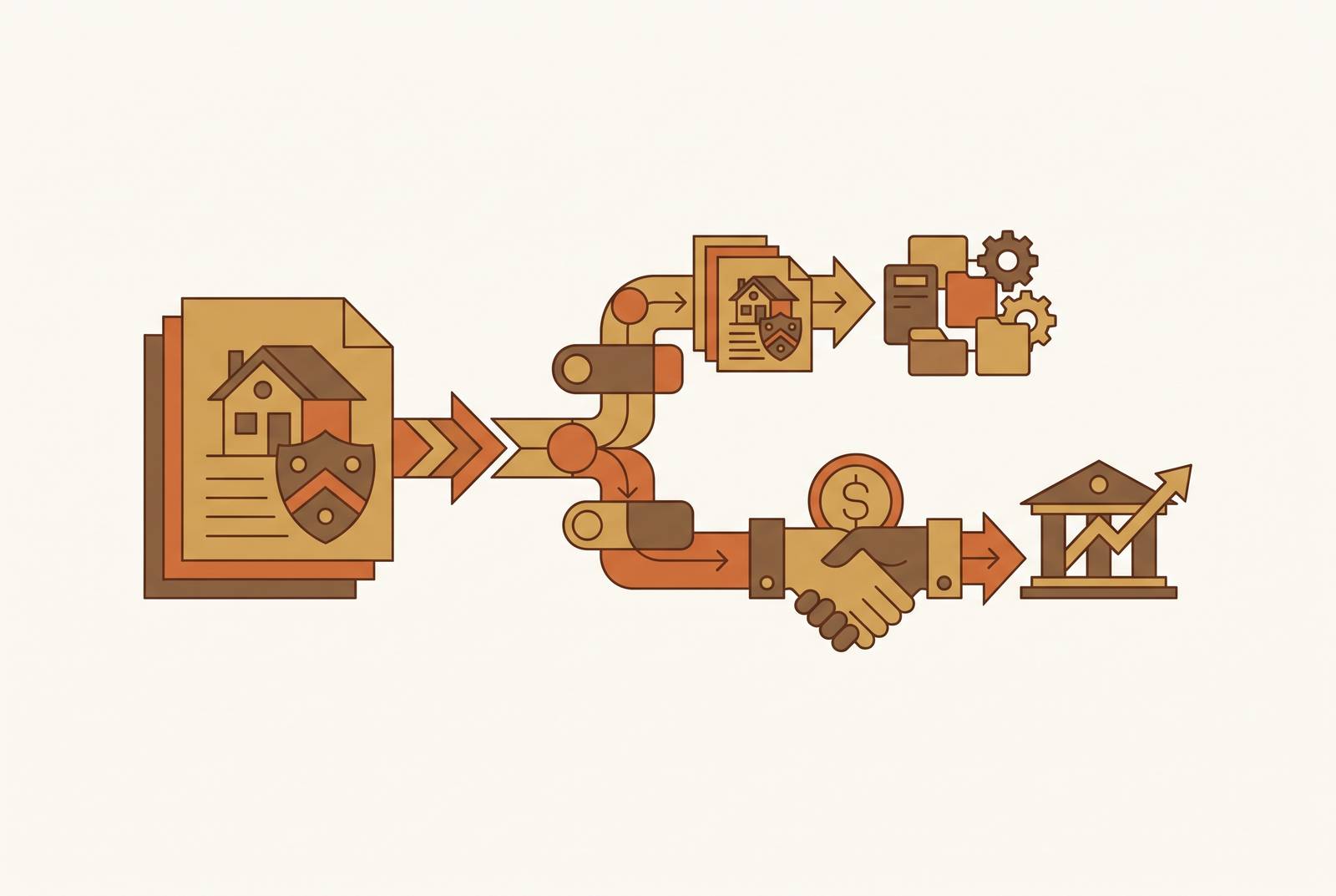
A subrogation file is a pile of documents, and none of them agree on a schema. Adjuster notes and first-notice-of-loss records are free text with no fixed length or format, while police and incident reports are semi-structured and vary by jurisdiction, sometimes down to the county. Repair and medical invoices carry tables, but every vendor and provider lays those tables out differently. Then there's the correspondence: demand letters, coverage denials, attorney letters, subrogation demand letters, and settlement releases, each with dates, names, and dollar figures that all need to land in the right field. Proof-of-loss statements and UIM release forms often arrive as scanned, notarized pages, with image quality bad enough to trip up text recognition before extraction even starts, and Arbitration Forums contentions sheets add another layer: structured argument forms that point to supporting evidence sitting in other documents entirely.
None of these documents share a field name, let alone a layout. A police report calls it "narrative." An adjuster note calls it "description of loss." One repair invoice lists "labor" and "parts" as separate line items; another vendor folds them into a single number. A parser built for one document type is close to useless on the next.
The harder problem is that the evidence needed to prove third-party liability rarely sits in one document. Take a water-damage claim caused by a defective pipe. Proving fault means connecting the adjuster's note describing what happened, the line items on the repair invoice showing what got replaced, and an external product recall record confirming the part had a known defect. None of those three sources use the same terms or the same field structure. A person can make that connection given enough time, but time is exactly what runs out at claim volume. That kind of cross-referencing is where manual review breaks down first, and it breaks down first on the highest-dollar files, since those carry the most documents to reconcile.
How subrogation potential goes undetected at first notice of loss
Adjusters are supposed to flag subrogation potential the moment a claim comes in, at first notice of loss. In practice, a large share of claims that could recover money never get flagged, and the reason isn't carelessness. Third-party liability is often not obvious on day one. The evidence that a contractor was negligent, or that a product had a defect, or that fault should split across two parties, sits inside documents nobody has read closely yet.
An adjuster's job at intake is triage: open the file, get the initial facts down, move to the next claim. Asking that same adjuster to spot a manufacturer defect pattern or a shared-fault scenario while processing a fresh loss report is asking for legal analysis the job was never built to do. What intake work rewards and what subrogation detection requires are two different things, and no amount of adjuster diligence closes that gap on its own.
Claims systems, billing systems, and subrogation teams typically run on separate databases that don't talk to each other, so even a straightforward file needs someone to reconcile records by hand across systems. That lack of synchronization produces reserve miscalculations and delays, and delays compound. The longer a file sits without a subrogation flag, the worse the odds of recovery get: statutes of limitation tighten, witnesses forget details, and the other insurer's willingness to cooperate fades with time.
Catching this earlier depends on reading documents fast and correctly, so it comes down to an extraction problem at its core. Filing documents into a system does nothing if nobody, and nothing, actually reads them until someone goes looking.
Where document extraction fails in a production subrogation pipeline
Most extraction tools handle the easy majority of documents fine. The trouble shows up in what's sometimes called the 95/5 gap: parsers that perform well on the clean bulk of a document set still fail on the small share of edge cases, and those edge cases happen to be exactly where the most valuable liability evidence lives.
Mixed-layout documents cause the most trouble. A police report with an embedded table, or a repair invoice with merged cells and a handwritten note scrawled in the margin, breaks parsers built to treat a page as a straight line of text. Cross-page tables are a particularly common failure in insurance files: a line-item cost breakdown that splits across two pages comes back as two disconnected fragments, with nothing tying them together. Scanned documents add another failure layer before extraction even begins, since skewed pages, low resolution, and partial redactions degrade character recognition, and errors introduced at that stage carry through everything downstream.
The most dangerous failures are silent. A parser can produce output that looks complete, correctly formatted, properly labeled, and still have dropped a row from a table, swapped two digits in a date, or flattened a nested field into something that reads fine but means something else. Nothing flags the error, so it moves downstream untouched. Agentic OCR pipelines have a documented failure mode where the model gets caught in repetition loops, or a collapse in token probability, and the output that comes out the other end looks like a finished extraction while being functionally garbage.
Insurance documents also fail in ways specific to the domain. A single page can carry a financial table, a block of legal language, and a paragraph of adjuster narrative, all at once. That combination behaves differently than a STEM paper or a general business contract, and a parser tuned on the latter won't transfer cleanly. A tool that looked sharp in a demo on a set of clean PDFs runs into a completely different failure pattern once it hits live subrogation files. That gap is a big part of why so few in-house document AI pipelines make it to production: the edge cases, and the upkeep they demand, outlast the enthusiasm behind the initial build.
Why field-level accuracy is the right measurement unit for subrogation extraction
Vendors like to quote character-level accuracy, and for this use case it's close to meaningless. A parser can get nearly all individual characters right and still put the wrong dollar amount in the repair-total field, because one transposed digit ruins the number even though every character in the document was read correctly. That single wrong digit is the whole ballgame; nobody downstream cares that the other 98 characters on the page were perfect.
What actually matters is field accuracy: did the system pull the right value into the right named field, whether that's claimant name, loss date, at-fault party, repair total, or policy number. A document can score well on character accuracy and still hand a reserve engine or a demand letter the wrong figure. Document-level accuracy, meaning the share of files that come through with zero extraction errors anywhere, is the number that actually decides how many files can move through the pipeline without a human touching them.
Confidence calibration is a separate question, and just as important. If a system marks an extracted field at 0.95 confidence, that value should be correct at roughly that rate at that threshold. A poorly calibrated system reports high confidence on values that are wrong, and that's the worst failure mode in production, because those errors pass through unquestioned. Calibration is testable: pull a sample of high-confidence extractions and check them by hand. If the error rate runs higher than the confidence score implies, the system is overconfident, and that overconfidence is doing real damage somewhere downstream.
Not every field type is equally easy to pin down. Structured numeric fields, amounts and dates, calibrate more predictably than free-text fields like adjuster narrative or coverage description, where language is looser and context matters more. Multi-signal confidence engines that route low-confidence extractions to a human reviewer, rather than forcing full automation, lift effective accuracy at real production volumes. Before signing with any vendor, insurers should demand field-level accuracy shown on a private evaluation set built from their own documents, edge cases included. A vendor's own benchmark set proves nothing about how the tool performs on the insurer's actual files, and treating it as proof is the single most common mistake in this procurement process.
How a structured extraction pipeline routes and validates subrogation documents
Getting this right is an orchestration problem more than a model-selection problem. No single model needs to handle every document type equally well; the pipeline needs to know which document is which and route accordingly.
High-volume, structured documents, standard repair invoices, policy declarations, go to deterministic extraction: fast, stateless, cheap per document. Mixed-layout or semi-structured documents, police reports, adjuster notes, get escalated to extraction that understands layout, not just text. Anything that comes back below a set confidence threshold, from either tier, gets flagged for a person to look at before it moves any further downstream.
That threshold isn't one fixed number across the board. It should be tuned per field type, based on how that field actually calibrates against an insurer's own document corpus, not a generic benchmark.
Validation runs across every tier regardless of how a document got routed. Cross-field checks catch inconsistencies, like a loss date that falls after the repair invoice date. Format checks confirm policy numbers and tax IDs look the way they're supposed to. Business-rule checks specific to subrogation confirm the basics: is an at-fault party actually named, is a release form present in the file. Output comes out as structured JSON with a confidence score attached to each field, so claims platforms, arbitration filing tools, and reserve engines can consume it directly without re-parsing anything.
Some pipelines add agentic validation, where the system checks whether the fields it extracted are internally consistent before passing anything downstream, cutting the volume that ever reaches a human reviewer. And because pipelines get updated, a fixed canary set of known documents should get re-run on every update, so drift shows up before it hits live files rather than after.
The role of continuous learning in keeping extraction accurate as document formats evolve
Document formats don't hold still. Repair shop invoice layouts change when a shop switches software, police report templates vary by jurisdiction and get revised periodically without notice, and third-party insurer correspondence follows no shared standard at all. A model trained once and left alone degrades as the documents it sees drift away from what it was trained on; accuracy in month one is not accuracy in month twelve.
The fix runs through human correction. When a reviewer fixes an extracted field, that correction should feed back into the model instead of sitting in a log nobody reads. That feedback loop is what separates a real document AI product from a demo: whether corrections improve future extractions on similar documents, or just get logged and forgotten.
At high volume, this compounds. A system that absorbs corrections made in January can handle a revised invoice format that shows up in March without anyone kicking off a separate retraining project. Fixed canary sets, benchmarked continuously rather than once a year, catch accuracy degradation before it spreads across a large batch of live files. Building and keeping up that kind of continuous learning loop in-house is a real undertaking, and it's the crux of the build-versus-buy question that follows.
The build-vs-buy decision for a subrogation extraction pipeline
A basic extraction pipeline isn't hard to stand up. One that handles the full range of subrogation documents at production-grade accuracy is a different scope of project entirely, and building it in-house is, for nearly every carrier, the wrong call. Most teams that try end up rebuilding what a vendor already sells, a year late and short-staffed on the machine learning side. The gap between the two is where budgets and timelines go to die.
The build side has costs that tend to compound faster than the initial estimate assumed. The first phase of development covers the easy 95% of documents without much trouble; the remaining edge cases eat a disproportionate share of engineering time after that. Formats keep evolving, so ongoing maintenance needs dedicated machine learning capacity, not a one-time project team. Vision-language models keep improving, and keeping pace, retraining, re-evaluating, redeploying, is a continuous commitment rather than a single integration. Confidence calibration, validation logic, and human-review routing all need to be built and kept up separately from the core extraction model. The maintenance surface grows with every document type added; a pipeline covering ten document types carries ten separate points where format drift can quietly break things.
On the buy side, the evaluation questions are specific to subrogation. Does the vendor put field-level accuracy in a signed SLA, or just in a slide deck? Can they show accuracy numbers on a sample drawn from the insurer's own document corpus, edge cases included, before any contract gets signed? Does their data handling meet SOC 2, GDPR, and ISO 27001 requirements, given that subrogation files carry sensitive personal and financial information? Is zero data retention available, meaning documents get processed and discarded rather than stored on vendor infrastructure? And does the pricing model track actual performance, charging for pages correctly extracted rather than pages merely processed?
A vendor unwilling to put an accuracy number in an SLA is asking the insurer to absorb all the extraction risk, and that's a bad trade no matter how polished the demo looked. Some APIs, such as Invofox, back their per-field extraction with a contractual accuracy SLA rather than a slide-deck claim. That alone is reason enough to walk away. Document intelligence APIs, ones built to take in unstructured PDFs and images and return validated structured JSON with field-level confidence, have become a mature enough category that this evaluation is now standard procurement work for P&C operations teams.
Data security and compliance requirements that subrogation document processing cannot sidestep
Subrogation files rank among the most sensitive document sets a P&C operation handles. They carry claimant personal information, financial records, medical detail, legal correspondence, and coverage terms, often all in the same folder.
Running these documents through any extraction pipeline, especially a cloud-based API, creates data handling obligations under state insurance regulation, GDPR where it applies, and general financial data governance standards. Before deploying any vendor, the certifications worth confirming are SOC 2 Type II, ISO 27001, and documented GDPR compliance. Zero data retention should be the default architecture, not an add-on: documents get processed and immediately discarded, with nothing kept on the vendor's infrastructure. The alternative, holding onto documents for model training or logging purposes, creates regulatory exposure and a breach surface that most P&C legal and compliance teams should refuse to sign off on.
Deployment geography matters too. Carriers operating across jurisdictions need to know whether EU and US data residency options exist, and whether on-premise deployment is even on the table. None of this belongs in due diligence as an afterthought, something to check in month three of a rollout. Security architecture needs to be a first-order requirement in vendor evaluation from day one, and a breach involving subrogation files carries regulatory consequences and reputational damage in roughly equal measure.
What changes operationally when extraction is accurate and structured from the start
When extraction produces validated, structured JSON with field-level confidence at the moment a document comes in, subrogation triage starts looking like a normal workflow rather than a scramble. Liability signals, at-fault party identity, damage causation, third-party insurer details, surface at first notice of loss instead of turning up weeks later during a file review nobody scheduled in time.
Reserve calculations can pull from structured extraction data instead of leaning on an adjuster's summary written under time pressure. Arbitration filings and demand letters can be pre-populated from that same structured output, cutting preparation time, while compliance checks, is the settlement release signed, is the proof-of-loss on file, stop being manual checklist items and become automated flags.
Firms that automate this part of the subrogation workflow recover meaningfully more per file and cut the staff hours spent chasing down file management. That gain traces back to adjusters and subrogation teams having complete, accurate information earlier in the process than they used to, more than to sharper negotiation tactics or tougher legal posture. The combined ratio improvement that follows from stronger subrogation recovery is really just the downstream effect of closing a document processing gap, one that started with a police report nobody had time to read closely enough.