Mortgage Closing Disclosure Processing Workflow
How lenders automate the four-stage pipeline that processes mortgage closing disclosures at scale.

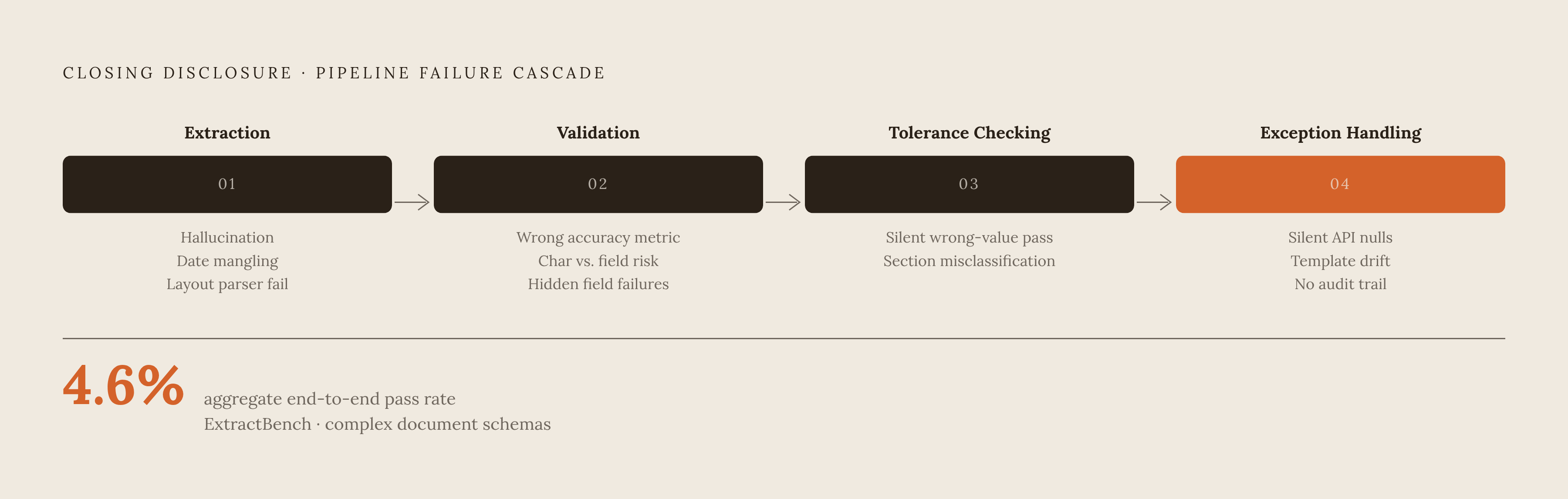
A Closing Disclosure runs five pages, covers final loan terms and closing costs, and has to reach the borrower at least three business days before closing. The rule leaves no room for interpretation. Processing that document at scale breaks into four stages: extraction, field-level validation, tolerance checking, and exception handling. Each stage fails in its own particular way, and most of those failures only show up once the pipeline hits real production volume, where the inputs are a lot messier than whatever curated set of test PDFs someone used to build the thing. I want to walk through the full workflow here, and point at exactly where it tends to snap.
The CD came out of the TRID rule in 2015, which folded the old TILA and RESPA disclosures into two forms: the Loan Estimate, handed over early, and the Closing Disclosure, handed over right before closing. Three kinds of changes force a lender to issue a revised CD and restart that three-day clock: the APR crossing a set threshold, a prepayment penalty getting added, or the loan switching products, say from fixed-rate to an ARM. Each revision means the whole pipeline runs again on the new document. Extraction, validation, tolerance checks, all of it, from scratch.
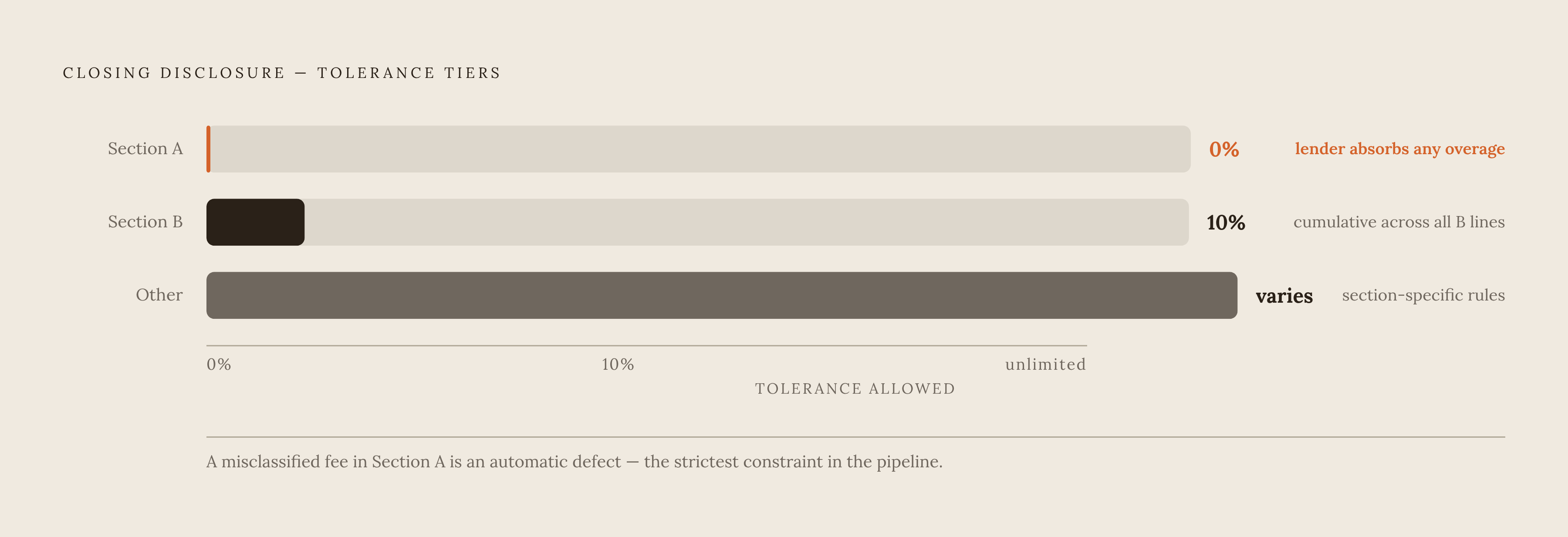
The fee tolerance structure is baked into the document itself, so a QC team can't just bolt compliance checking on after the fact. Section A fees carry zero tolerance: go a dollar over what the Loan Estimate quoted, and that dollar comes out of the lender's pocket. Section B fees carry that same zero tolerance. Because different sections play by different rules, a single pass/fail verdict at the document level tells you next to nothing. You need field-level, section-by-section results, or you're not really checking compliance at all.
And nothing about this holds still. The CFPB put out a Request for Information in July 2026 asking about changes to TRID timing rules, tolerance rules, and electronic delivery requirements. Late in 2024, the CFPB's final rule on PACE financing added a whole new disclosure type lenders now have to fold into their document universe. A pipeline built to handle today's CD and nothing else needs a rebuild the moment any of this shifts, which means building for change isn't some nice-to-have. It's the job.
Beyond the regulatory churn, the documents themselves are just hard to read: multi-column layouts, fee tables nested inside other fee tables, numeric and free-text fields sitting shoulder to shoulder, handwritten notes on paper-originated files, and no two lenders or title companies quite agreeing on a template.
Where CD processing sits in the broader mortgage operations workflow
The CD shows up late in the loan lifecycle, well after the 1003 application, the W-2s, employment verifications, bank statements, and the appraisal have all been checked over. By the time it lands, the file has already earned a lot of institutional trust, and that's exactly what makes an error at this stage so expensive, both to catch and to miss.
Three checkpoints downstream all consume CD data: pre-funding QC, post-close QC, and investor delivery. An extraction error that slips past pre-funding doesn't just sit there quietly. It can block investor delivery outright, or surface months later as a buyback demand, long after anyone still remembers the file.
At lenders without automation, the workflow is still manual stare-and-compare between the Loan Estimate and the Closing Disclosure, line by line. It's the single largest labor cost in mortgage operations at scale, and the error rate shows it: manual document review in mortgage runs a defect rate of 10% to 15%. Automated extraction and validation bring that down to a fraction of a percent. That's not an incremental gain, it's an order-of-magnitude difference.
Borrowers want speed, meanwhile. A Fannie Mae survey found 90% of homebuyers want a more digital mortgage experience, and that pull from the consumer side lands right back on the operations teams who now have to move faster without cutting a single corner on compliance.
The CD Balancer function, whatever tool or pipeline stage actually performs it, checks Loan Estimate figures against Closing Disclosure figures within the tolerances TRID sets. This is a compliance requirement first. It has to get engineered as one deliberately, not assumed as some side effect of decent extraction.
The market backdrop explains why so much engineering effort is pouring into this right now. The global intelligent document processing market was valued at $7.89 billion in 2024 and is projected to hit $66.68 billion by 2032, a 30.1% compound annual growth rate, with North America holding 48.04% of the 2024 share. Mortgage is one of the sectors driving that number. High volume plus high regulatory stakes means a pipeline that looks great on a demo set of clean, lender-provided PDFs is going to run into template variation, degraded scan quality, and real edge cases the day it actually goes live. Document parsing APIs such as Invofox, which converts structured documents into validated JSON with a per-field accuracy SLA, are built around that production reality rather than demo conditions.
Stage one: extraction — what can go wrong before a single field is validated
Extraction has to handle whatever comes through the door: digital-native PDFs, scanned paper, photos taken on a phone, mixed packages where half the pages are clean digital text and the other half are scans of scans. That variety alone is enough to break a lot of pipelines that only ever got tested on one input type.
A few failure modes show up specifically in production and rarely in a demo. Hallucination is the dangerous one: a model confidently extracts data that just isn't in the document, and the output looks plausible enough to sail past a spell-checker or a basic format check. A different failure, an empty result on a page where text is clearly sitting right there, usually traces back to a pre-processing step gone wrong, bad binarization, a deskewing failure, rather than any flaw in the extraction model itself. Dates get mangled in a well-documented way in financial document OCR: a year comes out "2014" instead of "2024," or "2025" instead of "2024," a single-character slip that a downstream tolerance check has no way of catching on its own. Parsers tuned on one lender's CD layout tend to break the moment a different title company shifts a column, swaps a font, or reorders a fee table.
Choosing between traditional OCR and vision-language models comes down to cost and document difficulty. Traditional engines like Tesseract or PaddleOCR are fast and cheap, and they're the right call for clean, digital-native CDs. VLMs handle the harder stuff, complex layouts, handwritten annotations, faded text, but they run much slower, and they're the ones prone to hallucinating convincing nonsense. The workable answer is tiered routing: fast engines take the clean input, and the expensive VLM inference gets saved for whatever a pre-screening step flags as genuinely hard.
Context windows do their own quiet damage. CDs run multiple pages, and chunking logic that splits text at some arbitrary character count can slice straight through a fee table row, severing the link between a line item and its value. Overlapping chunks meant to fix that create a different problem: redundant extractions that sometimes contradict each other outright.
None of these errors stay contained to one stage. A small per-stage error rate compounds as the document moves through the pipeline, so what looks like a low, tolerable error rate at any single step turns into a much higher end-to-end failure rate by the time the document reaches tolerance checking. The ExtractBench benchmark makes the scale of this concrete: across 210 extraction attempts, six frontier models managed only a 51% valid JSON rate and a 4.6% aggregate end-to-end pass rate on complex document schemas. A CD, with its layered sections and nested tables, sits right in that hard-document category.
Why field-level accuracy is the only metric that maps to CD compliance requirements
Vendors throw around accuracy numbers that don't all mean the same thing, and the mixing matters. Character accuracy measures the share of individual characters transcribed correctly, and it's the number behind most "highly accurate" marketing claims. Field accuracy asks whether the correct value came out for a specific named field, Total Closing Costs, APR, Loan Amount, and that's the metric that actually governs compliance. Document accuracy measures what share of documents came through with zero errors anywhere, which governs straight-through processing rate but tells you nothing about which fields failed.
For a CD, field accuracy is the only number that matters in practice. A single wrong APR value is a potential TRID violation, no matter how flawlessly every other character on the page got transcribed.
The published evidence backs this up. A 2025 study using o4-mini on NOAA reports, sample size 200, found an overall average field accuracy of 94.72%, but individual fields ranged from 87.94% to 100% depending on type. That aggregate number buries a lot of field-by-field risk underneath it. ExtractBench tells a similar story from a different angle: when models do manage valid JSON on complex schemas, field-level accuracy runs 65% to 80%, averaging 72.9%, a sharp contrast against that 4.6% end-to-end pass rate. Partial, patchy extraction is common even when full extraction fails outright.
The evaluation discipline that makes any of this trustworthy is simple enough in principle: for every CD field, compute a binary match against manually validated ground truth, then roll it up at the section level. That's the bar a production pipeline has to clear. Track accuracy per field, APR, loan amount, each fee category, cash to close, and per section, A, B, the rest, not as one blended score that hides the weak spots.
If a vendor hands you an accuracy number and can't break it down by field or section, that number belongs in a slide deck. It doesn't belong in a compliance review.
Confidence scores in CD extraction: calibration, miscalibration, and the routing decision they drive
A confidence score only means something if it's calibrated: a value marked 0.95 confidence should actually be correct at that rate at that threshold. No more, no less. Sounds obvious. It's routinely not true.
Miscalibration is the failure mode that does real damage. A system reporting 0.95 confidence that's actually right only 80% of the time at that threshold sends wrong extractions straight into automated processing instead of human review, and nobody catches those errors, because the system told everyone it was sure.
In one automated audit study, a document intelligence model reported an overall average field-level confidence of 0.781, but that average hid real spread underneath: minimum payment amount at 0.89, statement balance at 0.779, payment due date at 0.675. Confidence isn't uniform across field types, and treating it as one number per document throws away exactly the information you need. Numeric fields tend to calibrate better than free-text fields, which run overconfident at the high end, worth watching closely on CD fields like Loan Purpose or lender name, versus a cleanly numeric field like a fee amount.
Testing calibration means sampling extractions the system marked high-confidence and manually checking them by hand. If the actual error rate in that confidence band runs materially higher than the score implies, the confidence model is miscalibrated, full stop, and it needs fixing before it drives a single routing decision.
The routing threshold itself, say anything under 0.85 goes to human review, only works if it's set against observed accuracy, not whatever number sits in the vendor's documentation. Get this right and the payoff is real: a multi-signal confidence system called EXTRACTCONF reached 99.1% automated accuracy at 80% coverage, a 25.8 percentage point jump over a 73.3% base rate. Routing decisions calibrated against real outcomes are what determine how a pipeline actually performs once it's live. The confidence layer is the thing separating a compliant automated decision from an error that needed a human to catch it.
Stage two: tolerance checking — translating TRID rules into pipeline logic
Tolerance checking has no equivalent in a generic document extraction system. It has to be built specifically for mortgage, with the section-specific rules coded directly into the logic, not bolted on afterward.
The CD Balancer function, in pipeline terms, compares extracted CD fee values against Loan Estimate values, applies whichever tolerance rule matches each section, and flags what falls outside it. Section A carries zero tolerance: any overage is a defect, fixed before funding, no exceptions. Section B carries a 10% cumulative tolerance, which means the check has to sum across every Section B fee rather than judge each line on its own. Different sections, different rules, and the pipeline has to know which section a field belongs to before it can even apply the right one.
This is where things go wrong quietly. An upstream extraction error can produce a wrong fee value that still sails through the tolerance check clean, because the number just looks arithmetically reasonable even though it's flat-out wrong. A Section A fee misclassified and stored as Section B picks up the wrong tolerance rule entirely, a compliance error the pipeline has no way to catch unless the section-level field mapping was solid from the start. Revised CDs need the tolerance check re-run against the new document and the original Loan Estimate, never against the prior CD version, an easy mistake to make if the pipeline logic isn't explicit about which document counts as the baseline.
Tolerance results need to write back to the Loan Origination System with the underlying field-level evidence attached, not a bare pass or fail flag. A flag with no supporting values and no confidence score gives QC nothing to actually audit. Push the design further, and a pipeline that catches a tolerance violation can trigger a notification to the title company, pend the file automatically, and update the LOS status without anyone touching a keyboard. But that only works if the extraction and tolerance logic feeding it is trustworthy enough that the trigger itself can be trusted.
Exception handling: the stage that exposes whether the pipeline was built for production or for demos
A pipeline tested on clean, lender-provided PDFs meets a different population of documents the moment it goes live: degraded scans, template drift, handwriting, missing pages, files that somehow got mangled in transit. Exception handling is where you find out, for real, which kind of pipeline you built.
A handful of exception categories show up over and over. Low-confidence extractions below the routing threshold need to go to human review with the actual field-level evidence surfaced, not just the raw document dumped in front of someone. Tolerance violations need to route to whoever can act on them, the title company, the closer, with the specific fee lines named, not some generic error message. A missing required field is a compliance gap, not a data quality footnote; the CD legally has to contain certain disclosures. Beyond these, the pipeline needs to catch triggering-change events, an APR move, a product switch, a new prepayment penalty, and alert the workflow layer that the three-day clock just reset.
Escalation needs a real path, not a dead end. A file that fails initial extraction should escalate to a more capable, more expensive model built for layout complexity and handwriting, rather than just failing silently or getting dropped on the floor. Human reviewers, in turn, do better work when they get extracted values with confidence scores and field-level flags already attached, rather than a blank form to fill out from scratch. The point of human review is correction alongside the pipeline's output, not redoing everything from zero.
One failure is worth naming on its own: provider-level API problems, rate limits, recitation filters, model outages, can produce null outputs that a downstream step reads as a normal, successful, empty extraction. The pipeline has to tell "this document genuinely has no value here" apart from "the extraction call failed silently," because those two situations call for completely different responses.
Templates drift, too. Title companies redesign forms, lenders update systems, and new document variants show up over time whether anyone bothers to announce it or not. A regular exception review, weekly is usually enough, catches that drift faster than waiting around for a scheduled model retraining cycle to notice.
Every exception, every routing decision, every human correction needs a field-level log. Post-close QC and investor delivery both require proof that defects were found and fixed, and without that trail, there's no way to demonstrate any of it after the fact.
Build vs. buy for a CD-specific processing pipeline
Building this in-house means owning every stage above: extraction tuned to CD layouts across dozens of lender and title company templates, a calibrated confidence model, tolerance logic that tracks TRID's section-specific rules, and an exception workflow with full audit logging. That's a real, ongoing engineering commitment, and the regulatory ground keeps shifting underneath it. The CFPB's 2026 Request for Information alone signals more change coming to timing rules, tolerance rules, and delivery requirements. A pipeline built once and left alone falls behind fast.
Buying means holding a vendor to the standards laid out here, not to their demo. Does the vendor report field-level accuracy broken out by field type and section, or just one blended document-level number? Is the confidence score calibrated against observed outcomes, or reported as some static figure that never gets checked? Can the tolerance logic handle Section A's zero tolerance and Section B's cumulative 10% differently, correctly, every single time, including on revised CDs? Does the exception path produce an audit trail detailed enough to survive a post-close QC review or an investor delivery challenge?
Whichever path a lender takes, the real question is narrower than build versus buy in the abstract. It comes down to this: was the pipeline, whoever built it, designed against CD's actual regulatory structure from the first line of code, or retrofitted onto some generic document pipeline after the fact? That's the whole difference between a system that survives contact with production and one that only ever worked in the demo.