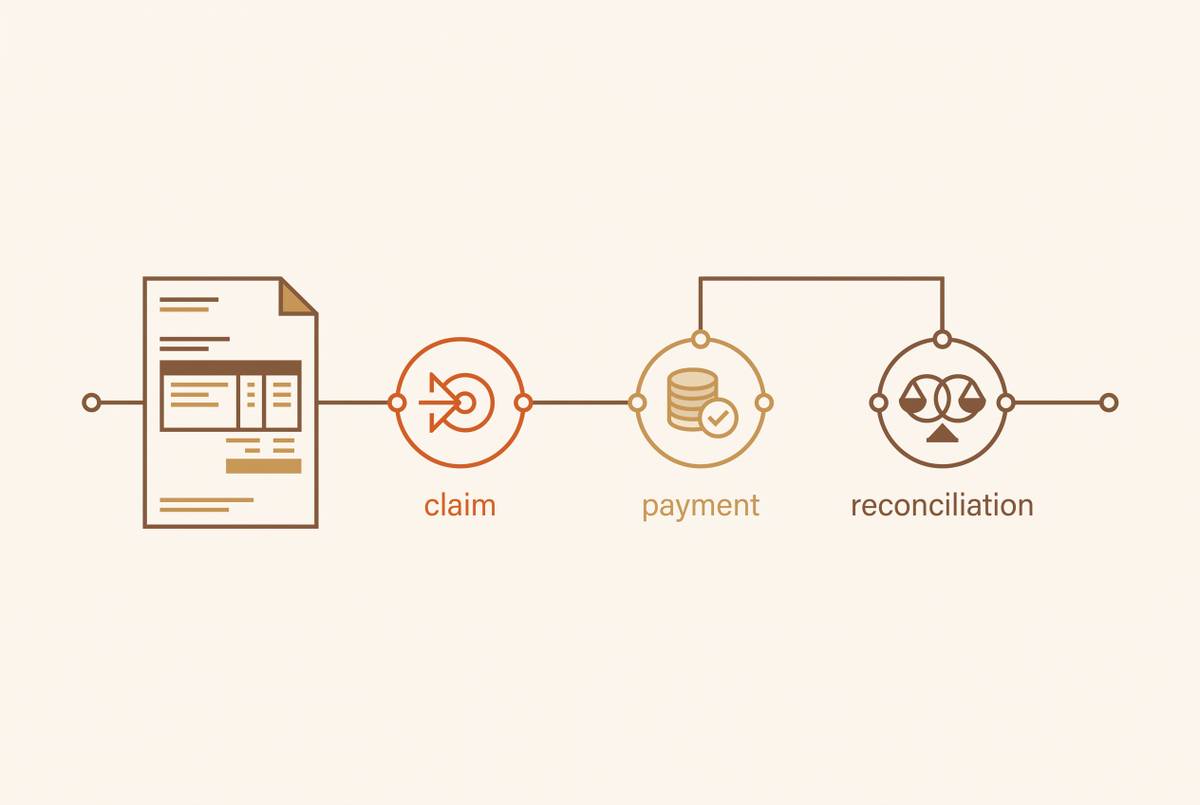
Payslip Validation Workflow for Mortgage Underwriting
Layered validation logic turns messy payslips into reliable income proof for underwriting.

Mortgage underwriting still leans on the payslip as the primary proof of income, and that document was never built to be read by a machine. It looks structured, clean rows, familiar labels, but every employer formats gross pay, tax deductions, National Insurance, pay period, and employer name differently, and there's no shared schema underneath any of it. Reading a PDF and pulling five numbers looks trivial at a demo. Run that same task across a real client folder with hundreds of employer formats, and it turns into a genuine engineering problem, one that only layered validation logic can solve. A single clever extraction step never gets there.
How payslip fraud has changed what validation must catch
Mortgage fraud losses in the U.S. topped $1.3 billion in 2025, according to CoreLogic, with income falsification among the documented drivers. The FBI logged a 59% jump in mortgage fraud losses that same year. In the UK, Cifas's Fraudscape 2026 report recorded more than 444,000 cases logged to the National Fraud Database in 2025, the highest single-year total on record, and 94% of those cases involved fake documents.
None of this is abstract risk. Generative AI has wrecked the old assumption that a human eye can catch a fake payslip. A convincing forgery, right employer logo, correct typography, numbers that add up internally, can be produced in minutes now, and it will pass a visual once-over every time. That's the part underwriting teams still haven't fully absorbed: the visual check that used to be a real filter is now closer to theater.
Looking plausible no longer counts as evidence of anything. Math has to hold together, metadata has to check out, and figures need to be cross-checked against outside sources. Fraud detection can't sit at the end of the pipeline as a final gate someone checks before closing a loan. It has to be built into extraction and validation from the very first field pulled off the page, and any lender still treating fraud review as a late-stage stamp is running a process built for a threat model that no longer exists.
Where document parsers break on payslips before validation even begins
Plain OCR on a clean, well-scanned document runs somewhere around 80 to 85% accurate. Feed it a poor scan, or a page with handwriting mixed into the print, and accuracy drops further; handwriting recognition alone averages closer to 64%. Even at the top end of that range, field-level mistakes in a high-volume pipeline aren't rare edge cases. They happen constantly, and they need to be caught constantly.
There's a cascading problem baked into how these tools work, too. A small misread at the layout-detection stage, say a header block gets misidentified, doesn't stay small. It flows straight into OCR and then into extraction, and the error compounds rather than self-corrects.
Payslips bring their own failure patterns on top of that. Employers label the same field five different ways: "Basic Pay," "Base Salary," and "Gross Basic" are the same number, but a rule-based parser built around fixed templates will misroute or simply drop the value the moment the label doesn't match what it expects. Variable pay, overtime, commission, bonus, has to be separated from fixed base pay for qualifying-income purposes, and a parser that flattens every line item into one row loses that distinction for good. Multi-page payslips with merged cells and repeated headers create their own trap: a header that shifts by one row produces a wrong number with no error flagged anywhere, so nothing downstream knows to question it. Scan artifacts and embedded fonts can knock out entire sections, or produce text that reads clean but has line breaks landing mid-sentence, which breaks every field assignment that follows. Tax codes and National Insurance categories, short strings of letters and numbers sitting right next to currency figures, have some of the highest confusion rates in character-level OCR.
Underneath all of it sits a more basic problem. OCR gives back text, not structured data, and a tool that hands back a wall of extracted text hasn't actually extracted anything an underwriting system can act on. Real-world client folders surface failure modes that demo documents never reveal, and they surface them quickly.
What field-level extraction for payslips actually requires
The extraction layer's job is to produce a validated, field-keyed record, not a blob of text with one confidence number slapped on top. That record needs to reliably resolve employee identifiers (name, address, National Insurance number or the last four of a Social Security number, payroll ID), employer identifiers (employer name, employer reference number, PAYE reference), pay period details (pay date, frequency, tax year), gross pay broken into basic salary and variable components kept separate, deductions (income tax, NI, pension, other statutory withholdings), net pay, and year-to-date totals for gross, tax, and NI. That YTD data matters more than it looks: it's what lets an underwriter annualize income accurately and catch fabrication at the period level.
Each field needs its own confidence score. A single document-level number hides exactly the fields where the model is least sure, which defeats the point of scoring in the first place. Numbers and words don't fail the same way: on a payslip, gross pay is numeric and constrained, easy to validate against itself, while employer name or job title is free text and far messier to extract reliably. A pipeline that scores the whole document at once is averaging away the one signal that matters most.
The practical implication is that fields can't all be treated the same way. Numeric fields and free-text fields need different confidence thresholds and different rules for when to flag something for review. And whatever format the source payslip comes in, the output schema has to stay identical: underwriting systems downstream need consistent field names every time, not a structure that shifts depending on which employer's template happened to come through the door.
Why confidence scores need calibration before they can route decisions
The whole point of a confidence score is to let high-confidence extractions move straight to automated processing while low-confidence fields get flagged for a person to check. Skip that step, and either every document lands on a human's desk or none do. Both outcomes defeat the purpose of building the pipeline at all.
Calibration is where this quietly falls apart if nobody checks it. A model can claim high confidence on a field and turn out to be wrong far more often than that score implies, and that gap alone makes threshold-based automation unusable, because the threshold stops meaning what it's supposed to mean. Standard logprobs out of a frontier language model aren't a reliable stand-in for extraction confidence, either, because most of the failure here isn't the model being unsure. It's the source document being unreadable. A model can read garbled OCR output and report high token confidence anyway, simply because nothing in its training told it that particular garble was wrong.
The fix that holds up in production is combining several signals rather than trusting one. The asymmetry between field types shows up here too: numeric fields like gross pay, net pay, and tax deducted tend to calibrate well, while free-text fields like employer name and job title get overconfident right where it matters most, at the high end of the predicted-probability range, meaning the model is more often wrong than it claims to be. The standard textbook approach to calibration, fit a score, hold out a calibration split, pick the smallest threshold that clears your target, quietly breaks its own coverage guarantee once it's run against real frontier-model output at scale.
The fix isn't complicated in concept, just in discipline. Thresholds need to be set per field, not per document. A 95% threshold on net pay and a lower threshold on employer name isn't overbuilding the system; it's the only version of the system that actually works. Anyone arguing for a single document-level threshold, because it's simpler to implement or explain, is choosing convenience over the thing the pipeline is supposed to catch.
The multi-layer validation logic that turns extracted fields into underwriting evidence
Extraction pulls the fields out. Validation is a separate job, deciding whether those fields actually hold together and deserve to be trusted. Keeping them as distinct pipeline stages, rather than one blurred step, is what makes the output auditable later.
The first layer is internal math. Gross pay minus itemized deductions has to equal net pay, and any gap beyond simple rounding is a flag. Year-to-date figures need to line up with the stated pay period and pay date. A tax deduction has to be plausible given the gross pay and tax code on the same document; a mismatched tax code producing a deduction that couldn't happen under that code is catchable without ever touching outside data. Dividing YTD gross by the current period's gross should roughly match the stated pay frequency, and if it doesn't, something's off.
The second layer pulls in other documents already in the file. Employer name and payroll reference on the payslip need to match the employment or offer letter sitting in the same application. The net pay figure ought to be traceable to actual credits landing in the applicant's bank statement for that period, and a mismatch there is a real fraud signal, not a clerical slip. Annual figures on a W-2 or a UK P60 should line up with the payslip data once it's annualized.
The third layer looks at the document itself, not what it says but what it is. PDF metadata, creation date, the authoring tool, any modification history, tells its own story; a payslip technically "created" in a generic PDF editor rather than generated by an actual payroll system is a red flag worth chasing. Font consistency matters too: payroll systems output consistent font sets, and a document with mixed fonts, or a font embedded shortly before submission, suggests manual editing happened. Template fingerprinting, matching a payslip's layout against known employer templates, catches deviations in structure or logo placement that a human skimming the page would likely miss.
The fourth layer, where it's available, checks against an outside authority. Cross-referencing tax authority records directly, where access exists, gives an official version of the income figure that outranks anything printed on the payslip itself. Open banking data serves as a strong corroborating signal too, not a full replacement for the payslip, but a real check against it.
Every validation failure needs a reason code tied to the specific field and rule that triggered it, not a flat "failed validation" flag with no context. The output of all four layers isn't a pass or fail. It's a structured record: field-level confidence scores, whatever rules got triggered, reason codes attached to each, and a routing recommendation for what happens next.
Routing logic: which documents go to automation and which go to a human
The goal is routing that discriminates. Blanket human review defeats the point of building automation in the first place; blanket auto-approval just reopens the door to the fraud the validation layers were built to close. Neither extreme is a real policy, just an admission that nobody trusted the confidence scores enough to act on them.
A three-tier model handles this correctly. Documents where every field clears its confidence threshold, every validation rule passes, and no fraud signal fires go straight to auto-approve: the record gets written directly into the loan origination system with a confidence report attached. Documents with one or two fields below threshold, or a validation discrepancy that isn't serious, go to soft review, where a human sees only the specific flagged field and its reason code, not the whole document demanding a fresh read from scratch. Documents with a failed math reconciliation, a metadata anomaly, a mismatch against another document in the file, or an outright fraud signal go to hard-flag: full audit trail attached, blocked from any automated path.
Thresholds belong to individual fields, not to the document as a whole. The bar for auto-approving a net pay figure can sit higher than the bar for an employer name field, and that's not excessive engineering; it's just accurate to how differently those two fields behave. The reviewer's screen matters too: showing the flagged field, the value extracted, the rule that fired, and the exact snippet of source document it came from turns a review into a quick confirmation instead of a full re-read of the file. Every routing decision gets logged, field values, confidence scores, rules checked, final outcome, which is exactly the audit trail regulators and internal QA teams need later. And corrections made during human review should flow back into the extraction model. A system that doesn't learn from its own corrections is just OCR with a nicer interface, not a pipeline built for production.
How the pipeline handles format diversity at scale
A single UK mortgage lender might see payslips generated by any number of payroll platforms, an in-house spreadsheet someone built years ago, and a scanned document from an overseas employer for an applicant with foreign income. Each source brings its own layout, currency, and labeling conventions. A pipeline trained against a curated set of known employer templates will eventually hit one it's never seen. The real question isn't whether that happens, it's when, and building a system around the assumption that template coverage will ever be "complete" is a mistake baked in from day one.
Template-free extraction is the only architecture that survives that reality: the system has to infer what a field is from its context and position on the page, not by matching it against a stored template. Learning from corrections is what keeps accuracy from sliding as new formats show up; a system that improves from every reviewer correction adapts to a new employer's layout without needing a rebuild. Edge cases are exactly why in-house parsing efforts stall out so often: fewer than 10% of in-house document parsing pipelines ever make it to production, mostly because edge cases pile up faster than an internal team can patch around them.
That has a direct operational consequence: format coverage isn't something to check off at launch. It's an ongoing maintenance cost, and any build-versus-buy decision needs to account for that cost over the life of the system, not just at the point of initial integration. Rocket Mortgage's Rocket Logic platform offers a useful sense of scale here: it processes roughly 90% of the 4.3 million data points extracted from documents each month, and the company credits it with saving over 4,000 hours of manual underwriter work. That's what it looks like when the format-diversity problem gets solved at the extraction layer instead of patched around it after the fact.
What regulators and AI governance requirements mean for the pipeline's audit architecture
Fannie Mae's Lender Letter LL-2026-04 and comparable AI governance requirements from Freddie Mac are now in effect, and they draw a clear line: lenders can no longer treat an AI-assisted underwriting decision as a black box that spits out an answer nobody can explain. The FCA's mortgage reform roadmap, published as FS25/6 in December 2025, names digital income verification directly under its innovation agenda, which signals where regulators want the industry to go. That direction comes bundled with an accountability requirement, not a free pass, and any lender reading FS25/6 as permission to move faster without also building the audit trail underneath it has misread the document.
Explainability isn't a feature layered on after the fact. It has to be built into the pipeline from the start: every field-level confidence score, every validation rule that fired, every routing decision, and the reasoning attached to each one needs to be there for review, not reconstructed after a regulator or an internal auditor asks a question nobody can answer. Given the scale of fraud recorded in 2025 and the governance requirements now sitting on top of it, the payslip validation pipeline can't be judged by whether it extracts numbers off a page. It has to be judged by whether every one of those numbers can be defended, field by field, months after the loan closed.