Tax Form Ingestion Workflow for Employee Onboarding
Structured extraction beats character recognition for tax forms in compliance-critical workflows.

Traditional OCR reads a document the way a typewriter reads keys, one glyph at a time, with no sense of what any of it means. That gap is why tax form pipelines built on character recognition alone fail long before they reach production, and it's the reason employee onboarding, a workflow governed by federal deadlines and dollar-for-dollar liability, cannot be treated as a UX problem. Most teams building these pipelines still get that backwards: they optimize for a clean demo instead of the compliance exposure sitting underneath it. Get the priority order right, and the rest of the architecture follows from it.
Why these forms break naive parsers before they reach production
An OCR engine pulls a number out of a table cell without knowing that the row header above it defines whether that number is a state code or a withholding allowance. On a clean invoice, that ignorance barely registers. On a W-4 or an I-9, it's fatal, because the form's entire meaning lives in the relationship between label and value, not in the characters themselves.
Look at what actually shows up in an onboarding stack. Handwritten W-4s bring free-text fields, mixed print and cursive, and letter shapes that vary employee to employee, exactly the conditions under which standard OCR engines lose accuracy fast without preprocessing built specifically for handwriting. Scanned I-9s bring skew, warped pages, and low resolution from a phone camera in bad light, and a parser with no OCR fallback just returns a blank page. State withholding forms bring a different layout for every state, so a template-based extractor needs a hardcoded template per form, and any state's minor revision to its own layout breaks extraction without so much as a warning.
That silence is the part that should worry anyone running this in production. A field sitting two pixels outside the bounding box a coordinate-based extractor expects doesn't throw an error. It just disappears, and the document moves on to the approval engine missing a value nobody flagged as missing. Research has documented how this compounds: a minor error in layout detection cascades into much larger failures downstream in OCR and element parsing, so one bad heading classification corrupts an entire section of a form.
The vendor demo never shows this failure mode, and that's not an accident. Demos run on the clean PDF. Production runs on the phone photo, the coffee-stained I-9, the W-4 filled out in ballpoint pen on a kitchen table. Fewer than 10% of in-house parsing pipelines reportedly reach production at all, because the edge cases pile up faster than engineering teams can patch them one at a time. That figure alone should end the debate over whether this is worth building from scratch.
What structured extraction actually requires beyond character recognition
Structured extraction has to clear three bars that character recognition never touches. Layout fidelity means preserving the actual reading order of a document: multi-column sections, nested subsections, page hierarchy, the kind of structure complex tax and onboarding forms depend on to mean anything at all. Extraction accuracy means getting the right value tied to the right named field, not just any plausible string sitting nearby. Table quality means handling merged cells, mapping headers correctly, and keeping rows aligned instead of flattening a table into unreadable soup, which matters directly for multi-state withholding tables and for the document classification tables that onboarding forms like the I-9 depend on.
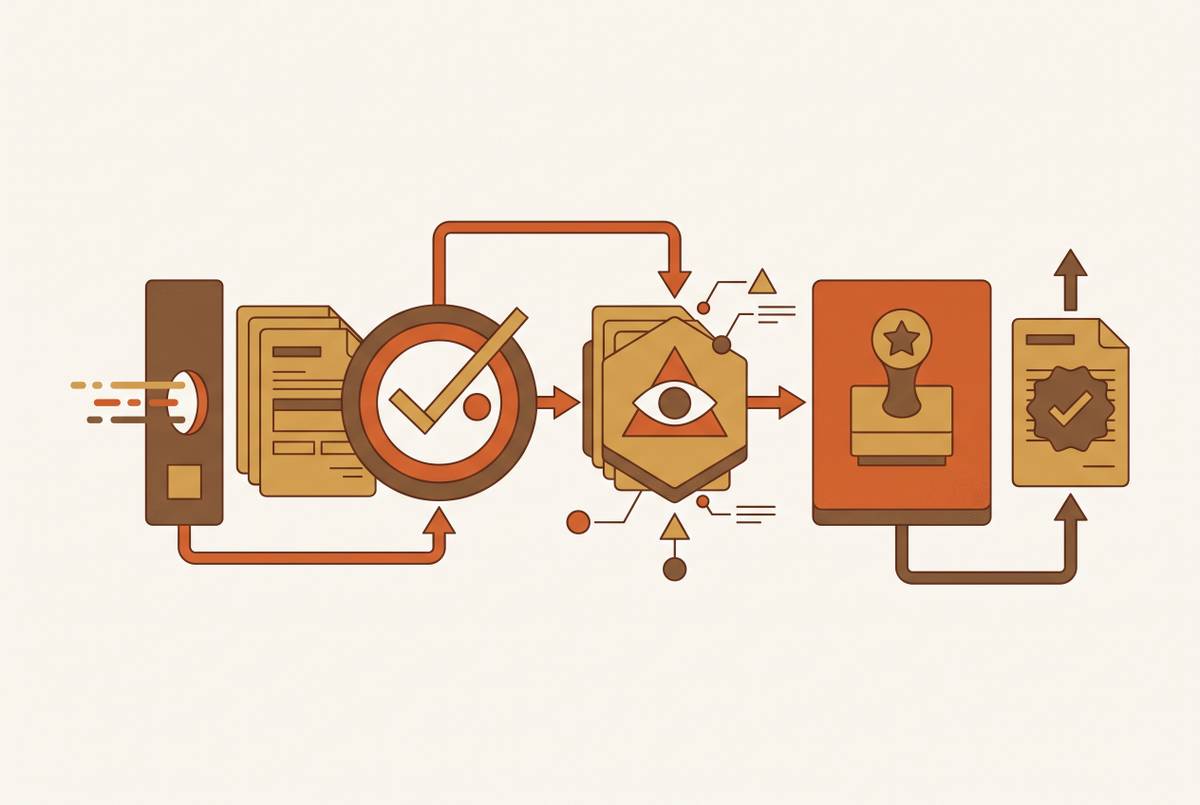
Vision-based parsing gets this right in a way character-first approaches structurally can't. Instead of reading text first, it processes the page as a visual object, running element detection before it ever extracts a character, so it recognizes a grid of values under a header row as a table rather than a loose sequence of words scattered on a page. That distinction sounds academic until a parser drops a table, scrambles the reading order, or flattens a nested section. At that point every system downstream, payroll, the HRIS, the withholding engine, inherits the error with no way to know it happened.
For pipelines that feed output into an LLM or a retrieval system, the bar gets stricter still. The parser has to hand back structured Markdown or JSON with reading order intact, because a model reasoning over scrambled input produces scrambled conclusions no matter how good the model itself is. None of this can be trusted on the strength of a demo. A parser has to be benchmarked against the actual mess it will ingest, handwritten W-4s and skewed I-9 scans, not the clean sample PDFs a sales deck tends to feature.
How to measure extraction accuracy in a way that actually predicts production behavior
Character accuracy is the number vendors like to lead with, and it's close to useless for this workflow. A withholding allowance or a Social Security number can be 95% correct at the character level and still be entirely wrong as a field, since a single transposed digit fails the whole value. Field accuracy is the number that actually matters: was the correct value pulled for each specific named field. Document accuracy sits a level above that, the share of documents that came through with zero extraction errors anywhere on the page, and that's the figure that governs whether a zero-tolerance compliance workflow can run on autopilot.
Confidence scores need their own scrutiny, because a score is only useful if it's calibrated. A confidence of 0.95 ought to mean the value is correct 95% of the time, full stop. Systems that inflate their own confidence let wrong values sail through undetected, which is worse than having no confidence score at all, since it manufactures false trust instead of leaving the gap visible. Catching this takes a calibration test: pull a sample of extractions the system marked above 0.90 and check them by hand. If more than one in ten contains an error, the confidence scores are lying, and no amount of downstream validation fixes a lying score.
Calibration isn't uniform across field types, either. Numeric fields, an SSN, a withholding dollar amount, tend to calibrate well. Free-text fields run overconfident at the high end, reporting near-certainty on values that are often wrong. That split matters directly for any onboarding form, where numeric fields tend to be more trustworthy at high confidence while free-text fields need more scrutiny than their confidence scores suggest. A 2025 study on financial statement extraction found an average field-level confidence of 0.781 across a document intelligence model, with individual fields ranging from 0.675 on a payment due date up to 0.89 on a minimum payment amount. That spread, on a single document type, is the whole argument against trusting one aggregate confidence number.
Routing on confidence works, and it's measurable, which is the part vendors leave out when they'd rather sell full automation. One extraction system, EXTRACTCONF, hit 99.1% automated accuracy at 80% coverage, a 25.8 percentage-point jump over its 73.3% base rate, simply by sending the uncertain fraction of extractions to human review instead of forcing everything through the automated path. Coverage and accuracy move against each other, and the right answer is to route the low-confidence tail to a person, not to chase 100% automation and write off the errors as overhead. ExtractBench, a recent benchmark, supplies the sobering counterpoint: frontier models attempting complex schema extraction returned valid JSON only 51% of the time, with an aggregate field-level pass rate of 4.6%. Even strong models produce structurally broken output on a complicated schema. No vendor number substitutes for testing against an actual onboarding document corpus, since field accuracy shifts by domain and field type.
Field-level validation and compliance-aware routing for onboarding documents
Confidence threshold routing is the mechanism that turns these accuracy numbers into an operational decision. Set a threshold appropriate to each field's risk profile, and anything below it gets routed to a human before it ever reaches payroll or the HRIS. Push the threshold higher and automated accuracy improves, but so does the review queue. Lower it and more volume clears automatically, at the cost of more errors slipping through. The threshold belongs at the field level, not the document level: a W-4's SSN field and its handwritten name field don't carry the same risk profile, and treating them identically wastes review capacity on the field that never needed it.
Confidence scoring alone isn't the full validation layer, though. Tax forms need rules that check the actual content against what's legally valid. Tax forms need rules that check each extracted value against what's legally valid for that specific field: format constraints, enumerated options where applicable, and numeric fields that must fall within defined ranges. An I-9's document fields have to satisfy the form's legal requirements, with document types, expiration dates, and section completion details each checked against the rules that govern them. State withholding forms need their state-specific fields checked for completeness, and any employee working across state lines needs a separate validated record per state, not one merged form standing in for two obligations.
When a field fails one of these rules, the system should trigger a targeted re-extraction attempt or send it to a human. Silent failure that moves downstream anyway is the one outcome the pipeline can't afford. Every extracted field also needs an audit trail sufficient for a compliance audit to reconstruct how a given extraction decision got made, not just what the final value was.
The liability angle is what makes all of this non-negotiable. A W-4 extraction error doesn't surface on its own. It surfaces later, when the IRS flags under-withholding, and at that point the employer carries the downstream consequences of that error, not the vendor that built the parser. Field-level validation is the control that closes that gap before it opens, and one more requirement sits right alongside it: Onboarding documents carry sensitive personal information, so any pipeline that retains document images or extracted fields beyond operational necessity introduces additional data-handling risk on top of the extraction risk already being managed.
Why building this pipeline in-house costs more than it appears to
Self-hosting a parsing stack at modest scale runs somewhere in the $15,000 to $40,000 range annually, and that figure excludes engineering time, which turns out to be the harder cost to absorb. Maintaining OCR dependencies, resolving library version conflicts, and writing custom preprocessing for every new edge case eats up something like 20 to 30 percent of an engineer's working hours each quarter, on an ongoing basis, not as a one-time setup cost.
Open-source stacks fail in three compounding ways, and the failures don't stay isolated. The OCR library, the layout detection model, and the format handlers each run on their own release schedule, and upgrading one tends to break compatibility with the others. There's usually no production monitoring or confidence scoring built in from the start, so accuracy regressions go unnoticed until payroll or compliance failures pile up downstream and someone finally traces the problem back. And every new state withholding form or IRS layout revision needs its own template and its own regression test, so the maintenance burden grows in direct proportion to how many document types the pipeline has to handle.
A five-year total cost of ownership analysis on build-versus-buy decisions for this kind of infrastructure points to technical labor as the largest cost driver: engineering time dominates in year one, with ongoing maintenance, security, and operational overhead compounding the total on a present-value basis. Accuracy doesn't level off and stay level, either, and keeping pace with how fast vision-language models evolve turns into something closer to a full-time engineering assignment than a side project.
Onboarding documents carry a specific version of this problem. The forms that break an in-house pipeline, handwritten W-4s, skewed I-9 scans, a state's new form layout, don't arrive on a predictable schedule. They show up irregularly, which makes them nearly impossible to write into a test suite ahead of time and expensive to patch one incident at a time after the fact. Building in-house makes sense in a few narrow situations: strict data residency mandates, low-volume pipelines running highly consistent layouts, or teams that need deep customization at the library level. Most onboarding pipelines operating at any real scale don't fit any of those, and pretending otherwise is how the $40,000 line item quietly becomes a permanent headcount.
What to require from a production API for tax form ingestion
Accuracy needs to show up in the contract, not just the marketing page. A vendor that won't commit to a field-level accuracy rate in an SLA is quietly handing all the extraction risk back to the customer, which matters enormously when the customer's downside is an IRS under-withholding penalty or a DHS I-9 fine. The question worth asking directly: what's the per-field accuracy rate against ground truth on your own document corpus, and is that number written into the agreement or just implied by a sales deck?
A handful of technical requirements follow from everything above. The API needs to handle handwriting natively, since additional withholding amounts and names on paper W-4s are commonly handwritten, without a separate preprocessing step bolted on beforehand. It needs OCR built to handle skew, low resolution, and physical scan artifacts, since I-9s regularly arrive as phone photos rather than clean scans. It needs to support multiple form schemas, since W-4, I-9, and state withholding forms all carry distinct field structures, and it needs to return validated, structured JSON per schema instead of generic dumped text. It needs field-level confidence scores, not a single document-level score, because routing decisions have to happen field by field in a compliance workflow. And it needs a feedback loop where human corrections actually retrain the model, otherwise the same handwriting pattern or the same unusual state form layout keeps failing the same way indefinitely.
Security requirements follow the same logic as the compliance argument above. Zero data retention on SSNs, citizenship status, and identity document numbers isn't a policy checkbox. It's a design requirement the infrastructure has to enforce structurally, not a promise buried in a terms-of-service page. Relevant certifications for this kind of document processing include SOC 2, GDPR, and ISO 27001, and employers with data residency obligations should be able to choose EU or US region processing, or an on-premise deployment, rather than accept one fixed location by default.
Pricing structure ends up being a useful signal on its own. An API that charges per page regardless of whether the extraction came back correct has no financial reason to chase accuracy improvements, since the vendor gets paid either way. A pricing model built around paying only for correct extractions turns accuracy into a commercial obligation the vendor has to keep earning, rather than a claim made once in a sales call and never revisited.