Schema Enforcement for Structured Document Output
Treating schema enforcement as a final step costs teams far more than catching it early.

Schema enforcement for structured document output decides whether an extraction pipeline survives production or fails quietly somewhere downstream. Most teams treat it as a formatting pass, something that tidies up the JSON after extraction already happened. Enforcement bolted on at the end covers far less ground than teams assume, because real enforcement runs at every stage: inference, field validation, routing, and the point where a downstream system actually consumes the output. Treating it as a final polish step is the most common mistake in this discipline, and it costs the most to unwind later, because by the time it fails, the failure is buried three systems deep.
"Structured output" in a document context needs more than valid JSON syntax. It means field values that match their declared types, fall inside expected ranges, satisfy required-field rules, and hold up against what the document actually says. A pipeline that returns perfectly formed JSON with the wrong invoice total has failed just as badly as one that returns broken JSON; the difference is that the first failure surfaces later, in a system with no way of knowing the number is wrong. Accounts payable platforms, mortgage origination systems, insurance adjudication engines, and EHR integrations all share the same gap: none of them have a human checking each record before it moves. One unexpected null or type mismatch cascades into a rejected batch, a stalled workflow, or a record that gets accepted and quietly corrupts a downstream ledger.
What breaks when schema enforcement is absent
Three failure patterns show up often enough to name, and none of them come from unusual documents. A scanned purchase order returns field labels merged directly into the values, so "Total: $4,200" becomes the content of the total field instead of the number itself. An insurance claim form loses two whole sections because the parser can't handle the embedded fonts in the layout. A financial statement produces text that reads cleanly to the eye but contains mid-sentence line breaks, which then break every downstream regex built to parse it. These weren't edge cases pulled from a stress test; they were the first three documents in a real client folder.
What connects them: the extraction step produced output that was structurally wrong in ways that would have been caught immediately, had anything checked the structure at the moment it was generated instead of after the fact. Prompt-only extraction, a raw call to a language model with no constraint layer, fails structurally on a meaningful share of production runs. The gap between how a system performs on a demo document and how it performs on the two-hundredth document in a real folder is exactly where these pipelines break.
Confidence miscalibration compounds the problem and is a particularly dangerous failure mode because it stays invisible until an audit finds it. A system that reports high confidence on a wrong extraction carries more risk than one that reports low confidence, honestly, on a value it got wrong; the second case routes to a human, the first doesn't. Field-level confidence also varies far more than teams expect. An aggregate confidence score across a document set might sit around 0.781, but that number buries enormous variance: payment due dates might average around 0.675 while minimum payment amounts average closer to 0.89. One aggregate figure says almost nothing about where the risk actually sits in a team's own documents.
Enforcement at the extraction layer catches this early, because nothing else will. Left uncaught, it surfaces downstream as reconciliation failures, rejected API calls, or compliance audit exceptions, and by that point, tracing the root cause takes far longer and costs far more than catching it at the point of generation.
Some of this damage happens before a language model ever touches the document, because plain OCR reads characters, not structure. It can pull the correct string of digits out of a table cell with zero understanding of which field that cell belongs to. Schema violations, in other words, start upstream of any LLM or parsing model, baked into the raw extraction layer itself.
The syntactic compliance trap: why schema shape is not schema correctness
Constrained decoding solves a real problem, but a narrower one than most teams assume: schema compliance and extraction correctness are not the same claim, no matter how often vendors let the first stand in for the second. Mechanically, a logit processor masks invalid tokens at each generation step, so the model can only produce tokens that keep the output conformant with a declared schema. The model's weights never change; only the sampling distribution at each step gets constrained. What this guarantees is structural validity: required fields show up, types match, the JSON parses. That's it.
Correctness is a separate question entirely. Constrained decoding cannot confirm that the value sitting in the invoice_total field is the actual invoice total rather than a plausible-looking number pulled from the wrong line. Neither can it confirm a date field holds the right date instead of a syntactically valid but wrong one, and it will not catch a missing value that got silently defaulted to null instead of flagged as absent.
A vendor can truthfully advertise "100% schema compliance," and mean it, while still extracting the wrong values at a meaningful rate. That claim is misleading without technically being false, because schema compliance measures shape, while whether the content inside that shape is correct is a different question entirely. Treating compliance as the headline metric risks a category error for anyone actually trying to judge a production pipeline.
Schema design itself isn't neutral either. Research on reasoning tasks has found that placing reasoning fields before answer fields in a schema can improve reasoning accuracy, because it lines up with how the model generates tokens left to right: it reasons its way toward an answer instead of committing to one and rationalizing it afterward. Field ordering is an engineering decision with measurable downstream consequences, not a stylistic preference.
Constrained decoding is necessary, but it settles little on its own, which is an uncomfortable conclusion for teams that stop there and call the job finished. Every model response has to get treated as untrusted data until it clears semantic validation, well past a mere syntax check. This is the gap most teams find after launch, once the test set that looked clean stops being representative of what actually shows up.
How schema enforcement operates across the pipeline stages
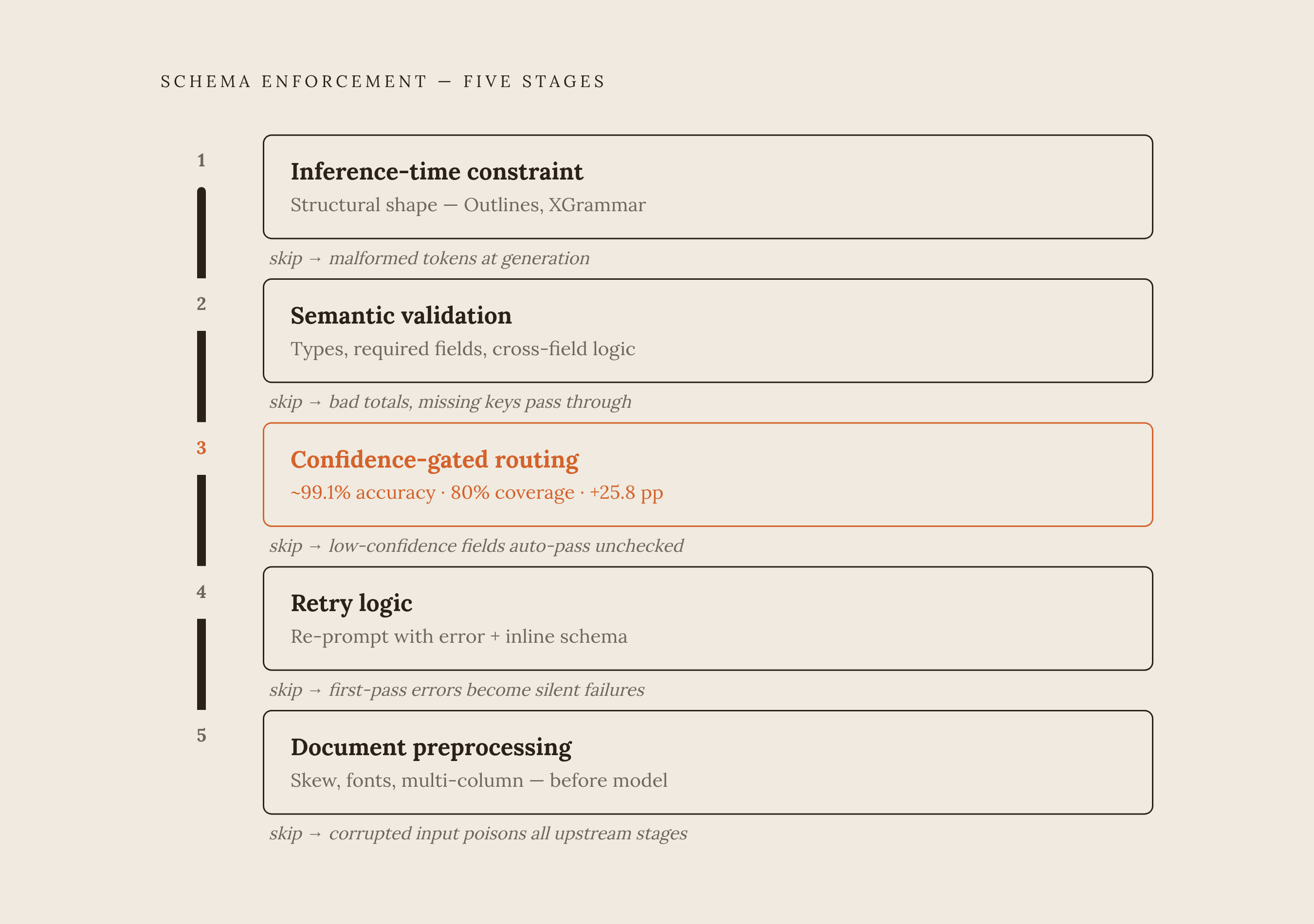
Enforcement isn't one mechanism. It's five, stacked in sequence, and skipping any one of them reopens the exact failure the others were built to close.
Inference-time constraint comes first. Frameworks like Outlines, LM Format Enforcer, or XGrammar (the default backend for vLLM and SGLang as of early 2026) enforce structural shape during generation itself, well before any after-the-fact cleanup could catch it. XGrammar in particular is designed to keep per-token overhead very low for JSON generation, so structural enforcement at this stage costs almost nothing in latency. Coverage still varies by framework, though: benchmarking across real-world JSON schemas has found meaningful gaps between frameworks, with the best-performing options supporting substantially more schemas than the weakest ones. Simple schemas rarely expose that gap; complex, nested, real-world schemas are where it shows up.
Post-generation semantic validation comes next, and this layer catches everything constrained decoding structurally can't. A code-based validation framework checks the generated output against the full object model: types, required fields, value constraints, cross-field logic. This is where domain rules actually live: an invoice total that has to equal the sum of its line items, a date that has to fall inside a valid range, a tax ID that has to match a required format. JSON mode without this layer is a delivery constraint rather than a logic guarantee, and treating it as one is where a lot of pipelines quietly go wrong.
Confidence-gated routing decides what happens after validation. Field-level confidence scores determine whether an extracted value passes downstream automatically or gets sent to a human reviewer. The trade-off here is measurable: research on multi-signal confidence estimation shows that holding back the lowest-confidence extractions for review, instead of passing everything through, can push automated accuracy to around 99.1% at 80% coverage, a 25.8 percentage-point gain over the unfiltered baseline. Calibration isn't uniform across field types, though, and confidence scores can vary substantially depending on the nature of the field being extracted. One threshold applied across every field type will misfire somewhere.
Retry logic handles the recoverable failures. When a generation fails validation, a structured re-prompt that includes the actual error message and a compact inline schema example gives the model what it needs to self-correct. A small number of retries is a reasonable ceiling; past that point, additional attempts are unlikely to resolve the underlying issue and the extraction should route to human review.
Document preprocessing sits underneath all of it, and it's the stage most teams underrate. No amount of downstream enforcement makes up for corrupted input upstream. Skewed scans, embedded fonts that break character extraction, and multi-column layouts that merge field labels into values all produce output that looks structurally plausible, passes every syntax check, and is wrong underneath. A frontier model reading OCR noise doesn't know it's reading noise; it generates confident tokens about garbage with the same fluency it would apply to clean text, which is exactly why so many production extraction errors trace back to the document, not the model.
Measuring whether schema enforcement is actually working
The most commonly cited accuracy figure in this space, "high accuracy," almost always refers to character accuracy: did the system read the characters on the page correctly. That number says close to nothing about whether the correct value landed in the correct field, since character accuracy and field accuracy are different measurements, and only one of them matters to a downstream system deciding whether to pay an invoice.
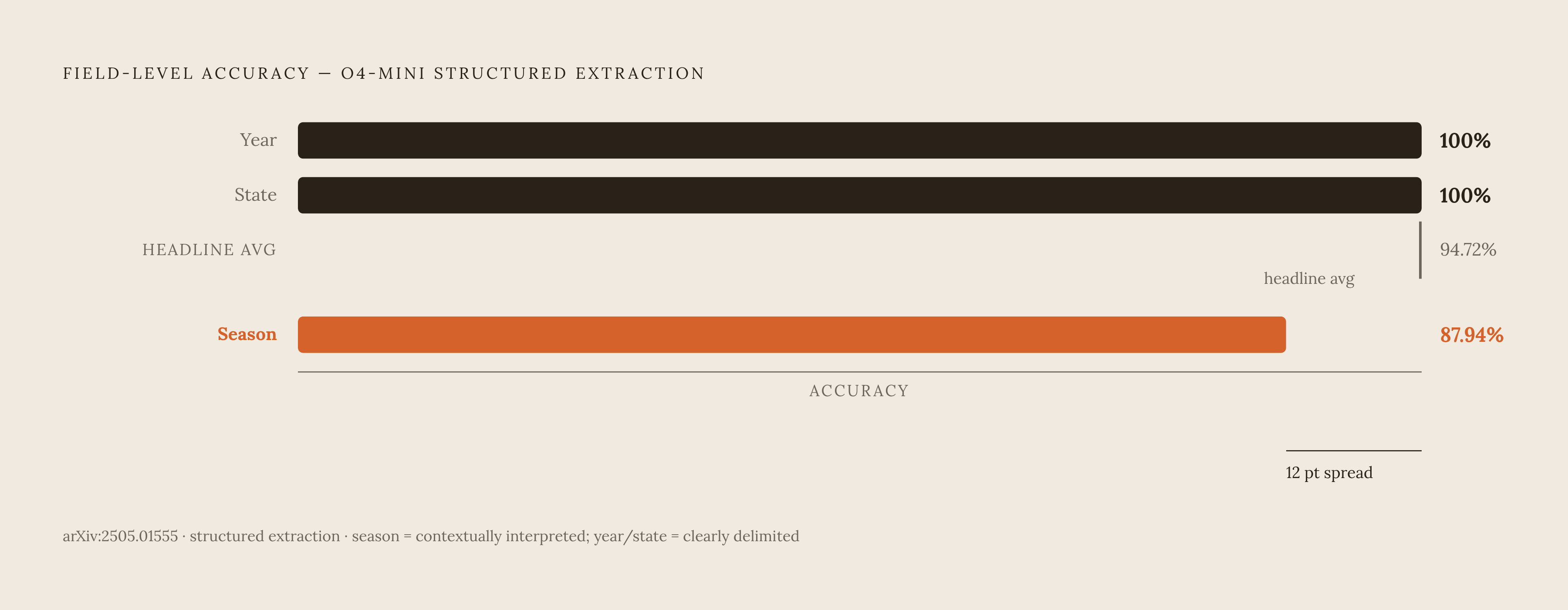
Field accuracy, meaning whether the correct value was extracted for each declared schema field against real ground-truth annotations rather than the model's own self-reported confidence, is the number that actually predicts production behavior. Even that figure hides variance once anyone looks underneath the aggregate. Research using o4-mini on structured document extraction found overall field-level accuracy of 94.72%, according to arXiv:2505.01555. Underneath that, accuracy ranged from 100% on clearly delimited fields like year and state down to 87.94% on fields that need contextual interpretation, like season. The single headline number hides exactly where a team needs to spend its engineering effort.
Calibration itself needs auditing, not assuming. A practical check: sample extractions the system marked at high confidence and verify them by hand. If errors appear at a meaningful rate, miscalibration is the likely diagnosis, and every routing threshold built on top of those scores becomes unreliable by extension. This matters more than it sounds, because model-internal confidence signals can offer limited real separation between an extraction worth trusting and one that isn't. Confidence signals need to draw on multiple sources and account for document quality, well beyond the model's own internal probability estimate.
The highest-leverage investment most teams can make in evaluation is a CI/CD eval gate: a suite that runs on every pull request and blocks a merge if any field-accuracy metric drops below its threshold. A separate regression check matters too, apart from the absolute floor, because a faithfulness metric in steady decline could still clear an absolute floor and pass the gate, even though it represents a real and compounding loss of quality that the threshold alone would never catch.
One evaluation approach worth naming directly is a schema-driven method that assigns a declared metric per field type instead of one scoring rule for everything: exact match for identifiers, semantic equivalence for free text, and a similarity threshold for fuzzy matching. Field evaluation has to match the field's semantic type, because one uniform scoring rule applied across a schema with a dozen different field types measures the wrong thing for most of them.
Vendor accuracy claims that show up without per-field ground truth behind them are marketing, not evidence. The risk they don't quantify gets absorbed entirely by the customer who takes them at face value.
Where the build-vs-buy decision intersects schema enforcement complexity
Teams scoping an in-house build tend to underestimate what the enforcement stack actually is. It's constrained decoding configuration, a semantic validation layer, per-field confidence calibration, routing logic, retry architecture, preprocessing quality, and a continuous evaluation harness, all running at once, and every piece needs upkeep as documents, models, and downstream systems keep shifting underneath it.
Initial development is rarely the dominant cost. Ongoing maintenance, meaning edge-case handling, schema updates, model version compatibility, and the evaluation infrastructure itself, compounds faster than most project plans account for. There's a volume threshold where self-hosting starts to pencil out: a substantial and sustained document volume, and only with dedicated engineering capacity maintaining the pipeline. Below that volume, the engineering overhead eats whatever per-page savings the self-hosted setup was supposed to deliver, and most teams evaluating build-vs-buy below that line have already decided against build without admitting it to themselves.
There's also a ceiling most teams don't see coming until they hit it. A large share of in-house parsing pipelines never make it to production, and the common cases aren't what stops them. The edge cases compound instead, and the specific failure modes described earlier, embedded fonts, multi-column merges, and scanned skew aren't rare exceptions that emerge only after extended production exposure. They are characteristic of real document sets from the outset.
Here's what most teams get backwards: a single well-built model looks simpler on a whiteboard, but it carries one point of collapse, and everything downstream of it goes down together. Purpose-built platforms made of specialized components that get monitored, tested, and improved independently tend to beat DIY builds on both accuracy and uptime, largely because a failure in one component doesn't drag the rest of the system down with it. The stacked system, the one with five separate pieces instead of one clean model, tends to fail more gracefully. Betting on the single model because it seems easier to reason about carries real risk teams underestimate, and it is, on the evidence, the wrong bet more often than not.
For teams evaluating a vendor instead of building, a few things separate a production-grade extraction API from one that only looks production-grade in a sales deck. Per-field accuracy measured against ground truth, not an aggregate character-accuracy number, matters more than any other single figure, and a contractual accuracy commitment matters too: if a vendor won't put accuracy into an SLA, the customer is the one holding the risk. Field-level confidence scores need a documented calibration method behind them, not just a number with no explanation of how it was derived. Zero data retention should be the default, since documents carrying financial and personal information have no reason to sit on vendor infrastructure once processing finishes. Continuous learning from corrections lets the system improve specifically on the document types a given customer actually sends it, rather than staying frozen at whatever accuracy it shipped with. Security certifications, SOC 2, GDPR, ISO 27001, and deployment flexibility, region isolation or an on-premise option, matter for regulated industries that require them. A pricing model tied to correctly extracted pages, rather than pages merely processed, is one of the few structures that actually lines up vendor incentive with pipeline accuracy instead of volume.
Schema enforcement as an ongoing operational discipline, not a launch checklist item
Document formats change, model versions update, downstream system contracts evolve, and new document types get onboarded on a timeline nobody planned for at launch. Schema enforcement that was correct on day one drifts without active maintenance behind it, and setting it up correctly once does not survive contact with a moving pipeline.
Continuous learning is one of the mechanisms that keeps enforcement current instead of static. A system built to learn from human corrections on low-confidence or failed extractions improves its field-level accuracy specifically on the document types the pipeline actually processes in production. That improvement marks the real line between a document AI product and a static OCR tool deployed once and left to drift slowly out of sync with the documents it's supposed to read.
The evaluation harness is the infrastructure that makes any of this observable. CI/CD eval gates, per-field accuracy tracking against ground truth, and regular calibration audits work as the mechanism that lets a team catch enforcement quality drifting before a customer or a downstream system finds it first. None of this is optional instrumentation bolted on for compliance's sake.
Teams that skip validation layers, confidence calibration, and eval infrastructure during the initial build are deferring a cost, not saving time. It comes due as a production incident: a reconciliation failure, a compliance exception, a batch of downstream rejections, landing at whatever moment is least convenient to trace back to its source.
Done properly, schema enforcement is what lets a downstream system trust its inputs without checking them by hand. That trust is the actual product: the difference between a document extraction pipeline that works as a foundation for automation and one that quietly becomes a permanent source of manual cleanup, no matter how clean its output looks on the surface.