Utility Bill Extraction for Tenant Onboarding and KYB
Extraction accuracy on utility bills determines whether compliance checks stall or proceed.

Utility bills are the shakiest document type in KYC and KYB workflows, and their inconsistency has a direct cost: every misread field, whether it's a transposed digit or a misplaced address line, turns a routine compliance check into a manual review or an outright rejection. This piece breaks down why extraction fails on utility bills specifically, what the accuracy numbers actually show once you look past vendor marketing, and what a production-grade pipeline needs to catch the errors that OCR alone will always miss.
Where utility bills sit in KYC and KYB compliance workflows
In KYC, a utility bill is the proof-of-address leg of identity verification. A government ID confirms who someone is; the utility bill, paired with it and dated within the last 90 days, confirms where they live. The extracted address gets cross-matched against the address declared on the ID, and if the two don't line up, the application stalls.
KYB extends the same logic to businesses. A utility bill verifies a company's registered or operating address, sitting alongside incorporation certificates and beneficial ownership records as part of the entity-level document package. The bill isn't the star of the file, but it's often the tiebreaker: the document that either confirms a business actually operates where it claims to, or raises a flag that sends the whole application to a compliance analyst's desk.
None of this works if the extraction underneath it is sloppy. A transposed digit in an account number, a misread issue date, an address line split across two OCR blocks: each of these produces a false mismatch, and false mismatches trigger manual review or rejection regardless of whether the applicant did anything wrong. The compliance check is only as good as the text pulled out of the PDF.
Regulatory pressure is narrowing the room for that kind of error. The EU's Anti-Money Laundering Authority began operating in July 2025, and the directly applicable AML Regulation rulebook takes effect in July 2027, replacing a patchwork of national rules with enforceable, EU-wide standards on extraction and retention. Compliance teams building or buying utility bill pipelines are now working against a real deadline, not an abstract best practice.
The business case cuts both ways. Slow onboarding costs money: per Fenergo's 2025 survey of senior executives, a large majority of financial institutions lost clients the previous year because onboarding took too long, up sharply from 2023, and AML/KYC operations now cost these firms hundreds of millions of dollars a year in aggregate. Compliance risk sits on one side of the ledger, client attrition on the other, and extraction accuracy sits in the middle of both.
How standard OCR fails on utility bills specifically
Character accuracy and field accuracy are not the same thing, and vendors rely on customers not noticing the difference. A clean digital PDF can produce near-perfect character recognition while still putting the right value in the wrong field: an account number read correctly, but assigned to the "reference number" slot instead of "account number." Field accuracy, meaning whether the correct value landed on the correct named field, is what compliance logic actually checks. When a vendor advertises very high accuracy, that number is almost always character accuracy. Field accuracy and full-document accuracy are separate, and lower, numbers.
Layout errors cascade. A small mistake in how the page's layout gets parsed, a column boundary drawn one pixel off, propagates through every step downstream: text blocks fragment, two separate fields merge into one string, an address line breaks in the middle of a street name. On a utility bill specifically, this shows up in a handful of predictable ways. The issue date gets confused with the due date or the billing period end, since all three often sit within a few lines of each other. Service address and billing address, two distinct blocks on the same page, get flattened into one. The provider name, frequently rendered as a stylized logo rather than plain text, gets degraded or dropped by OCR entirely. The account number, sitting near meter IDs and reference numbers that look almost identical in format, ends up mislabeled.
Then there's the input itself. A tenant photographing a crumpled bill on a kitchen counter, at an angle, under yellow lighting, produces an image that even strong OCR engines struggle with. Research on document parsing suggests that without preprocessing steps built specifically to handle low resolution and skew, a meaningful share of key fields simply gets missed before extraction even starts.
Rigid template matching makes this worse, not better. A pipeline built around fixed templates for known providers works fine until a provider updates its bill design or a new provider enters the market, at which point the pipeline doesn't fail loudly. It degrades quietly, returning plausible-looking but wrong values that pass a naive accuracy check and fail a real one. In practice, the investment that moves the accuracy needle most is preprocessing, not the OCR engine itself: document quality signals predict failure better than model confidence scores do on their own.
What field-level accuracy benchmarks actually show about extraction in production
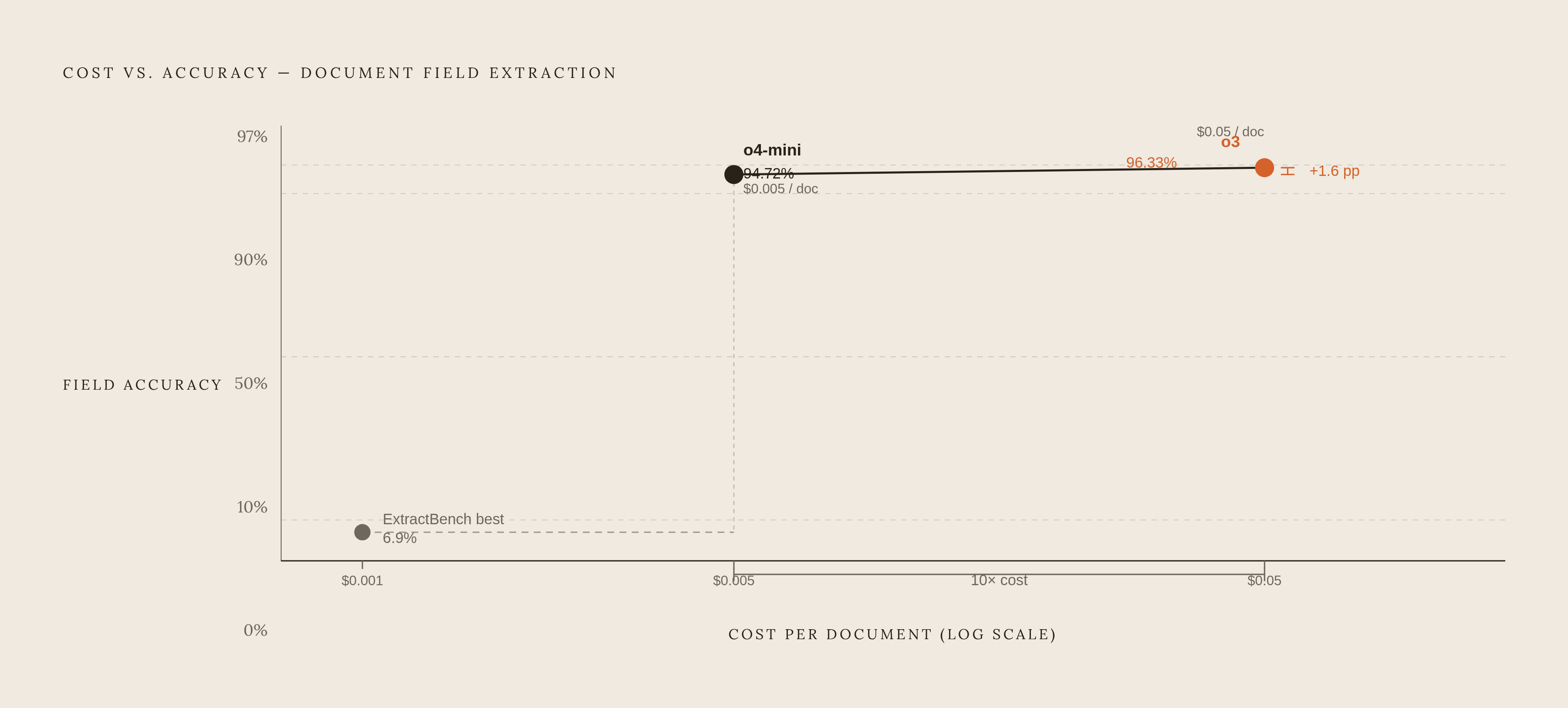
The numbers here are worth sitting with. ExtractBench, a benchmark testing frontier large language models across 210 extraction attempts on complex schemas, found a 51% valid JSON rate and an aggregate field-level pass rate of just 4.6%. The best model in the study hit 6.9%. Those are not typos: producing syntactically valid output and extracting the correct value are two separate problems, and most models fail the second one even when they clear the first.
Narrow the lens to cases where models did produce valid output, and the picture improves, but not by as much as vendor claims would suggest: aggregate field accuracy across valid extractions in the same study landed at 72.9%. That's the floor a production pipeline needs to build above, not the ceiling it's already reached.
A separate field-level study using 200 documents and the o4-mini model found per-field accuracy ranging from 87.94% to 100%, averaging 94.72% overall. The spread matters more than the average: field type drives as much variance as model choice does. Some fields are just structurally harder to extract correctly than others, regardless of which model is doing the extracting.
Cost complicates the picture further. That same o4-mini setup ran at roughly $0.005 per document. Stepping up to o3 raised accuracy to 96.33%, a gain of about 1.6 percentage points, at roughly $0.05 per document, ten times the cost. For a lender processing a few hundred applications a month, that trade might be worth it. For an onboarding pipeline processing tens of thousands, it's a serious line-item decision, and the right answer depends entirely on which field accuracy a given compliance check actually requires.
The lesson for utility bills specifically: provider name, address, account number, and issue date need to be benchmarked individually against ground truth, field by field. An aggregate accuracy number, even a good one, hides which of the four is quietly failing.
Why confidence scores are the critical signal in a utility bill extraction pipeline
A confidence score only means something if it's calibrated. A score of 0.95 should mean the extracted value is correct at that rate at that threshold; a poorly calibrated system reports high confidence on wrong answers just as often as right ones, which defeats the entire point of having a score in the first place.
Calibration quality isn't uniform across field types. Numeric fields, like account numbers, tend to calibrate well: a model is either confident and right or unsure and flags it. Free-text fields, provider name and service address especially, show a pattern of overconfidence at exactly the probabilities where a human would expect the model to be most reliable. A pilot document intelligence audit reported an average field-level confidence of 0.781, with real spread underneath that average: minimum payment amount scored 0.89, statement balance 0.779, payment due date only 0.675, tracking roughly with how structurally and semantically complex each field is to pin down.
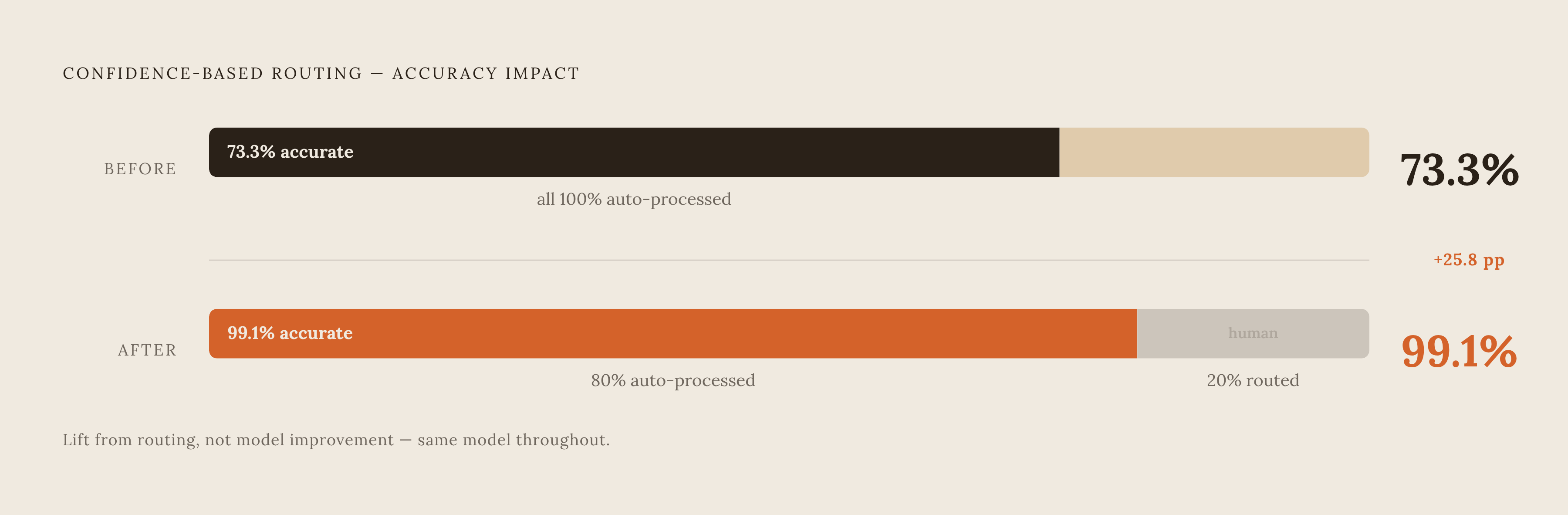
Multi-signal confidence systems close that gap. One such system, EXTRACTCONF, reached 99.1% automated accuracy at 80% document coverage, a 25.8 percentage-point improvement over its 73.3% baseline, by routing the remaining 20% of low-confidence documents to human review instead of forcing every document through the same pass/fail gate.
That routing logic is the operational core of a working pipeline. Thresholds need to be set per field, not per document: a bill can clear the confidence bar on provider name and account number while failing it on issue date, and only that one field should route for review. The math behind this is straightforward. A wrong address that auto-approves costs far more, in compliance risk, than the operational cost of a human glancing at one flagged field. And because document variants keep multiplying as new providers and bill formats show up, a confidence threshold calibrated at launch will drift; running continuous benchmarks against a fixed set of canary documents is what catches that drift before it shows up as compliance failures.
The validation layers a production utility bill pipeline must include beyond OCR
OCR produces raw text. Extraction assigns that text to named fields. Validation checks whether those assignments actually make sense. These are three different jobs, and a pipeline that treats them as one step is skipping the part that catches errors before they reach a compliance officer.
Date validation has to do real work, not just parse a string. It needs to normalize whatever date format the bill uses, whether that's DD/MM/YYYY, "Month DD, YYYY," or a two-digit year abbreviation, then check that the date falls inside the 90-day recency window KYC and KYB rules require. Just as important, it needs to catch the case where the parser grabbed a due date or a billing period end instead of the actual issue date, since those three dates often sit stacked on top of each other in the same corner of the bill.
Address validation means telling service address and billing address apart, since they play different compliance roles and conflating them produces a mismatch that isn't really a mismatch. The address then needs to be standardized into a canonical format before it's compared against the identity document, and geocoding it against a real-world location catches transposition errors that a pure text comparison would miss entirely.
Name matching needs fuzzy logic, not exact string comparison. Hyphenated last names, initials instead of full first names, transliterated spellings: exact match fails on all of these, and a match confidence score should be logged alongside the pass or fail result, not discarded once a decision is made.
Authenticity checks matter more for utility bills than for most document types, because they're easy to alter and commonly submitted as photographs or scans rather than verified digital originals. Tamper detection looks for inconsistencies in font embedding, metadata timestamps, and pixel-level artifacts that suggest editing. Redaction deserves specific attention here too: a visual overlay covering a line of text can look redacted while leaving the underlying text layer intact, so validation needs to confirm the text is actually gone, not just visually hidden.
When a field's confidence score comes in below threshold, the fix should be targeted. Route just that field for human review rather than kicking the whole document back through the pipeline. And every one of these decisions, the field-level score, the rule that triggered the flag, the reviewer's correction, needs to be logged. That log isn't just an audit trail. It's the ground-truth dataset that lets the model get better over time instead of repeating the same mistake on the next thousand bills.
How continuous learning separates a document AI pipeline from a static OCR tool on utility bills
Utility bill layouts don't hold still. Providers rebrand, regulators mandate new disclosure lines, paper bills give way to ePDFs with entirely different structure. A model trained on last year's set of layouts starts degrading the moment a new variant shows up, and it does so quietly.
That's the dangerous part. Accuracy drops on new document variants while staying steady on familiar ones, so the aggregate metric a compliance team is watching stays flat and reassuring even as a growing slice of documents fails on the fields that actually matter. Nobody notices until the wrong addresses start piling up in an audit.
Continuous learning is the fix, and it works by feeding human reviewer corrections back into the model as labeled training data. The pipeline improves on the specific failure cases it actually runs into in production, not on a fixed benchmark dataset that stopped reflecting reality months ago. For utility bills, this matters more than for almost any other document type in the KYC or KYB stack: a new regional energy provider, a telecoms company rebranding its invoice template, a local water authority redesigning its bill layout. None of these show up in a vendor's demo, and none of them get handled correctly unless the pipeline is built to learn from the ones it gets wrong.
That correction loop isn't free to build. Fewer than one in ten in-house document parsing pipelines make it to production, and the reason is almost always the same: edge cases pile up faster than the team maintaining the system can keep up with. Continuous learning is itself a significant engineering commitment, not a checkbox. The honest question for any team evaluating its own setup: who owns the retraining cycle when a new bill format breaks the pipeline at two in the morning on a Tuesday?
The build-vs-buy decision for utility bill extraction at scale
Cheap inference has scrambled the old math on this decision. Open OCR pipelines can run on modest self-hosted hardware now, and managed vendors sell extraction by the page in bulk, so cost per page alone doesn't settle the question the way it used to.
Volume is what actually settles it. Against a managed parser, a self-hosted pipeline staffed by even a quarter-time engineer doesn't pull ahead until volume reaches roughly 50,000 invoices a month, around 200,000 pages. At that point the numbers are close to a wash, roughly $2,146 for self-hosted against roughly $2,000 for managed, according to a 2026 analysis from digitalapplied.com. The build case only gets genuinely stronger above that line. Most onboarding operations, particularly in SMB lending, property management, and insurance, never get there.
The bigger surprise is where the five-year cost of building in-house actually lands: not on infrastructure, but on labor. Technical staffing costs dominate the total, and the first-year cost of hiring the infrastructure and model engineers needed to keep a homegrown pipeline running typically exceeds what teams budget for going in. OCR software looks cheap on a price sheet because the license is cheap. The real cost is the human labor needed to turn raw extracted text into structured, validated fields, and that cost scales with volume; it doesn't shrink on its own the way infrastructure costs sometimes do.
For teams leaning toward buying, the evaluation checklist should demand specifics, not marketing copy. Field-level accuracy benchmarks broken out by field type, not one aggregate character-accuracy number. A contractual accuracy SLA: if a vendor won't put an accuracy commitment in writing, the customer is the one absorbing the error risk. Confidence scores and provenance data returned alongside the extracted values, not just the values themselves. A clear, written data retention policy, with zero-retention processing as the reasonable default for anything containing personal financial information. Human-in-the-loop routing with full audit logging built in. And a straight answer to how fast the system adapts when a new provider or a redesigned bill format shows up.
Data security requirements specific to tenant-submitted and KYB utility bills
Utility bills carry a specific kind of personal exposure: full name, home address, account number, and consumption history, often submitted by a tenant who has no real say in how the document gets stored once it leaves their hands. That makes the handling of these documents a security question as much as an accuracy one.
Zero-retention processing is the standard worth holding vendors to. A document extraction pipeline that retains a copy of every uploaded bill after processing is a liability sitting in someone else's server, and the credible default is deletion immediately after extraction completes, not deletion on request or deletion after some retention window measured in months.
Encryption needs to cover the document in both states: in transit as it moves from upload to processing, and at rest for whatever brief window it sits in a queue before extraction runs. Access controls matter just as much as encryption. Who inside a compliance team can view the raw uploaded bill versus who can only see the extracted, structured fields is a meaningful distinction, and a pipeline that doesn't support that separation is handing broader access than most workflows actually need.
KYB introduces a second layer worth noting: a business utility bill sometimes lists an address shared by multiple tenants or subletting arrangements, so the extraction system's confidence in matching that address to the specific entity under review matters as much as the raw accuracy of reading the address off the page. Getting the text right and getting the compliance judgment right are related but not identical problems, and a pipeline built only for the first one will still leave a business exposed on the second.