Data Quality Checks for Extracted Mortgage Loan Package Fields
Extraction catches numbers on a page, not whether they're accurate across a 300-page loan file.

Extraction pulls values off a page. It does not tell you whether those values are true, current, or consistent with the twelve other places the same fact appears in the file. That gap, between "the OCR engine read a number" and "the number is right," is where most mortgage data quality problems live. Closing it requires a system of checks built into the pipeline itself, not a review step tacked on at the end.
The common assumption in mortgage tech circles runs the other way: extraction is the hard part, and once fields are read off the page, the data is basically usable. Anyone who has looked at OCR output at scale knows better. Optical character recognition, and even the more advanced ML-based extraction models built on top of it, return values. They do not return verified facts. A model can read "$3,846" off a pay stub with high character-level confidence and still hand an underwriter a number that means nothing, because it doesn't know if it's weekly, bi-weekly, or monthly.
The scale of a typical loan file makes this worse, not better. A single package can run 300 to 700 pages and touch 30 to 50 distinct document types, and the same borrower fact, an address, an employer name, a monthly income figure, appears in several of them. Extraction alone has no way to know which instance is authoritative, or whether the five instances even agree with each other. Industry studies of manual mortgage processing have long put error and defect rates somewhere in the 10 to 15% range at the early stages of a file's life. Automation that skips validation doesn't fix that error rate; it just moves the same bad data downstream faster. It just moves the same bad data downstream faster, so the loan origination system, the underwriting engine, the QC team, and the compliance function all inherit whatever the extraction layer got wrong, usually discovering the mistake only after conditions have already been set and closing dates promised.
The argument here is straightforward: reliable mortgage data extraction depends on a layered system of field-level checks, cross-document validation rules, and confidence thresholds, and that layer has to live inside the pipeline, not in some downstream review queue. What follows maps the specific checks that matter for each major category of loan file data, then explains why routing decisions built on confidence scoring are what actually turn all of this into a usable system.
What a mortgage loan package contains, and why that diversity creates validation complexity
A loan package is a stack of varied document types, not one document type repeated. It's a stack that includes the standardized loan application form, pay stubs, W-2s, 1099s, full tax returns with Schedule C and Schedule E attachments, bank statements, credit reports, appraisals, an early cost-disclosure form, Closing Disclosures, verification forms (VOE, VOD, VOI), automated underwriting findings, the purchase contract, and whatever conditions or supplemental documents the underwriter later requests.
Each of those has its own layout, its own field vocabulary, and its own sense of time. A pay stub is a snapshot, true on the date it was issued. A tax return covers a full calendar year. A bank statement covers a rolling 30-day window. A Closing Disclosure is terminal: it's the final word on what the loan actually looks like at close, not a projection like the earlier cost-disclosure form that preceded it.
That mix creates a specific problem. The same underlying fact, a borrower's income, their address, their employer's name, gets restated across several of these documents, and each restatement uses different units, different formatting, and sometimes genuinely different numbers for legitimate reasons. A file with two borrowers, or a self-employed applicant with three years of Schedule C filings, multiplies this. Files running 500 to 2,000 pages are not unusual once loan complexity increases.
As a practical result, validation logic can't be generic. A rule built to sanity-check W-2 gross income is the wrong rule for Schedule C net profit, because the two numbers are computed differently and mean different things to an underwriter. Every check that follows in this piece is document-type-aware and field-type-aware by necessity, not by design preference.
Identity and borrower field checks: format, consistency, and cross-document matching
Borrower identity fields, name, co-borrower name, Social Security number, date of birth, address, employer name, are the foundation everything else in the file gets checked against. Get these wrong and every downstream comparison inherits the error.
Format checks come first and are the easy part. A Social Security number should be nine digits, shouldn't be a known invalid pattern like an all-zero segment, and shouldn't match a recognized test number. A name field shouldn't contain digits and should carry consistent casing. An address should parse into a valid postal format, with a state code that actually exists and a ZIP code that's plausible for that state. None of this is hard to check. It's just easy to skip.
Cross-document consistency is where the real value lies. The borrower name on the 1003 has to match the name on the pay stub, the W-2, and the bank statements, with some reasonable tolerance for a dropped middle name or a hyphen that shows up on one document and not another. A full mismatch, though, gets flagged. SSN matching gets zero tolerance: the number on the 1003 has to match the W-2 and the tax transcript exactly. A mismatch there isn't a formatting quirk; it's a fraud signal. Address checks need to distinguish between a borrower who legitimately hasn't moved into the property yet and an extraction error that garbled the property address. Employer name changes between the 1003 and the VOE happen for real reasons, job changes, acquisitions, but they need to be documented, not just waved through.
The stakes on identity fields go beyond tidy data. Errors in SSN and borrower ID fields touch credit checks, fraud review, and loan eligibility directly, and manual-process shops have historically shown higher rates of audit findings requiring corrective action than shops running structured software checks. Given that, identity fields deserve a high confidence bar before anything auto-passes. A low-confidence SSN read should route to a human, not slide through on the assumption that it's probably fine.
Income field checks: period normalization, field disambiguation, and multi-source reconciliation
Income is where extraction quietly breaks the most often, and the failure is almost never a misread digit. It's a missing unit.
An extracted income figure means nothing on its own. Is it weekly? Bi-weekly? Semi-monthly? Monthly? A bi-weekly gross of $3,846 annualizes to $100,000. Mistake that for a monthly figure instead, and the borrower's computed annual income drops to $46,152, which can push a debt-to-income ratio straight past the disqualification line. The fix is a firm rule: never extract an income number without extracting its pay period alongside it, and flag any income field that comes back without a period tag attached. Annualized pay stub income should also get checked against the gross income figure on the W-2, with some allowance for known deduction differences, but a gap beyond a reasonable range needs a flag.
Disambiguation matters just as much. Base pay, overtime, bonus, and commission need to come out as separate fields. Summing them into a single income number at extraction time destroys the underwriter's ability to apply qualifying guidelines correctly, since lending guidelines treat variable income very differently from base pay. If a role clearly carries variable pay but the extraction returns only one number, that's a flag, not a clean result.
Self-employed income is its own category. Schedule C net profit, Schedule E rental income, and K-1 ordinary income or loss each follow their own calculation logic, and extraction has to return the specific line items an underwriter needs, not a rolled-up total. Most programs require a two-year average, so the system needs to confirm the tax years pulled are consecutive and current, flagging single-year returns or any gap in the sequence.
One more check catches a lot of quiet drift: take the year-to-date figure on the most recent pay stub, divide by months elapsed, and see if it lines up with the stated monthly gross. A meaningful deviation points to a pay raise, a gap in employment, or an extraction error, and the system can't tell which without a human looking. Finally, the income stated on the 1003, the income derived from pay stubs, and the income shown on tax returns should all get compared against each other. A material gap among the three is a condition to resolve before underwriting.
Asset and bank statement field checks: balance ownership, deposit sourcing, and period coverage
Bank statements carry more structure than they get credit for: account holder name, partial account number, institution name, statement start and end dates, opening and closing balances, and the individual deposit and withdrawal lines, not just the net change.
Ownership is the first check. The account holder name on the statement has to map to the borrower or co-borrower identified in the loan file. Joint accounts need the account holder names identified, with at least one tying back to the borrower. A statement where the account holder name is missing or unreadable can't stand alone as asset verification. It needs supporting documentation before it counts.
Period coverage catches a different kind of problem. The loan program specifies how many months of statements it needs, and those months need to be consecutive. Pulling the start and end date off each statement and checking for continuity catches both a missing month and, just as often, a duplicate statement submitted twice under different filenames. Balance consistency follows from that: the opening balance on this month's statement should reconcile with the closing balance on last month's, and an unexplained gap between the two flags a sourcing problem.
Large deposits get their own attention, and for good reason. Extraction needs to capture individual deposit amounts and dates as well as the net balance change for the period. Any single deposit that appears unusually large given the account's activity should get flagged for reviewer follow-up. The extraction system cannot classify that deposit as a gift, a loan, or an undisclosed liability on its own, but it must surface it rather than let it disappear into an aggregated total. That aggregation problem occurs constantly on multi-column statement layouts, where deposits get merged or truncated during extraction. Checking that the number of extracted deposits is plausible given the account's actual activity level catches a lot of that. Finally, the closing balance on the most recent statement should be compared against the funds-to-close figure pulled from the Closing Disclosure, a check that only works if both documents are in scope for comparison at the same time.
Credit and liability field checks: completeness, DTI inputs, and URLA reconciliation
Credit report fields feed directly into the debt-to-income calculation, so an extraction error here doesn't just create a data quality problem, it can change whether a loan qualifies.
Every credit score needs a bureau name (Equifax, Experian, or TransUnion) and a pull date attached to it. A score with no date can't be judged for staleness, and the pull date needs to fall inside the program's required recency window. Tri-merge reports draw from all three bureaus, so extraction should confirm that each bureau's data is represented. If a bureau's output is missing, that warrants a completeness flag rather than an automatic pass.
Liability completeness needs to be checked on its own terms. Extraction should pull every open tradeline along with its balance and minimum payment, and a credit report showing an unusually small number of tradelines for the borrower's profile deserves a completeness flag rather than an automatic pass. Cross-referencing those tradelines against what the borrower disclosed on the 1003 catches a different problem: any account on the credit report that never made it onto the application needs a flag.
DTI depends on getting the minimum payment figure right, and that's a field that trips extraction up more than it should. The monthly minimum payment needs to come out as a monthly dollar figure, not an annual number and not a per-statement figure. Revolving accounts often state the minimum as a percentage of the balance rather than a dollar amount, and the system needs to know the difference and extract the actual dollar figure, not the percentage. Finally, delinquency codes, collection accounts, and public records need to come out as their own discrete fields, not folded into narrative text, since downstream eligibility rules can only evaluate a flag they can actually read as a flag.
Property, appraisal, and loan term field checks: value consistency and disclosure comparison
Appraisal and loan term fields carry the checks that most directly touch regulatory compliance, and that's where extraction errors get expensive fastest.
On the appraisal side, the property address needs to match the address on the 1003 and the purchase contract exactly, which usually means normalizing street abbreviations before running the comparison, since "St" and "Street" shouldn't trigger a false mismatch. The appraisal's effective date needs to fall inside the program's recency window, and an expired appraisal should get flagged before it ever reaches an underwriter's desk. Appraised value against purchase price matters too, since the loan-to-value calculation depends on whichever figure is lower, so extraction has to return both numbers and the system needs to confirm the LTV calculation used the correct one.
The comparison between the earlier cost-disclosure form and the Closing Disclosure is arguably the single highest-value cross-document check in the entire pipeline. The interest rate on the CD has to match the most recent LE, and any change needs a documented change of circumstance in the file. The loan amount needs the same comparison: some shifts are expected, a payoff adjustment, for instance, but others are errors that need catching before close. Cash to close on the CD should get checked against the closing balance pulled from the bank statement, and that comparison needs to get surfaced for a reviewer, not resolved silently. Fee itemization matters most of all here, because regulated fees on the CD have to fall within TRID tolerance of what the LE quoted; extraction must return fee-line-level detail rather than a single fee total. This is a compliance check, not just a data quality check. It's a compliance check, and getting it wrong carries regulatory consequences, not just underwriting friction.
One more plausibility check belongs in this category even though it doesn't decide anything on its own: comparing the loan amount to income and flagging a ratio that falls well outside the program's historical range. Extraction can't make an underwriting call, but it can put a flag in front of the underwriter before the file arrives on their desk.
Confidence thresholds as the basis for a routing system
None of the checks above matter if there's no mechanism deciding what happens when one fails. That mechanism is confidence scoring, and it needs to work at the level of the individual field, not the document as a whole. A pay stub can have a perfectly confident employer name right next to a garbled income figure, and treating the whole document as one confidence score throws away that distinction.
The operational logic is simple to state: fields that clear a high confidence bar move straight into the loan origination system and underwriting workflow automatically, while fields that fall below the bar get routed into a queue for a person to check before they touch any downstream process. That's the whole point of the exercise, getting the routing decision right often enough that automation actually saves time instead of just moving errors faster.
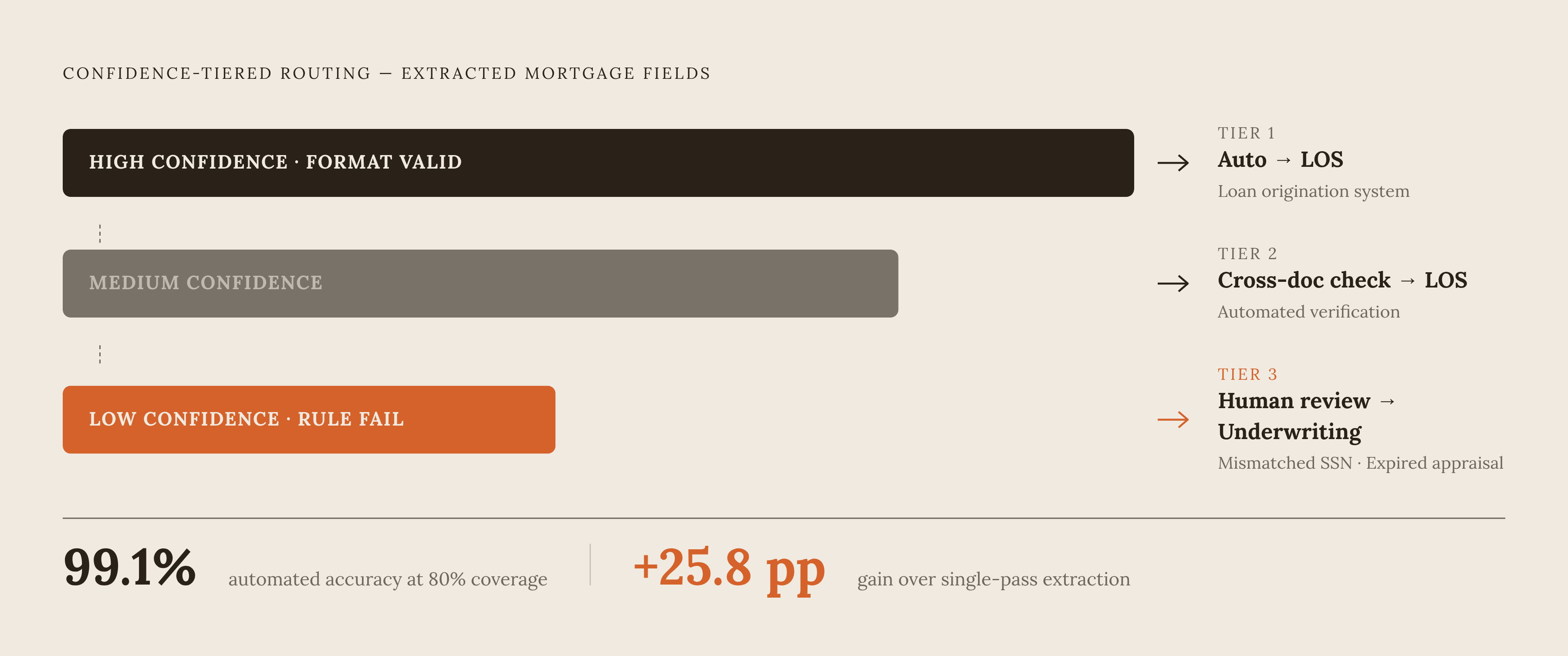
There's a real tradeoff buried in where that bar gets set, and it's fully configurable rather than fixed. Pushing the confidence threshold higher makes the automated output more accurate, but more documents land in the manual review queue, which costs throughput. Lowering the threshold raises automation coverage, but more extraction error slips through into business workflows unchecked. Research on multi-signal confidence approaches, the kind that combine several extraction signals rather than relying on a single OCR confidence score, has shown systems reaching around 99.1% automated accuracy at 80% coverage, a meaningful jump, on the order of 25.8 percentage points, over what base-rate extraction achieves without that layered confidence approach.
Calibration also needs to differ by field type as well as by document. Numeric fields tend to be well-calibrated: when the model says it's confident, it usually is. Free-text fields behave differently and show overconfidence even at high predicted probabilities, so a free-text field claiming a high level of confidence deserves more skepticism than a numeric field claiming the same figure. Per-field accuracy studies on structured documents back this up directly: one study with a sample of 200 documents found accuracy ranging from 100% on simple categorical fields like Year down into the high 80s on more complex fields, with something like an Agent field landing around 89.95% and a Season field around 87.94%. Mortgage fields of comparable complexity, variable income breakdowns, liability minimum payments stated as percentages, self-employment net income calculations, should carry lower auto-approve thresholds than a simple categorical field like loan type or property state.
In practice, that means building tiers into the pipeline rather than a single pass/fail gate. High-confidence, format-validated fields pass straight to the loan origination system. Medium-confidence fields get a lighter review, maybe an automated cross-document check rather than full human review. Low-confidence fields, and anything that fails a cross-document rule outright, like a mismatched SSN or an expired appraisal, go to a person before they go anywhere near underwriting. That structure is what actually makes the field-level checks described above valuable to build. A check nobody routes on is just a log entry nobody reads.