Root Cause Categorization for Recurring Document Exceptions
A shared taxonomy of failure types turns exception logs into diagnostic data for fixing root causes.

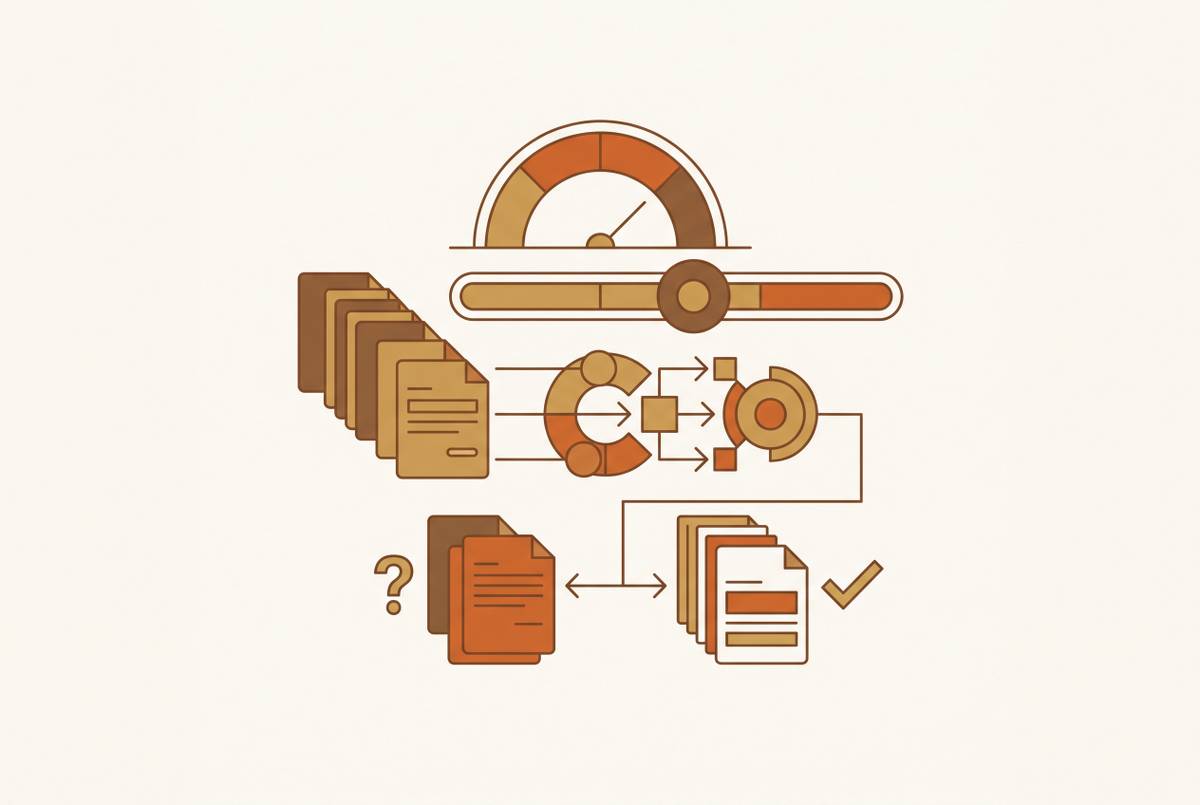
Recurring document exceptions almost never come from a single bad file. A small set of repeatable causes drives them, and once a team names those causes and tracks them separately, the exception queue turns into something a lot more useful: a diagnostic tool. Skipping that naming step leaves the team fixing the same broken field every Tuesday, forever.
The instinct when an exception fires is to fix the case in front of you: reroute the file, correct the field, reprocess the batch, move on. The queue empties, the dashboard looks clean, and the weekly metric says everything's fine. Then the same failure appears again the following week, on a different document, from the same vendor, in the same field, and nobody connects the two because nobody logged them the same way. Treating exceptions as one-off events instead of signals from whatever system produced them is the mistake that keeps the queue full. Recurring, in the operational sense, means the same field, the same document type, the same upstream source, or the same failure mode keeps appearing, sometimes across documents that otherwise look nothing alike.
The Ishikawa framework, sometimes called the 5M model, Man, Machine, Material, Method, and Measurement, offers a useful structure for categorizing repeatable failures. Applied to a document pipeline, those five buckets map onto training gaps, extraction logic, input quality, workflow and SOP design, and validation or monitoring gaps.
The mapping only works if everyone uses the same words for the same failure. Without a shared vocabulary, a post-mortem produces five different write-ups for what is functionally one problem: one analyst writes "bad scan," another writes "OCR failed," a third writes "field missing." None of those are comparable, so none of them can be counted, ranked, or fixed at the source. A shared taxonomy turns scattered notes into something closer to a ledger, and a ledger supports a Pareto analysis: rank the categories by frequency and by downstream cost, because they are not equally expensive, and fix the highest-volume cause first so the effort actually shows up in the numbers.
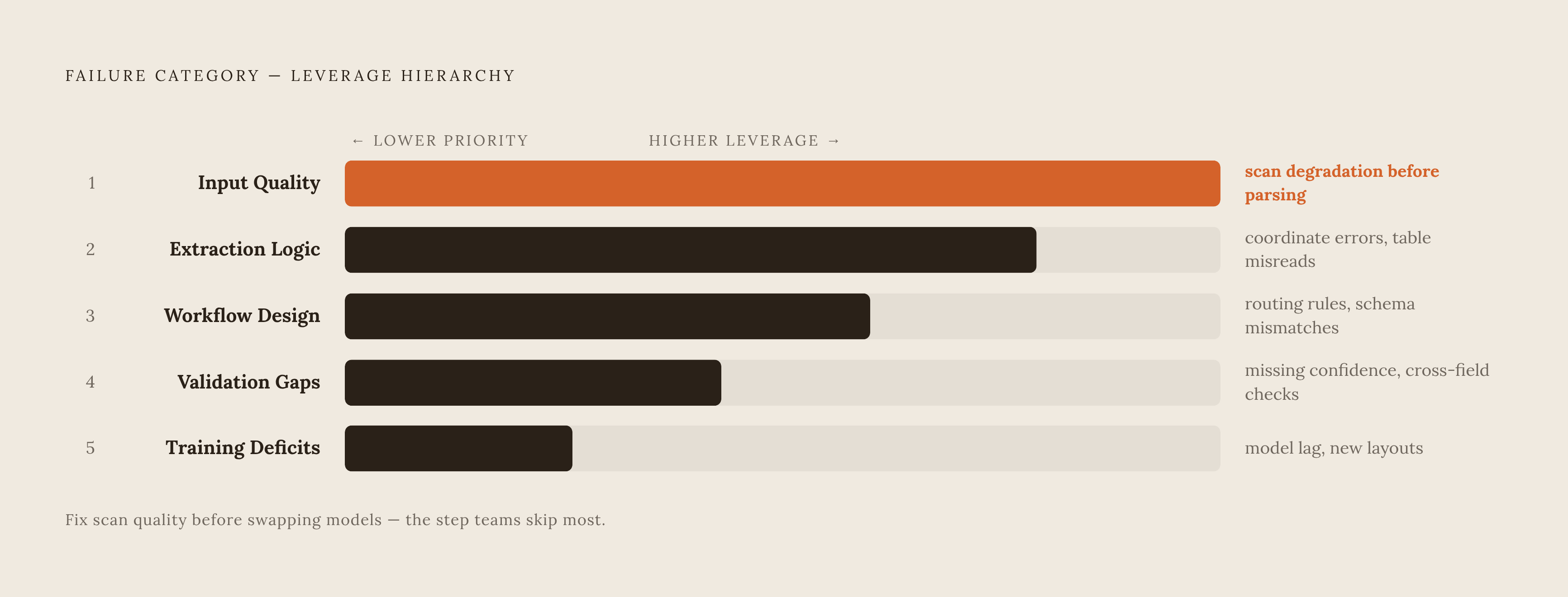
Applied to document pipelines specifically, the five categories are input quality (physical and digital degradation before the parser runs), extraction logic (failures inside parsing or OCR itself), workflow design (routing and approval logic that mishandles valid output), validation gaps (missing confidence scoring or schema checks), and training deficits (models and rules that haven't caught up to new document layouts or new vendors).
Input quality failures: what degrades documents before the parser runs
This category covers everything that shows up already damaged or structurally ambiguous, before the extraction layer ever touches it. It splits cleanly into physical and digital degradation, and the two behave differently.
On the physical side, resolution is the biggest lever. A clean digital PDF can deliver high accuracy, while a photographed, crumpled receipt can leave accuracy materially lower. Even small degrees of rotation can drag OCR accuracy down enough to matter, so deskewing as a preprocessing step tends to pay for itself many times over. Fax artifacts and scanner noise are fixable through binarization and denoising, but only if that step actually exists in the pipeline instead of being assumed. Handwritten annotations scrawled on a printed form remain a stubborn edge case too, one that neither template-based systems nor basic OCR handle well.
Digital degradation is quieter, and in some ways more dangerous, because it doesn't look broken. Embedded fonts a parser can't decode will cause whole sections to vanish with no error thrown. PDFs generated by different accounting or ERP platforms often represent the same document type with completely different internal structure, which breaks any extractor built around fixed coordinates. And an image-only PDF with no real text layer can masquerade as a normal text PDF, so extraction returns empty or garbled output while the system reports nothing wrong.
Fixing input quality is the highest-leverage move on this whole list, and it's the one teams skip most often. A preprocessing pipeline that takes input quality from poor to good can move extraction accuracy by 10 to 15 percentage points, often a bigger gain than swapping out the extraction engine. Teams that spend their budget hunting for a better model before fixing scan quality have the priority backwards, and no amount of model upgrading will fix a problem that starts at the scanner.
Extraction logic failures: where the parsing layer breaks on real documents
Most engineering attention lands here. That is why it gets lumped into one vague label, "parser error," instead of being split into distinct, separately fixable failure classes.
Coordinate-dependent extraction is a particularly widespread trap. Layout models classify text by spatial position, so a field sitting two pixels outside its expected bounding box gets misclassified or dropped, silently, before table reconstruction even runs. This is the canonical silent failure in this category. The document processes, the output looks plausible on its face, and the mistake stays invisible until a downstream system acts on a value that was never right to begin with.
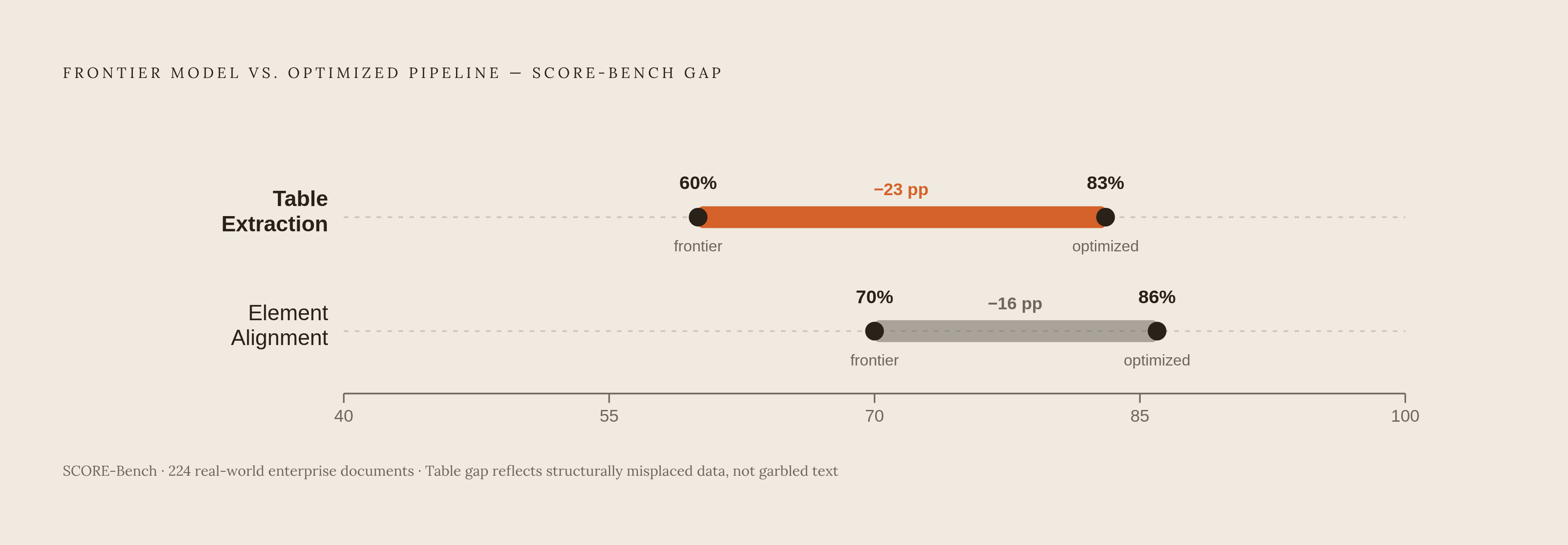
Table extraction carries its own set of failure modes. Merged cells get either duplicated across the merge or dropped. Cross-page headers, where a column label appears only on page one and the data keeps going for three more pages, tend to break the header-to-column mapping, leaving orphaned rows with no label. Totals rows that span the full table width sometimes get parsed as their own single-cell table, and sub-headers embedded mid-table get read as ordinary data rows. Right-aligned numeric columns shift position as font rendering changes across different PDF generators. On SCORE-Bench, a benchmark of 224 real-world enterprise documents, table extraction accuracy across frontier models ran up to 23 percentage points below an optimized pipeline, and the failure mode wasn't garbled text. It was structurally misplaced data that looked entirely correct on the surface.
Reading order is the third failure class, and it's the hardest to catch because nothing looks missing. Multi-column layouts, sidebars, captions, and footnotes get interleaved out of sequence. Paragraphs get attributed to the wrong section, figures separate from their captions, subheadings fold into body text. The words are all there, the document technically "processed," but the structural relationships between pieces of text are wrong. When those broken chunks feed into a downstream retrieval pipeline, the context handed to the model is simply incorrect. On the same five frontier models tested on SCORE-Bench, element alignment accuracy ran up to 16 percentage points below an optimized pipeline.
Workflow design failures: exceptions that the extraction pipeline didn't cause
A document can extract perfectly and still generate a recurring exception, because the workflow receiving it was built on assumptions that don't hold for every case. The blame usually lands on the extraction team, and that needs correcting before anyone proposes a fix, because the fix belongs somewhere else.
Routing rules are the first culprit. A rule that routes documents based on a single field's value breaks the moment that field is legitimately absent in a valid variant of the document, generating a false exception on a perfectly good file. Hardcoded routing by vendor or document type has the same problem in slow motion: it works fine until a new vendor gets onboarded and nobody updates the rule.
Approval gates cause a subtler version of the same failure. A confidence threshold, say 0.85, routes any document scoring below it to a manual review queue. If that routing doesn't log why the document landed there, the queue just grows, and nobody can see the extraction pattern driving it. Thresholds are adjustable: push them higher and accuracy improves at the cost of more manual routing, push them lower and more gets automated at the cost of some accuracy. Choosing the right number means knowing which specific fields actually drive most of that manual volume, and that's impossible to know without the logging in place.
Integration logic rounds out this category. Downstream ERP or accounts-payable systems built around a fixed schema will throw errors the moment extraction returns a field they didn't expect, or omits one they assumed was mandatory. Those errors get logged as document exceptions, but they're really schema mismatches sitting in the integration layer, not extraction failures. Blaming the parser here just sends the fix to the wrong desk, and it stays broken until someone routes the ticket correctly.
Validation gaps: exceptions that should have been caught before they reached a human reviewer
A validation gap is defined by absence: no confidence check fired, no schema rule enforced, no cross-field consistency test ran. An error that a simple gate would have caught instead flowed straight downstream to a person who never should have had to see it.
Confidence scoring, or the lack of it, is the clearest example. Without a per-field confidence score, there's no way to tell a high-certainty extraction from a low-certainty one, so everything routes the same way regardless of how reliable it actually was. The cost is direct: human reviewers end up checking fields the model already got right at high confidence, purely because nothing sorts reliable output from shaky output. The fix isn't complicated. High-confidence fields flow straight through to downstream systems, low-confidence fields go to a review queue, and manual effort concentrates where it's actually needed instead of spreading evenly across everything.
Schema enforcement at the output boundary closes a second gap. A date field returning a string, a numeric field returning a text label, a required field missing entirely: all of these are catchable the moment extraction finishes, before the data goes anywhere. Skip that check and these errors slide into ERP, accounts-payable, or lending systems, where they look like ordinary data entry mistakes rather than what they actually are: extraction failures wearing a different costume.
Cross-field consistency checks catch a third class. An invoice total that doesn't reconcile against the sum of its line items, a tax amount that doesn't match the stated jurisdiction, a service date that falls outside the policy period: each one is detectable by a simple rule, provided that rule has actually been written and deployed rather than assumed to exist.
Training deficits: exceptions caused by models and rules that haven't kept pace with real documents
A training deficit is a gap between the document distribution a model or rule set was built on and the distribution it's actually facing in production right now. That gap doesn't announce itself. A slow drip of exceptions appears in the queue, looking unrelated until someone lines them up side by side.
New layouts from existing vendors are the most common trigger. When a document layout changes, the extraction model may not keep pace, and values begin dropping quietly. The exceptions pile up for a while before anyone connects them to the layout change, because each individual failure looks like a one-off. The document type is familiar and the vendor is familiar, but the specific layout is new, and nothing in the system was built to notice that distinction until the failures had already stacked into a pattern.