Staffing and SLA Design for Document Review Teams
Confidence thresholds, not response times, should anchor SLAs for document review teams.

SLA design for document review teams breaks down the moment it meets real operating conditions, and the reason is almost always the same: the templates get built around volume, not accuracy. A durable SLA anchors its priority tiers to field-level confidence thresholds, not to arbitrary response-time targets borrowed from IT helpdesks. Get that anchor wrong, and every downstream promise, staffing plan, and escalation path inherits the mistake.
Most SLA templates assume a co-located team, synchronous communication, and predictable ticket types. None of that holds for a document review pipeline. GrowRK's 2026 SLA template guide makes the point that templates document a company that already exists, and they let you make promises before you understand what those promises will cost to keep. Document review differs from IT or customer support work in one specific way: the input itself is a variable. Scan quality, layout complexity, and document type all change how long review takes and how often a human has to step in, and no ticket-routing template built for password resets accounts for that.
Volume compounds the problem, since it isn't smooth. Spikes of 30 to 40 percent are routine during business-hours surges and end-of-cycle processing runs, and a team sized for average load breaches its SLA every single time one of those spikes lands. Accuracy variance in the parsing layer upstream is a variable most staffing models never touch, and it produces review workload that volume forecasting alone can't predict. A batch of clean PDFs and a batch of degraded scans might contain the same number of documents, but they generate wildly different amounts of review work, and forecasting built on document count alone will never see that difference coming until the queue is already backed up.
Document parsing failures and the review work SLAs don't account for
Review queue size is a function of how many fields the parsing layer got wrong, got partially right, or dropped without telling anyone. These three failure types appear in the queue in three completely different ways, and treating them as one problem is how staffing plans end up understaffed in the exact place they need coverage most.
Header metadata omission is the most obvious: an entire product or entity block goes missing from the output, and the reviewer has to rebuild it by hand from the source file. Reading order errors are sneakier. The tables are all there, the values are correct, but they land in the wrong section order, so the reviewer has to check the logical grouping of the document rather than just spot-checking field values. Technical symbol mutation is the nastiest of the three, since an engineering unit gets silently corrupted, a magnitude shifts by a decimal place, and none of it is visible to a reviewer who doesn't know the source domain well enough to notice the number looks wrong.
Silent failures do the most damage precisely because nothing flags them. Parsli's comparison of Azure Document Intelligence output describes a vendor invoice where records merged, one vendor's name got paired with another vendor's total, and the response still carried a status of "succeeded," no warning field, nothing. Any workflow consuming that output posts bad data straight through, and nothing downstream catches it.
Then there's the long tail. Parsers might handle something like 95 percent of documents cleanly. That remaining 5 percent needs specialized handling, and in a high-volume pipeline, 5 percent raises real staffing demands. This standing staffing requirement appears every single week, regardless of whether anyone budgeted for it.
Failure types also cluster by domain. STEM documents concentrate their errors in notation and formula fidelity. Business documents concentrate theirs in structural integrity and metadata completeness. Putting a generalist on a formula-heavy engineering doc and a technical specialist on a routine invoice wastes both reviewers, one underqualified, one overqualified, and slows the queue down on both ends. If a team can't say what share of its queue comes from silent failures versus flagged low-confidence output, its response targets are being set against a workload nobody has actually measured.
What field-level confidence scores measure and where they fall short
A confidence score is a numeric estimate of how reliable one extracted field is, and it usually decides whether that field flows straight downstream or gets pulled into a review queue. These scores are rarely uniform, even within a single document, and treating one number as representative of the whole page is where most calibration mistakes start.
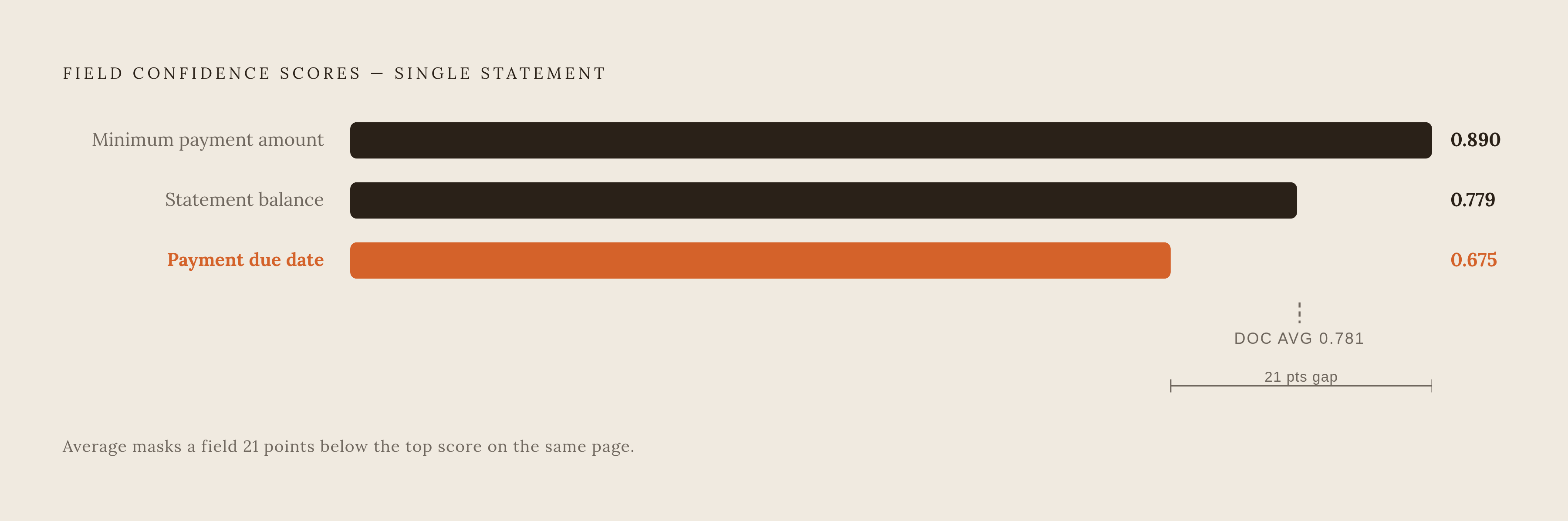
Across a set of processed financial statements, one document intelligence model reported an overall average field-level confidence of 0.781. Broken down by field, though, the picture splits: minimum payment amount landed at 0.89, statement balance at 0.779, and payment due date all the way down at 0.675. That's more than a 20-point gap between fields sitting on the same page, and it isn't a model quirk. It reflects genuine differences in how structurally and semantically complex each field is inside an unstructured layout. A single document-level score would have hidden that spread completely.
Field-type accuracy shows the same pattern elsewhere. A 2025 study evaluating LLM-based extraction from NOAA reports, across 200 documents, found per-field accuracy ranging from a perfect 100 percent on structured fields like Year down to 87.94 percent on Season, a 12-point spread inside the same model and the same document set.
An arXiv paper from 2026 points out that no systematic benchmark currently exists to test confidence calibration for key information extraction against real-world document quality variation. Existing benchmarks lean on clean, high-quality documents, which leaves the low- and mid-accuracy range too sparse to evaluate with any real confidence.
A confidence score of 0.82 doesn't mean the same thing across document types, scan qualities, or field classes, and any staffing model that treats one threshold as a universal auto-approve gate is trusting a calibration it has no way to verify. Some newer approaches fuse multiple signals, logprobs, consistency checks, per-field trust scores, into a steadier estimate. Most production pipelines aren't using them yet. Most teams are still running on the single-number assumption this section just took apart.
Building priority tiers around confidence thresholds rather than arbitrary response times
The default approach in most shops is a P1 through P5 scale sorted by business impact, with a P1 carrying a very short response window and lower-priority tiers stretching out to multiple business days. That scale makes sense for IT incidents. It encodes nothing about extraction quality, and extraction quality is what should drive review urgency in a document pipeline, not a label someone assigns at intake based on who's asking.
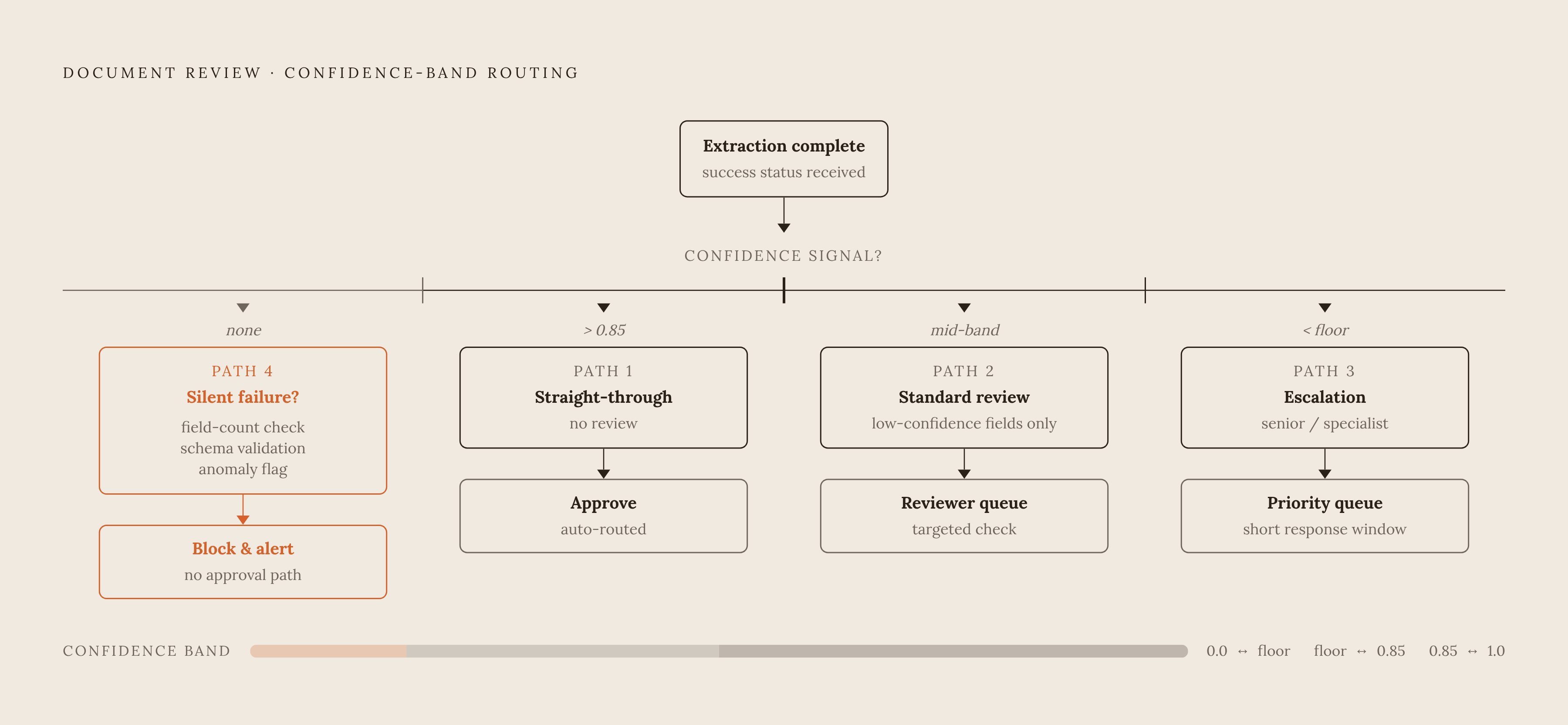
Route documents, and individual fields within them, into review tiers based on confidence bands instead. Above roughly 0.85, a field goes straight through, no human review, no delay. In the mid-confidence band, the document lands in a standard review queue with a defined response window, and the reviewer checks the specific low-confidence fields rather than re-extracting the whole thing from scratch. Below that, it escalates to a senior reviewer or a domain specialist, and the response window there runs shorter because the extraction itself is genuinely uncertain. A fourth path has to exist for silent failures: documents returning a success status with no confidence signal at all need a separate trigger, whether that's a field-count check, a schema validation step, or an anomaly flag, before they're allowed anywhere near an approval path.
The threshold itself is a policy choice. Pushing it higher routes more documents to manual review, buying accuracy at the cost of throughput. Pull it lower and manual load drops, but so does the safety margin. That trade-off deserves to get written down and reviewed on purpose, not left to whatever an individual analyst decides on a busy Tuesday.
Tier assignment has to happen at intake, full stop. The moment a document enters the queue, its tier should already be driving routing, staffing, and escalation timing. Leaving that judgment to analyst discretion during triage creates a quiet incentive to down-classify documents just to keep the queue moving. Breaches in document review frequently trace back to inconsistent classification at the front door, which is a policy fix, not a performance conversation with whoever was on shift. Response targets tied to a measurable, auditable confidence threshold hold up under scrutiny. Response targets tied to a subjective priority label don't, and no amount of retraining fixes that gap.
Staffing models that account for accuracy variance and volume spikes
The mistake nearly every staffing plan makes is sizing for average volume against average accuracy, as though both numbers hold steady at the same time. They don't, because both averages break down simultaneously the moment a difficult batch shows up. Both averages break down simultaneously the moment a difficult batch shows up, and a plan built on averages has no slack left when that happens.
Volume spikes of 30 to 40 percent are structurally predictable: business-hours surges, batch submissions from upstream systems, end-of-period filing crunches. Size a team for average load and every one of those spikes turns into a breach. Accuracy variance is a separate driver. A batch of scanned or degraded documents can generate a mid-confidence review queue several times the size of a clean-PDF batch containing the same number of files, and volume alone won't tell that story ahead of time.
Distributed teams add a third wrinkle. A single response-time target applied across time zones either overpromises somewhere or leaves a region understaffed, and there are only three honest ways out: acknowledge different service levels by location, staff for round-the-clock coverage, or shrink the SLA window down to the hours where coverage genuinely exists.
Escalation staffing needs its own line item too. Senior reviewers handling low-confidence escalations can't carry the standard review queue at the same time, so escalation demand should get forecasted separately, with capacity held in reserve rather than borrowed from the general pool whenever things get busy.
Teams running self-hosted, open-source parsing infrastructure carry a cost that often goes uncounted: something in the range of 20 to 30 percent of an engineer's time per quarter goes to dependency management and edge-case preprocessing. That's reviewer-adjacent capacity quietly consumed by pipeline upkeep instead of actual document review, and it needs to show up in the staffing math, not get absorbed as a rounding error.
Cadence matters too. Regular review of response, resolution, and overdue metrics is a standard SLA management practice, since that's the pace at which document mix and volume actually shift. Setting the staffing model once a year and leaving it causes it to drift out of alignment with a document mix that's already moved on by the second quarter.
Escalation paths that work when the parsing layer fails unexpectedly
Most SLA templates assume escalation is linear: a lower-priority ticket that doesn't get resolved in time gets escalated to a higher priority. Document review escalations rarely follow that pattern. They tend to get triggered by a discrete event instead, such as a parser version change, a new document subtype entering the corpus, or a silent failure pattern that quietly accumulates until someone finally notices.
Three conditions ought to trigger escalation on their own, independent of any confidence score. A schema validation failure, where the extracted output doesn't match the expected field structure, is a different problem than a low confidence score and needs a different response. A structural anomaly, where the extracted output looks incomplete relative to the source document, signals that something got dropped silently on the way through. And systematic accuracy drift across a batch points the escalation somewhere else entirely: to the pipeline engineering team, not to a document reviewer who has no way to fix an upstream problem.
Automate these triggers and build them into monitoring dashboards wherever possible. Don't leave them dependent on a reviewer noticing a pattern spread across dozens of individual tickets. An escalation path also needs a named owner at every step: who gets the alert, what they do about it, and within what window. "Notify senior reviewer" without naming who and specifying the channel fails the instant that person is out sick or on vacation.
Document AI escalations differ from IT incident escalations in one important respect: the fix often sits outside the review team's control. If the failure lives in the parsing pipeline itself, the escalation path has to reach someone with the authority to pause automated processing, not just someone who can reassign tickets. And when an accuracy event forces a pause, holding a batch pending pipeline review, saying so up front protects credibility. Letting the SLA clock keep running against a queue the team physically cannot clear does the opposite.
Measuring SLA performance when accuracy is part of the commitment
Response time, resolution time, first-contact resolution rate: these standard metrics measure speed and throughput, and they say nothing at all about whether the extraction was any good. A team can hit every single response target while consistently pushing bad data downstream, and the dashboard will look fine the entire time.
A document review SLA needs a few things layered on top, and none of them are optional extras. Per-field accuracy against ground truth, the share of fields in the review queue the reviewer confirmed as correct versus corrected, closes the feedback loop and shows whether the parsing layer is actually improving or just generating more work at the same rate. Escalation frequency by confidence band tells a different story: if the mid-confidence tier is escalating more than expected, that threshold needs recalibrating, not more headcount thrown at it. Correction rate by document type flags which subtypes are generating the most human fixes, usually the earliest sign that something in the parsing layer is degrading before anyone else notices. Backlog age by tier reveals a specific blind spot: a P1-equivalent queue clearing right on target while a mid-confidence queue quietly ages out is a staffing allocation problem the response-time number alone will never reveal.
Mean time to resolution is necessary, but nowhere near sufficient on its own. Without correction rate and escalation frequency sitting next to it, a team managing to its MTTR number is managing perception, not actual performance, and the two are not the same thing no matter how clean the dashboard looks.
A fixed canary set, a held-out group of documents with known ground truth, checked on a continuous basis, gives an early drift signal that human review metrics alone can't provide. When the canary set starts degrading, the live review queue is about to follow, and the team gets advance warning instead of finding out after the SLA has already been breached.
Vendor accuracy claims deserve real scrutiny here. High accuracy on a clean vendor sample doesn't automatically carry over to the messier documents a team processes every day. Any accuracy figure worth setting an SLA target against needs to be run against the team's own production corpus, edge cases included, before it goes anywhere near a contract. Accuracy needs to live inside the SLA itself, not just get claimed alongside it: a vendor or internal platform unwilling to commit to a specific field-level accuracy figure is quietly transferring the measurement risk onto the customer. A stated per-field accuracy guarantee turns accuracy into a commercial commitment rather than a marketing claim, and that distinction is what separates knowing the SLA is holding from just hoping it is.
A durable document review SLA in practice
A durable document review SLA is not a faster version of an IT incident SLA copied over with new labels. It's a different document, built around a different set of variables: field-level accuracy, confidence band distribution, document type mix, and correction rate, none of which appear on a standard incident template.
Tier definitions need to name something concrete, such as a confidence band, a field-count trigger, or a schema validation state, instead of a subjective priority label someone assigns based on gut feel. Response and resolution targets attach to each of those tiers, and the target for a low-confidence escalation tier should run tighter than the target for standard review, because uncertainty itself is the urgency, not business impact. The threshold policy needs to be explicit, with the actual confidence cutoffs separating auto-approve, standard review, and escalation documented, versioned, and revisited whenever the document mix shifts. A staffing model names the number of reviewers assigned to each tier, the buffer held for volume spikes, and who owns each step of the escalation chain, so the SLA is backed by capacity anyone can point to rather than assumed availability nobody checked. An accuracy commitment sits right alongside the speed commitment, stated in the same document, measured against the same corpus, held to the same scrutiny.
None of this removes uncertainty from document review. Scan quality will keep varying, layouts will keep breaking parsers in new ways, and volume will keep spiking on the worst possible Tuesday. A confidence-anchored SLA makes that uncertainty visible and priced in, instead of hidden inside a response-time promise that was never built to hold it.