Error Rate Measurement Before and After Document Automation
Measure automation's true accuracy gain by tracking escaped errors, not just processing speed.

Most teams that roll out document automation report a single headline number: percent reduction in manual processing, hours saved, invoices cleared per day. None of those numbers can tell a genuine accuracy gain from an error that just moved somewhere nobody is looking. A straight-through processing rate that climbs quarter over quarter looks like a win, but the only way to know if it is a win is to ask whether the documents that passed through untouched were actually correct. If accuracy holds steady while STP climbs, that's a real gain. If accuracy quietly erodes while STP climbs, the system has just gotten better at hiding its mistakes, and someone downstream will find them later, at a higher cost than a reviewer would have paid at intake. A measurement framework that tracks automation rate without tracking escaped errors separately will understate the true cost of every error it misses, and it will do so by design, not by accident. The rest of this piece builds the framework that closes that gap.
Why character-level accuracy hides production failures
Vendors report character-level accuracy because it produces the biggest, most favorable numbers, and those numbers are the wrong ones to build a production decision on. Character-level accuracy grades how many individual characters a system recognized correctly, which sounds reasonable until you remember that fields in production aren't graded on partial credit. An invoice number read with a capital O instead of a zero might score high marks on character accuracy, since only one character out of many is wrong, but the field is now completely useless. It will fail a database lookup, it will corrupt a three-way match against a purchase order, and it will trigger a manual exception that a human now has to resolve by hand. Field-level accuracy treats that same case correctly: a field counts as correct only if every character in it matches ground truth, full stop, no partial scoring. One wrong character in an account number, a date, or a tax ID makes that field wrong in exactly the same way a field with every character wrong is wrong, because downstream systems treat almost right and completely right as the same thing.
The gap between what character-level accuracy reports and what field-level accuracy reports is often large enough to decide whether a deployment is viable in production. A vendor demo built on clean sample documents can show very high character accuracy and still fail on a meaningful share of fields once it meets the format variability, scan quality, and layout diversity of a real document queue. That difference between demo performance and week-one production performance is where the field-level number earns its keep, because it is the number that actually correlates with how many documents need human correction. A third granularity sits above both: document-level accuracy, which counts a document as correct only when every required field in it is correct. Document-level accuracy is useful for estimating how many documents are eligible for straight-through processing, but it is derived from field-level accuracy, not a replacement for measuring it. Choosing the right granularity is a foundational choice: it sets whether every other number in the measurement framework means anything.
How to construct a valid ground truth baseline
Field-level accuracy only means something if it is measured against a reliable reference, and that reference is ground truth: a human-verified record of what each field in each document should actually contain. Without a carefully built ground truth set, a field accuracy figure is unverifiable, and a vendor's accuracy claim is untestable, because there is nothing independent to check it against. The operational form of this comparison is Exact Match Rate, or EMR, which reports the percentage of fields that exactly match ground truth across a sample of structured documents. EMR is the number that makes a before/after comparison defensible, because it is tied to a reference set that was built the same way both times.
Building that baseline starts with sampling from real production documents, not from the cleaned, well-scanned examples that show up in demos. The sample needs to include the actual formats, scan qualities, and vendor layouts that arrive in the document queue day to day, because a sample that excludes the messy cases will produce an accuracy figure that has nothing to do with production reality. The sample should also be weighted toward high-consequence fields, meaning amounts, dates, account numbers, and tax identifiers, since a wrong value in one of those fields causes a payment error, a compliance violation, or a reconciliation failure, not just an inconvenience. Before automation goes live, manual error rates should be recorded on that same sample, because that manual baseline is the number the post-automation figure has to beat for the comparison to prove anything. And the baseline should note, field by field, which ones are structurally harder to extract: high-entropy fields like agent names, freeform descriptions, or seasonal identifiers reliably underperform structured, low-entropy fields like state codes or fixed-format years, even in systems that otherwise perform well.
A peer-reviewed 2025 evaluation of LLM-based field extraction illustrates exactly this pattern: structured, low-entropy fields reached near-perfect accuracy, with State and Year fields hitting 100 percent, while high-entropy fields dragged the overall average down by a meaningful margin. An average field accuracy figure built across both kinds of fields hides the fields most likely to fail once the system is running at volume. The practical fix is to report accuracy broken out by field category rather than as a single blended average, so the comparison shows exactly where manual review is still needed instead of burying that fact inside a number that looks better than the system actually performs.
The three metrics that must be read together: STP rate, field-level accuracy, and escaped error rate
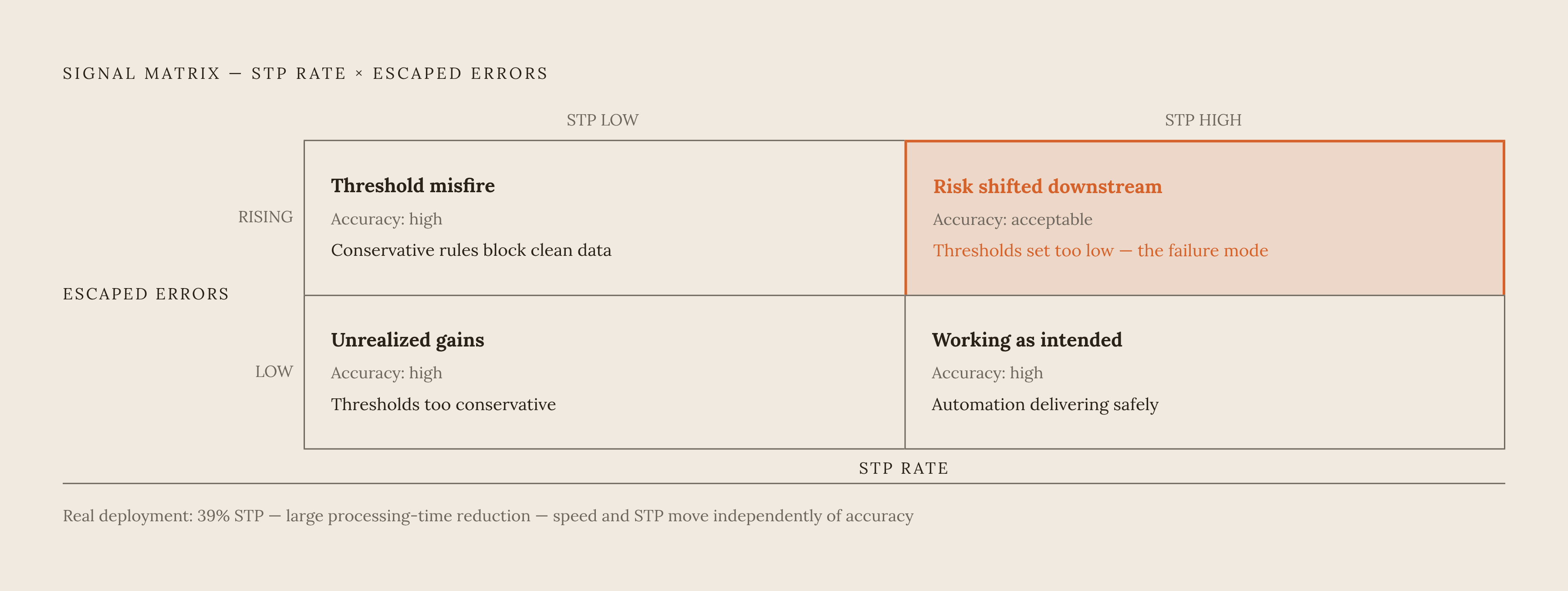
No single metric in this framework is sufficient on its own, because each one can be gamed or misread in isolation, and a valid before/after comparison requires reading all three together. STP rate is calculated as transactions processed automatically divided by total transactions, multiplied by 100, and it measures automation depth, not accuracy. A high STP rate achieved by lowering confidence thresholds is not a gain, it is a shift of risk from the automation layer to whoever discovers the error later. Field-level accuracy, measured against ground truth as described above, supplies the quality signal that STP rate structurally cannot provide on its own. Escaped error rate closes the remaining gap: it is the count of errors found downstream or in audit, divided by the number of documents processed without review, and it catches what periodic field accuracy sampling misses when that sampling isn't continuous.
Reading the three together produces a small number of clear patterns. If STP is high and field accuracy is high and the escaped error rate is low, automation is performing as intended. High STP paired with acceptable field accuracy but a rising escaped error rate means thresholds have been set too low, and the system is auto-approving documents it should be flagging for review. If STP is low but field accuracy is high, the extraction itself is correct, but routing thresholds are too conservative, so you aren't realizing the economic case for automation even though the quality is there. One deployment reported a large reduction in processing time alongside a straight-through processing rate of 39%, a pairing that shows speed and STP move independently of each other and that time savings alone never confirm whether automation is working correctly. The practical reading rule follows directly: STP, exception rate, and escaped errors belong on one dashboard, read together, and any week where STP rises alongside a rise in escaped errors should be flagged immediately.
How confidence scores should set routing thresholds
A confidence score is a routing signal, and it is not a certificate of correctness. A model that is confidently wrong on a given field will auto-approve that error every time unless the threshold for that field has been calibrated against how the model actually performs, not against what it claims about itself. A 2026 benchmark of vision-language models on document extraction found calibration quality ranging from near-perfect to severely overconfident across different models, so a 0.95 confidence score from one model doesn't carry the same real-world accuracy as a 0.95 score from another. Treating confidence as a stand-in for correctness, without checking it, means a high-confidence score attached to a hallucinated value offers no real protection. The responsible way to use confidence is to compare confidence bands against observed field accuracy on a representative sample of production documents, and set routing behavior from that comparison.
Calibration should be segmented by the consequence of a wrong value, not applied as one blanket number across every field. Fields where an error causes a payment mistake, a fraud exposure, or a compliance violation need tighter thresholds than fields where an error just means a follow-up phone call, and a single global threshold applied across all of them will be wrong for some share of the fields it covers no matter where it is set. One useful calibration method plots confidence deciles against observed error rates on historical extractions, and the point where the model's self-reported confidence diverges from its actual accuracy is where the threshold needs to sit. Confidence calibration also cannot do everything on its own: deterministic business rules fill the gap it leaves, so duplicate invoice numbers, failed three-way matches, and changed bank account details should go to human review regardless of what the confidence score says, because these are exactly the cases where a model can be confidently wrong. Auditing a random sample of whatever got auto-approved is the only continuous check that catches a threshold set too low before a downstream team catches it instead, and that audit feeds directly into the escaped error rate calculation described above. The underlying architecture is simple to state: the model proposes values, and deterministic rules paired with calibrated thresholds decide what happens to them next. Confidence scores inform that decision. They should never be left to own it alone, and the three-lane routing structure that follows is where this calibration logic turns into an actual workflow.
The three-lane review structure that keeps human effort proportionate to risk
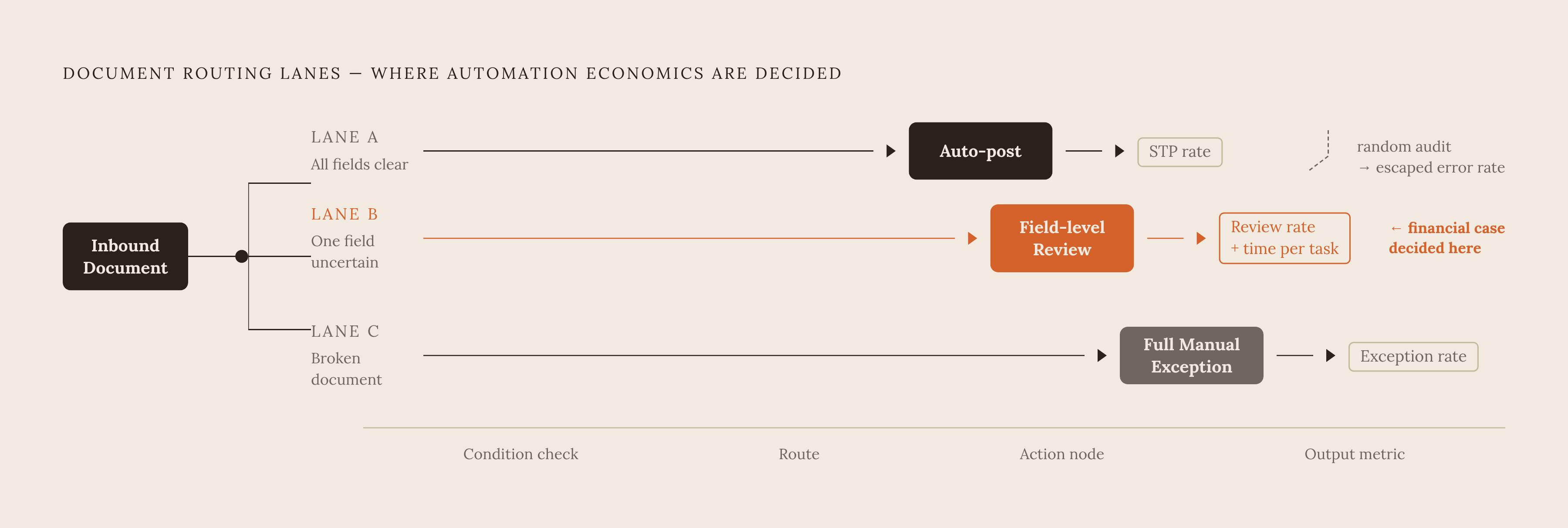
If you split everything into fully automated or fully manual, you waste reviewer time and let exception queues grow without limit, because every uncertain case lands in the same undifferentiated pile regardless of how much attention it actually needs. A three-lane structure fixes this by concentrating human effort specifically on the fields and documents where the cost of an escaped error justifies spending that effort. The three lanes are straight-through, field-level review, and full manual exception, and collapsing them into a single "needs review" queue lets that queue grow until it defeats the purpose of automating.
In Lane A, straight-through processing applies: every required field is present, every confidence score clears its calibrated threshold, business rules reconcile, and no exception trigger fires, so the document posts without a human touching it. Lane B is field-level review: the system read the document correctly overall, but one specific field is uncertain, failed a validation rule, or is flagged as high-risk regardless of its confidence score, so the reviewer sees only that single field. Lane B is where the economics of the whole system actually get decided. Lane A determines how many documents a reviewer opens in a day, and Lane B determines how long each of those reviews takes once opened, so if you get Lane B's scope right, the STP rate means something financially, not just numerically. Lane C is full manual exception, reserved for documents that are themselves broken: wrong document type, a missing page, an unreadable scan, a suspected duplicate, or a case that calls for judgment. For claims processing and other high-consequence workflows, extraction review and adjudication should sit in separate queues with separate time budgets: "did the system read this correctly" is a factual, data-driven question, and "should this be approved" is a judgment call that takes a different kind of attention and a different amount of time.
Each lane also produces its own piece of the measurement picture. Its throughput feeds the STP rate calculation directly. Lane B volume and the time spent per review feed the human review rate and the average review time per document. Lane C volume feeds the exception rate. And the random audit drawn from Lane A's output feeds the escaped error rate, so the loop closes back to the quality check that a straight-through rate alone can never give you. Read this way, the three lanes are the data-generating structure behind every metric described earlier in this piece.
Edge cases that distort before/after comparisons
Pilot results routinely overstate what a system will do in production, because pilots tend to run on cleaner documents than the full population actually contains, and the edge cases that break extraction are exactly the cases a pilot sample tends to exclude. Scan quality is the upstream variable with the most direct effect on field-level accuracy at scale: low resolution, page skew, and noise introduced by photocopying or faxing are leading triggers of extraction failure, and they show up rarely in demo sets while showing up constantly in real production queues.
Document completeness is a separate failure mode: an incomplete document, whether it's missing a page, uses an outdated form version, or simply wasn't scanned in full, can cause extraction to fail or produce incomplete data silently rather than visibly, so the error may not surface until a downstream validation step catches it, if one exists. The defense against this is to validate document completeness at intake, before extraction even runs, checking page count, required sections, and form version before a document enters the pipeline.
Format variability compounds both problems. Template-based extraction performs well against repeat supplier layouts it has already seen, but it struggles the moment a new vendor, an unconventional layout, or a multi-column format arrives, and in a template-dependent system, every new vendor format effectively becomes an exception by default. Table and line-item extraction is the field type most likely to diverge sharply between pilot and production: structured tables in clean PDFs extract reliably, but multi-row tables in scanned documents with merged cells, rotated headers, or inconsistent column counts fail to extract reliably. A production multi-agent document pipeline processed a large volume over several months and found that fallback to legacy systems or manual handling was triggered specifically by unrecognized formats, severe image degradation, or explicit operator override, cases distinct from the document types the system was originally built to handle.
The measurement consequence is direct: a before/after comparison has to run on a sample that reflects the full distribution of document quality and format variability present in the actual production population. A sample skewed toward clean, well-structured documents will produce an accuracy figure that looks strong at launch and erodes steadily as volume grows and the full range of real documents starts arriving. Pilot numbers are a starting hypothesis, not a finished measurement, so they stay provisional until you test them against the documents a pilot never saw.