Cycle Time Reduction Metrics for Mortgage Document Processing
Document-layer metrics reveal where mortgage cycle time actually accumulates.

Mortgage cycle time is lost mostly at the document layer, not in underwriting judgment. Clerical document work generates more processor touches per file than underwriting and closing combined. The stages where time actually bleeds out are document intake and indexing, income and asset calculation pulled from extracted fields, and condition clearing. All three are clerical tasks. All three are automatable in principle. At many lenders, all three remain largely manual in practice, which is the gap this piece maps.
Underwriting gets the attention because it carries the credit decision, and closing gets the attention because it's the finish line borrowers and agents watch. The stretch between application and underwriting, where documents get collected, classified, read, and turned into usable numbers, does the quiet damage. A processor who spends an hour hunting for a missing page of a bank statement or re-keying a figure off a paystub is not exercising judgment. That processor is doing clerical work, and a properly instrumented system should have finished it before the file ever reached a human queue.
Application-to-close is too coarse a measure to drive improvement
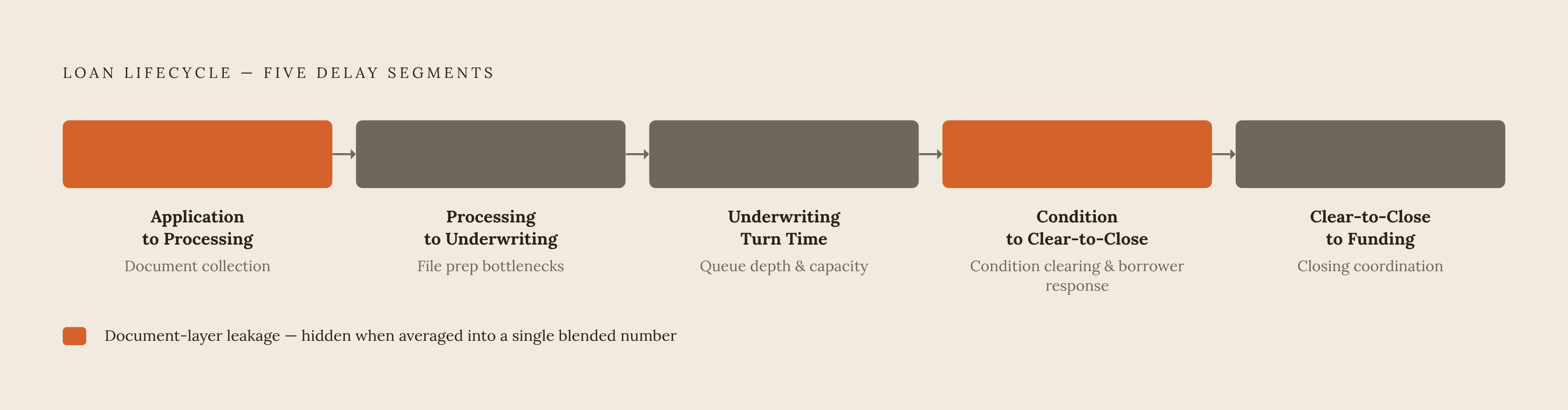
Application-to-close, reported as a single number of days, hides exactly which stage is causing the delay, which makes it close to useless as a lever for operational change. The loan lifecycle breaks into at least five measurable segments where time accumulates: application-to-processing, where document collection delays dominate; processing-to-underwriting, where file preparation bottlenecks build up; underwriting turn time, driven by queue depth and staff capacity; condition-to-clear-to-close, shaped by condition management and how fast borrowers respond; and clear-to-close to funding, governed by closing coordination. A single blended number averages all five together and tells an operations manager nothing about which one is broken.
A blended cycle time figure can look perfectly healthy in aggregate while one segment, often document collection or condition clearing, accounts for most of the actual delay. Pull-through rate suffers from the same blind spot: an overall rate that looks strong can still mask severe fallout concentrated in one document-intensive loan type, such as self-employed borrower files or foreign national loans. So averaging across loan types buries the problem the same way averaging across stages does.
That blindness raises the cost of fixing something when a lender tries to act on a single cycle time number. Without stage-level visibility, there's no way to tell a document extraction problem (wrong data entered) apart from a routing problem (a file sitting untouched in a queue) or a borrower responsiveness problem (documents that simply haven't arrived). Each of those three requires a completely different fix. Throwing underwriting capacity at a document extraction problem does nothing. Retraining processors on data entry does nothing for a routing bottleneck. A single cycle time number can't tell an operations team which intervention to make, and that's the case for breaking the measurement down to the document layer directly.
The four document-layer metrics that reveal where cycle time is lost
Four metrics, tracked together, tell the complete story of where document-layer cycle time goes: extraction time per document, error-driven rework rate, stale-data lag, and processor touches per file.
Extraction time per document measures the elapsed time from the moment a document is received to the moment structured, validated field data is available for underwriting to use. That's a broader measurement than OCR completion. It covers the full pipeline: classification, extraction, validation, and exception routing, end to end. Rocket Close used AI tools through AWS and cut document review time from a multi-hour baseline to under 2 minutes, so you now have a concrete production benchmark for what automated extraction can achieve at the extreme end. Tracking this metric per document type reveals which document is actually slowing the pipeline down. Paystubs, tax transcripts, bank statements, and closing disclosures each carry different extraction complexity and different baseline processing times. Blending them into a single number hides exactly which document type is slowing the pipeline down.
Error-driven rework rate measures the fraction of extracted fields that need correction after the initial pass, whether that correction comes from human review, cross-validation, or an underwriting catch downstream, along with the processor time that correction consumes. Rework rate carries more weight than raw accuracy, because even a small per-field error rate, applied across a 500-page loan file, produces a large volume of bad fields, each of which has to be found, corrected, and re-entered before the file can move forward. The cost of a missed error compounds as it travels through the pipeline. Data extracted incorrectly at loan setup turns into an underwriting exception. An exception not caught in underwriting turns into a QC defect. A QC defect not caught turns into repurchase exposure. Rework rate is the earliest point in that chain where the cost can be measured and contained, before it escalates into something far more expensive.
None of that is measurable without the right logging in place. A well-designed AI pipeline logs every extracted field along with its source document, the page it came from, a model confidence score, and the last human touch it received. That provenance data makes rework rate measurable. Without it, corrections happen invisibly to the people running operations.
Stale-data lag measures the age of extracted income, employment, and asset data at the moment it reaches underwriting, the gap between when the source document was generated and when validated, structured data is actually available for decisioning. NFM Lending attributed a reduction of more than a week in application-to-clear-to-close time directly to eliminating the delays caused by manual document collection and verification workflows. Mutual of Omaha Mortgage processors now open files that already contain complete income and employment data, which eliminates duplicate steps and manual uploads. American Pacific Mortgage realized a similar double-digit cycle time reduction. Reverification requires updated data before closing, and traditional methods restart the entire request process to get it, often adding a week or more to the timeline, while real-time or near-real-time extraction removes that restart. Stale data also creates fraud and risk exposure that pure cycle time metrics never catch: an employment status change or income fluctuation that happens after document collection but before closing won't appear in a static extracted dataset.
Processor touches per file counts how many times a human has to step in to move a file from intake to underwriting-ready. Each touch costs labor, adds latency, and opens a new opportunity for error. A modern extraction pipeline treats the processor's role as validation and anomaly review, not data entry. The processor receives flagged fields with the specific reason attached instead of the entire file bounced back to the queue, and that routing discipline makes the touches-per-file metric compressible. Touches per file should be segmented by stage, intake and indexing, income calculation, and condition clearing, to match where manual work actually concentrates. A lender who reduces condition-clearing touches without addressing intake indexing will see limited gain in overall cycle time, because the bottleneck simply moves upstream.
Field-level confidence data the extraction pipeline must supply for these metrics to work
The four metrics above are only measurable if the extraction system is instrumented at the field level. That's a production engineering requirement, not a nice-to-have, and most OCR and legacy tools cannot meet it. Measuring rework rate, stale-data lag, and touches per file all depend on field-level provenance coming out of the extraction layer. Without that provenance, the metrics collapse into guesses reconstructed after the fact, long after the actual cost has already been incurred.
Production-grade AI infrastructure treats every extracted field as a first-class data point carrying its own provenance: which document it came from, the model's confidence score, and who last touched it. The NIST AI Risk Management Framework recommends exactly this kind of provenance for higher-stakes automated decisions, and that maps directly onto lending model governance requirements. Legacy OCR tools were built to digitize documents instead of guaranteeing data quality, so their failures are quiet: misfiling, versioning errors, and extraction mistakes go undetected until they surface later as costly exceptions. So you have no field-level confidence score to check those failures against.
A confidence score only counts as a measurable signal if it's calibrated to a specific field and traceable to a location in the source document. A confidence score that floats free of that grounding is a vendor claim, not a measurement. For rework rate to be instrumentable at all, confidence has to be grounded, tied to a page, a bounding box, or a character span, and the accept-or-review decision on that field has to be logged individually.
Where automated extraction pipelines break in mortgage production
The failure modes that matter in mortgage document processing concentrate in the document types that are hardest to extract, and they stay invisible to cycle time metrics unless the pipeline logs them explicitly. Cycle time gains that look impressive in a demo often don't survive contact with the edge cases that dominate real loan files.
Three document categories get routed to human review more than any others: handwritten letters of explanation, self-employed borrower packages with income spread across multiple business entities, and foreign national loan files carrying non-standard asset documentation. These are the same file types where rework rate and touches per file run highest, and where cycle time gains from automation shrink to almost nothing without specialized handling built for them.
A system can read a handwritten figure correctly and still fail to recognize that the figure replaces a typed value sitting in an adjacent paragraph, the kind of context failure handwriting introduces. The extracted value ends up wrong because of a context failure, a missed relationship between two fields on the page. So that kind of error stays invisible to accuracy metrics, which only check a value against its expected schema type and never check the semantic relationship between fields.
Handling that kind of failure well requires diagnostic visibility into what went wrong and why: whether the OCR engine misread a character, the extraction model tagged the wrong field, or a validation rule threw a false positive. Without that visibility, a reviewer has to re-examine the entire document from scratch, which erases the automation benefit and inflates the touches-per-file metric right back up. The point of auditing these failure modes honestly isn't to cast doubt on automation. So cycle time metrics stay reliable only when the pipeline handles these edge cases explicitly, logs what failed and why, and skips the full manual re-review.
Cross-document validation as the check that connects extraction accuracy to cycle time
Cross-document validation is the step that turns per-field extraction accuracy into actual cycle time gains, because it catches the errors that single-document review misses, before those errors become underwriting exceptions.
A properly built extraction pipeline runs four stages in sequence. Ingest handles document type classification and a completeness check against the file. Extraction pulls named fields out of the document, and each one carries its own confidence score. Validation reconciles data across sources: it checks year-to-date income on a paystub against W-2 totals and against bank deposit patterns, so no single document gets trusted in isolation. Orchestration routes anomalies to a processor with the specific reason for the flag attached, rather than kicking the entire file back into the queue.
Income mismatches, signs of document tampering, and field placement errors surface at the validation stage. Skipping it lets a confident but wrong value pass straight through to underwriting, where catching the same error costs far more time and effort than catching it at the point of extraction. Cross-document validation also directly improves stale-data lag. When the validation layer compares extracted figures across the entire application package in real time, it can identify which documents have gone stale relative to each other and flag them for re-collection before the file ever reaches underwriting.
What comes out of a well-instrumented validation stage is a structured dataset carrying confidence scores, source linkage, and flagged exceptions. You need exactly that field-level provenance data to measure rework rate and touches per file with any accuracy. The validation stage, in other words, is what makes the rest of the measurement framework possible.
Measured cycle time gains in production deployments
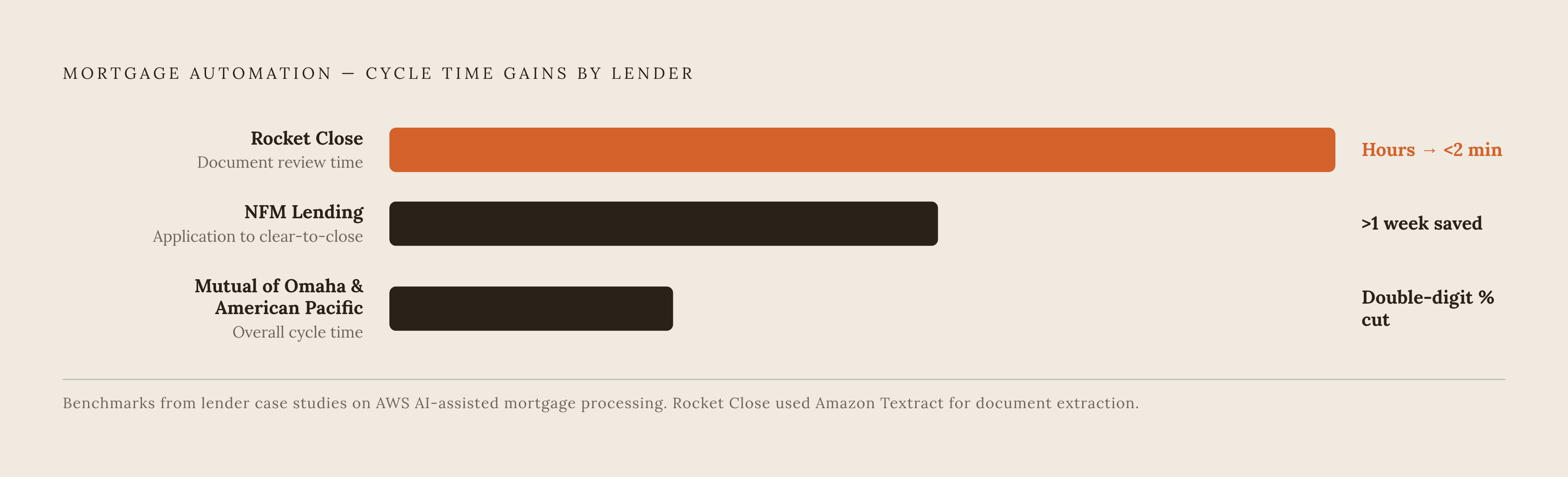
Production deployments show large cycle time gains concentrated in the document-processing stages, but you need the right instrumentation to read those gains accurately, so you can separate genuine extraction improvement from gains that are really just queue or workflow effects.
Rocket Close's reduction of document review time from a multi-hour baseline to under 2 minutes, using AI tools built on AWS, stands as one of the clearest production benchmarks available for what extraction time per document can look like once a pipeline is properly built. NFM Lending attributed a reduction of more than a week in application-to-clear-to-close time to eliminating delays from manual document collection and verification. Mutual of Omaha Mortgage processors now open files that already have complete income and employment data in them, so their workflow loses duplicate steps and manual uploads. American Pacific Mortgage also cut cycle time, by a comparable double-digit percentage.
These gains line up with the four metrics laid out above, not as marketing claims but as measurable outcomes: extraction time per document drops when classification and field extraction happen without manual re-keying, rework rate drops when field-level confidence scoring and cross-document validation catch errors before they reach underwriting, stale-data lag drops when real-time extraction replaces static document collection, and touches per file drops when processors review flagged exceptions instead of entire files. The gains are real and documented across multiple lenders, and they depend entirely on an extraction pipeline instrumented at the field level, with provenance, confidence, and cross-document validation built in from the start.