Exception Handling Rules for Multi-Page and Bundled Documents
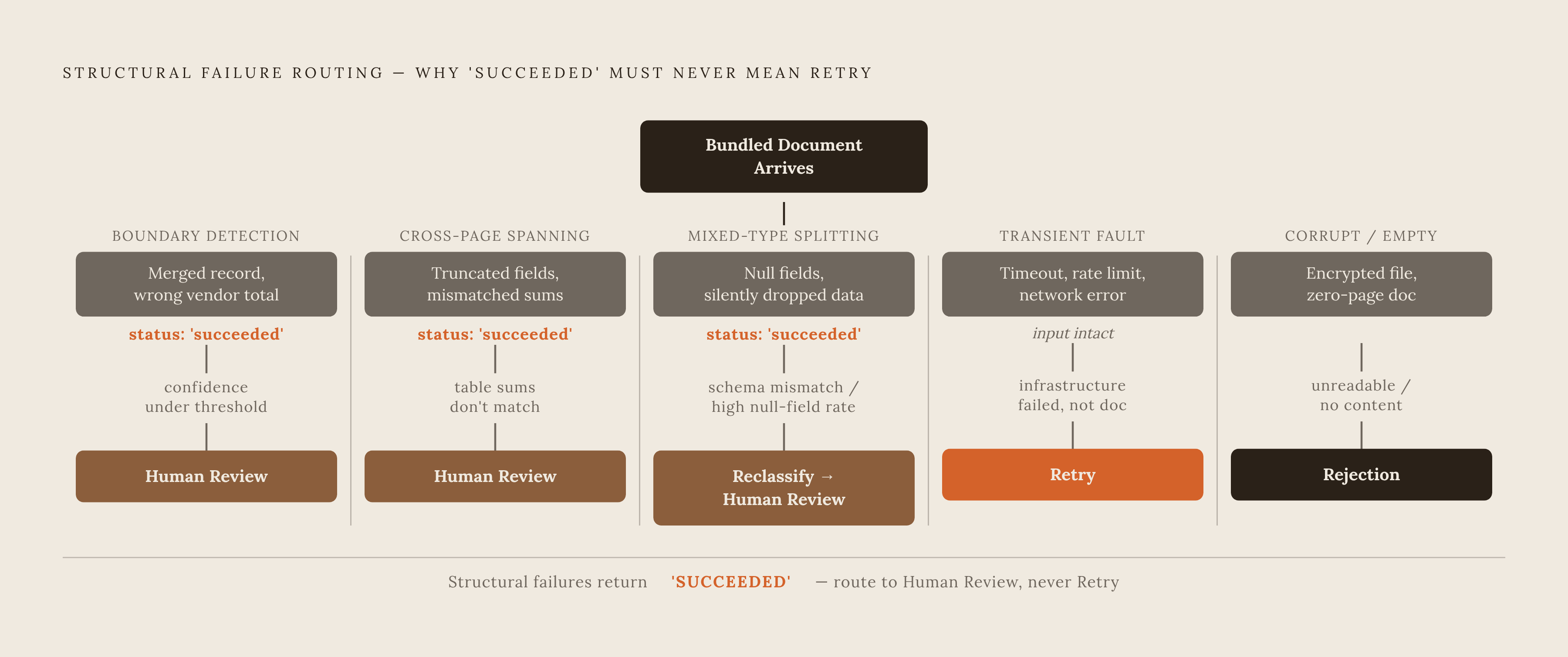
Bundled documents fail at three predictable points that look like success to downstream systems.

Multi-page and bundled documents fail at three specific, predictable points: document boundary detection, cross-page field spanning, and mixed-type splitting. The market for intelligent document processing was valued at $10.57 billion in 2025 and is projected to reach $91.02 billion by 2034, so getting these three wrong at scale is not a minor bug. The wrong number posted enough times raises costs that appear on a cost line somewhere, usually in accounts payable or claims processing. The fix is a set of exception rules built specifically for each of these three failure modes. It is a set of exception rules built specifically for each of these three failure modes.
Enterprise documents rarely arrive as one clean file of one type. The real intake shape is a stack: closing packets, insurance claim bundles, AP batches, mortgage origination files, payroll runs. A single-page document has one failure mode, extraction quality. A bundled document has three: extraction quality, boundary detection, and cross-page field coherence. Any one of them can produce a "succeeded" status attached to the wrong data, and that combination, wrong data plus a clean status, is what makes bundled intake harder than single-document intake, not extraction accuracy on its own.
Boundary detection comes first. When a parser gets a multi-document PDF, it has to figure out where one document stops and the next one starts, usually with no metadata, no separator page, and no dependable visual cue. When this fails, the parser does not throw an error. It returns one merged record built from multiple source documents. In a stress test run on Azure Document Intelligence in August 2026, Parsli fed it three invoices in a single PDF. Azure returned one record with the wrong vendor's total, $1,590, status: succeeded, no warning field anywhere. Parsli's own system, tested against the same file, returned three correct records. The danger is not that the parser gets it wrong. Every system will get it wrong sometimes. The danger is that the output looks fine, and a downstream workflow posts one vendor's invoice number against a different vendor's dollar amount with nothing in the pipeline flagging it.
Cross-page field spanning comes second. A line-item table, a running total, or a contract clause can start on one page and finish on the next. That requires the parser to hold state across pages. Naive extraction does not do this. It treats each page as its own island, and the result is a truncated field, a value with no home, or a duplicate entry where a continuation gets read as a new item. Tables make this worse. Embedded PDF text has no built-in sense of columns; text objects just sit at x/y coordinates on the page, so a table spanning two pages often comes out as a flat list with no link between the description, the quantity, and the amount.
Mixed-type splitting comes third. A single bundle often holds several document types, a purchase order, an invoice, a delivery confirmation, a remittance advice, each needing its own extraction schema. Splitting has to happen before extraction runs, not after. Feeding a mixed bundle to one schema causes the extractor to either jam every page into the wrong shape or quietly drop fields that do not fit. Extend's document automation guide makes the point directly: extraction accuracy rides on clean parsing, and splitting has to come first, or data gets pulled from the wrong document.
All three failure points share the same dangerous property. Each produces output that passes format validation and comes back marked as a success. Nothing in the response tells the caller anything is wrong.
Why generic retry logic does not address these failures
Retry logic is built for one kind of problem: transient failure. A timeout, a rate limit, a dropped connection. Retrying makes sense when the failure announces itself and the same request has a real shot at succeeding the second time.
The three failure points above are structural. They are structural. Retry a boundary-detection failure on the same file and it returns the same wrong merged record, with the same succeeded status, every time. The input did not change, and neither will the mistake.
A production parsing system has to work as an exception-routing system just as much as an extraction system, as nutrient.io's best-document-parsing guide makes clear. The API has to hand the calling application enough information to decide among retrying, rejecting, or routing a result somewhere for review. Generic retry logic covers none of that; it only covers the transient case, and treating a structural failure as if it were transient just burns compute on repeating the same wrong answer.
Most teams build their exception classes around API-level failures: bad input, unsupported format, timeout. Few build classes around semantic failures such as incomplete schema output, a failed grounding check, a violated business rule, or a boundary merged wrong. That gap is the real problem here, not model accuracy. Handling exceptions in multi-page and bundled documents means defining typed exception classes with explicit routing rules attached to each, not one fork that says "retry or fail." Teams building splitting and boundary logic in-house should expect the maintenance bill to grow with every new vendor template and document format, usually faster than anyone budgeted for.
Exception rules for document boundary detection failures
Never assume a PDF is one document just because it looks like one. Any file over a set page-count threshold should count as a candidate bundle and get routed to a splitting step before extraction starts.
Run classification before extraction, not after. Identify document types at the page or page-group level first, segment the file into typed units, then run extraction on each unit against the schema that actually matches it.
Set a boundary-confidence threshold and enforce it. If the classifier is not confident that a given page range is one document, route it to human review instead of letting it pass through as if the question were settled. An unresolved boundary call should not get resolved by default.
Where the expected count is known, check it. An AP batch of 10 invoices that comes out of the splitter as 9 or 11 records is a boundary exception, full stop. That check belongs at the pipeline level, watching the whole batch, not buried in field-level validation.
Build a specific exception class for succeeded-status merged records, too. Instrument the pipeline to catch cases where the vendor name, invoice number, and total amount resolve to different vendor identities in the system of record. That cross-field mismatch is often the only signal a boundary failure leaves behind, since the parsing layer itself, as the Parsli test showed, may raise no flag. Post-extraction cross-field validation is the backstop for exactly this kind of silent failure.
Exception rules for cross-page field spanning failures
Tables need their own test. Do not assume table extraction works fine just because general OCR accuracy or field accuracy looks good. Test cross-page tables specifically, on your own document mix, before anything reaches production.
Keep page-number metadata attached to every extracted element. Page splitting and relevant-page detection are their own distinct pipeline stage, for good reason: an element with no record of which page it came from cannot be debugged when something goes wrong.
For line-item tables that cross a page break, check that the extracted line items actually sum to the document total. A mismatch there is a concrete sign of a truncated or duplicated spanning extraction, not something to wave off as a confidence-score quirk.
Define a "continuation page" as its own exception class. A page that starts mid-table or mid-clause with no document header on it is a continuation candidate. It should route to a joining step rather than getting extracted on its own as if it were a fresh document.
Apply cross-field business rules after spanning gets resolved, not before. A negative invoice total, a sum that does not match the line items, a date sitting outside the expected filing window: these catch spanning failures the extraction layer let through clean.
Confidence scores will not save you here. A field pulled from the wrong page can still carry a high confidence score, because the model read real text correctly. It just read the wrong text. The rule layer is what catches that, not the score. On the input side, cleanup steps like deskewing, denoising, and contrast normalization can lift OCR accuracy by something in the range of 15% to 30%, but that is an image-quality fix. It does nothing for a missing spanning rule.
Exception rules for mixed-type document splitting failures
Splitting has to happen before extraction. That is a hard architectural constraint, not a preference. Once mixed-type content reaches a single-schema extractor, there is no way for the extractor to signal which fields belong to which document.
Treat schema mismatch as its own exception class. If an extractor returns a high share of null or low-confidence fields against what the schema requires, the likely cause is a type mismatch, and the fix is reclassification.
Keep an explicit document-type taxonomy with a separate schema for each type. Different document types appearing in the same real estate bundle each need their own separate schema. One generic "real estate document" schema will quietly drop fields it was never built to catch.
When classification confidence for a page group sits below threshold, do not force it into the nearest matching type. Surface it as unclassified and send it to review. A wrong type assignment fails silently and produces bad extraction; an unclassified routing at least gives someone a reason to look twice.
After splitting, check that each segment's field set actually makes sense on its own. A segment tagged as an invoice with no invoice number, no vendor name, and no total is not a low-quality extraction. It is a misclassification, and it should get treated that way.
This is not an edge case. Mortgage origination files, insurance claims packets, and AP batches all routinely arrive with several document types bundled into one submission.
Where confidence scores and source grounding stop being useful
Confidence scores work at the field level. They tell you how sure a model is about a value given the text in front of it. They cannot tell you that text came from the wrong document.
A boundary merge failure produces high-confidence fields, because the model pulled real values out of real text. The error sits one layer up, in structure, not extraction, and confidence scoring has no visibility into that layer.
A calibration problem underlies this. A model that claims 95% confidence is not necessarily right 95% of the time in production; confidence needs calibration against a labeled sample of your own documents before it is fit to use as a routing threshold. A common starting setup uses a high-confidence band to route results straight through and a medium-confidence band to send them to a review queue. What that two-band setup misses is a fourth class entirely, the case that scores high but is wrong for structural reasons the score cannot see.
Source grounding earns its place here. Per-field bounding boxes and page references let a human reviewer check that a value actually came from the page range it should have. Source grounding is the one confidence-adjacent signal capable of revealing a boundary or spanning failure during review, because it points at where the text physically sat on the page.
Confidence scores route extraction-quality questions. Business-rule validation, cross-field checks, record-count checks, and sum checks route structural questions. Keep those two jobs separate, because merging them into one threshold and calling it done is how a high score ends up bypassing a check it should never touch. A high score should never skip format checks, cross-field rules, database checks, or human review on high-risk fields. The rule layer stays in place no matter how confident the model claims to be.
Tiering exception routing
Three destinations exist for an exception, and each has its own trigger.
Retry fits transient failures such as a timeout, a rate limit, a network fault, or an OCR engine that is momentarily down. The input itself is fine; the failure sits in infrastructure. Retry with idempotency and exponential backoff and move on.
Human review fits structural ambiguity such as boundary confidence under threshold, a page group that came back unclassified, a spanning table where the sums do not add up, or a cross-field inconsistency the pipeline can see but not resolve on its own. The system has enough signal to flag the problem, just not enough to fix it.
Rejection fits input that cannot be salvaged, such as an encrypted or corrupted file, a page count of zero, a document type with no schema defined for it, or anything that fails basic file validation before extraction runs.
nutrient.io's best-document-parsing guide lays out the exception classes a production system needs: unreadable input, unsupported format, incomplete schema output, low-confidence field, failed grounding, business-rule mismatch. Each maps to one of the three destinations above.
Asynchronous processing is the right infrastructure for all of this. Running OCR synchronously inside an API call invites latency spikes. Job queuing with idempotency, retries, and webhooks lets retry, review, and rejection each run on its own schedule instead of blocking each other.
Whatever gets routed to review, log the exception class along with it. A "routed to review" tag with no reason attached teaches the pipeline nothing. The exception class is what actually drives improvement over time.
When a high-resolution parsing attempt fails, a sound fallback strategy preserves some output and page metadata rather than crashing outright.ide recommends falling back to a faster strategy that still preserves some output and page metadata, instead of crashing. A fallback result can still go to review. A crash cannot.
Watch for drift, too. Vendor templates change, new document formats show up, and the mix of exception classes firing will shift underneath a pipeline over time. A weekly look at exception-class distribution catches that shift faster than waiting for model retuning to surface it.
Applying exception rules across high-volume industry document bundles
Accounts payable batches are multi-vendor invoice bundles by default. A boundary detection failure there produces exactly the cross-vendor posting error the Parsli test surfaced: the $1,590 merged record built from the wrong vendor's total. Record-count validation against the expected batch size is the primary catch here, and it belongs at the batch level, not buried inside individual field checks.
Mortgage origination packets bundle a closing disclosure, a purchase agreement, a title commitment, and assorted addendums. Mixed-type splitting is the dominant risk in this stack. Each document type needs its own schema, and packet structure shifts by county and by lender, which makes a fixed taxonomy hard to keep current for long.
Insurance claims packets combine EOBs, prior authorization forms, clinical notes, and CMS-1500s, often with wildly uneven quality: some typed, some scanned, some handwritten. Multi-type splitting has to deal with that quality spread, and classification thresholds need setting per document type inside the bundle, not applied once to the whole packet.
Healthcare records push cross-page spanning to its extreme. A patient chart running 1,000 pages or more interleaves clinical notes, lab results, and medication lists with no consistent separator between sections. Continuation-page detection and segment-level schema validation both have to be in place, or the spanning failures compound page after page.
Logistics documents, bills of lading, proof of delivery, customs paperwork, arrive from hundreds of different carriers, each with its own format, stamps, handwriting, and scan quality. That range means no single splitting or extraction rule set holds up across the whole intake stream. The exception rules have to flex by carrier and document condition as well as by document type.