Handling Handwritten Fields in Structured Document Workflows
Handwritten fields break extraction pipelines built for typed text.
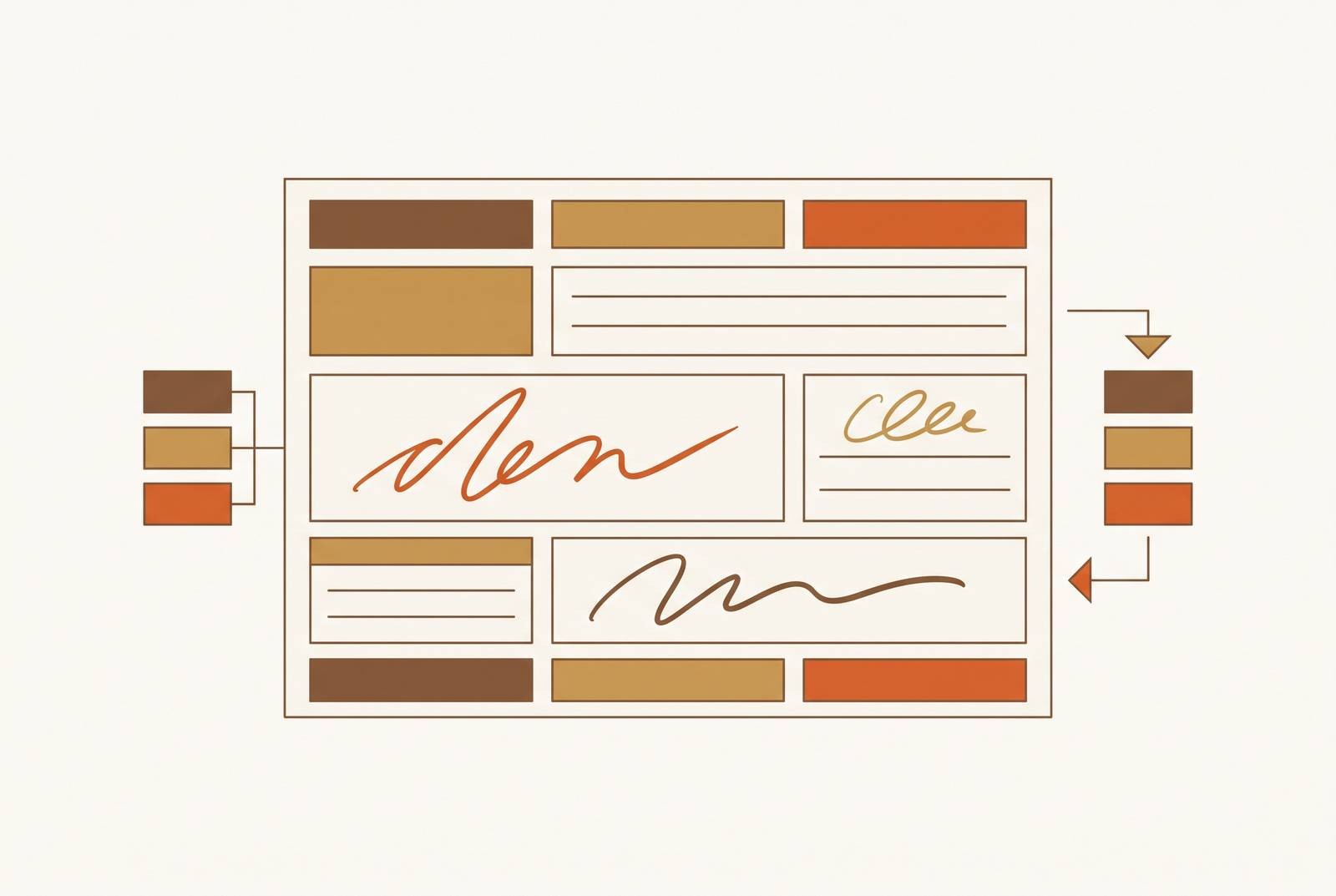
Handwritten fields are the failure point structured document workflows least expect and most often hit. A pipeline built around typed text, fixed field positions, and consistent fonts runs fine until a borrower scrawls a note in the margin or a clinician jots something on an intake form, and then the whole set of assumptions the system was built on falls apart. Fixing that isn't just a matter of better recognition models. It takes validation layers, honest confidence scoring, and human review built specifically for the kind of variability handwriting introduces, not bolted on as an afterthought.
Structured workflows assume predictable input: known fonts, known field positions, consistent character shapes. Handwriting breaks every one of those assumptions at once. Stroke width, letterform, slant, spacing, ink density: all of it varies from person to person, and often from document to document written by the same person. There's also a technical split worth naming up front. Online recognition, the kind used on a tablet or stylus device, captures stroke order and sometimes pressure as the person writes. Offline recognition, which is what business documents require because you're reading a finished scan, has none of that. It works from the static shape left on the page, nothing more, and its error rate reflects that missing information.
The current standard architecture pairs a CNN, which reads character shapes, with a transformer or RNN language model that uses surrounding text to resolve ambiguous characters. That combination helps a lot, but only when the surrounding fields are themselves readable. If the field next to the messy one is also handwritten, or blank, the language model has nothing to lean on.
None of this is a hypothetical problem confined to some edge case pile. It shows up in the first real folder from the first real client, not in a stress test somewhere down the line.
Where handwritten fields actually appear in production document types
Handwriting shows up carrying some of the most consequential data in the document: names, dates of birth, account numbers, transaction amounts, invoice references, addresses, free-form notes, signatures, and corrections written over or beside typed text. These aren't decorative fields. They're often the fields a downstream system needs most.
Mortgage lending is a good example of how this plays out in practice. Borrowers write margin notes, loan officers scribble corrections onto forms, and a 4506-C can arrive with handwritten annotations on it. Mixing typed and handwritten entries on that particular form is actually treated as an alteration, which tells you something: the handwritten piece sits inside an otherwise clean, structured document that the extraction pipeline processes just fine, right up until it hits the part a human wrote by hand.
Healthcare carries a heavier version of the same risk. Illegible handwriting on prescriptions is a documented contributing factor behind the more than 1.5 million preventable medication errors that injure Americans each year, according to a 2006 Institute of Medicine report. That's not an abstract inconvenience. A misread handwritten field in that context has a body count attached to it, however indirect.
Insurance claims carry adjuster notes and handwritten remarks scattered across forms with layouts that shift from carrier to carrier, which compounds the recognition problem before you even get to the handwriting itself. Accounts payable and logistics have their own version: handwritten line items, quantities, or corrections scrawled onto purchase orders and bills of lading.
The pattern repeats across all of it. A mostly structured document carries one or two handwritten fields, and the pipeline treats them no differently than the typed fields around them. Mixed documents, part typed and part handwritten, turn out to be harder than fully handwritten ones, because the pipeline often can't even detect that the input type switched mid-page. No detection means no different treatment, and no different treatment means the handwritten field gets run through the same logic built for clean typed text.
How recognition accuracy varies by handwriting type and what the benchmarks obscure
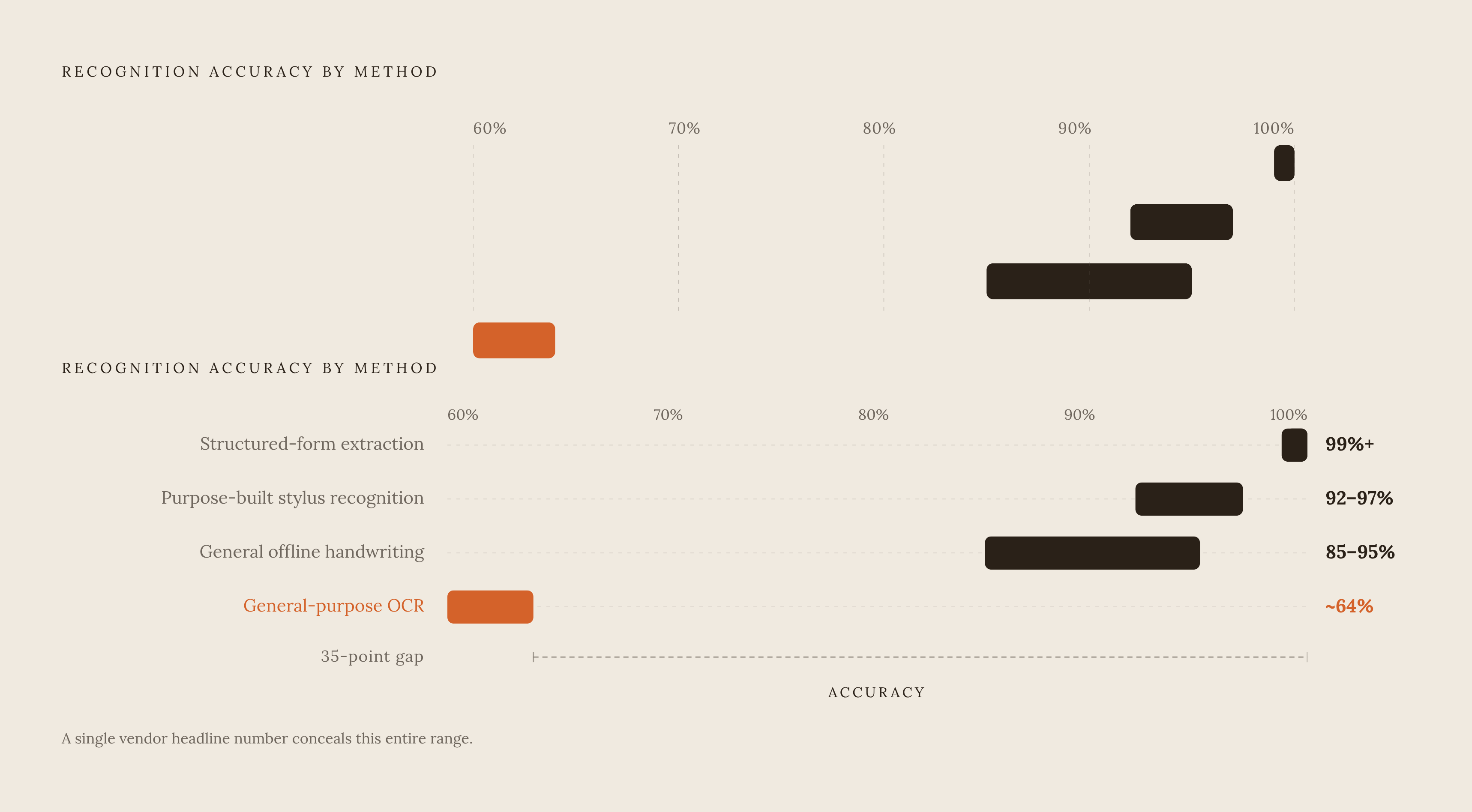
Accuracy numbers in this space span a wide range, and the range itself is the useful part. Structured-form extraction, meaning clean, printed handwriting sitting inside well-defined fields, can hit 99%-plus in best-case conditions. General offline handwriting recognition runs 85 to 95%. General-purpose OCR tools not built for handwriting, Tesseract running in handwriting mode being one example, land around 64% or lower. Purpose-built online stylus recognition, where stroke data is available, runs 92 to 97%.
A single accuracy figure quoted by a vendor is a best-case number generated on their sample set, not a number that tells you anything about your documents. Structured-form extraction and general handwriting recognition are different benchmarks measuring different things, and conflating them is exactly how a vendor advertises 99%-plus while actual performance on a messy intake form lands closer to 70 or 80%.
The headline number hides a handful of things worth digging into directly: performance on cursive versus print (most systems fall apart on cursive), performance on faxed or low-quality scans versus clean ones, and performance broken down by field type rather than averaged across all of them. Numeric fields, free-text remarks, and names all behave differently under the same model.
A parser that scores well on one document source and poorly on another produces an average that hides the real problem entirely. Accuracy needs to be broken down by document type, field type, and scan quality tier, or the number is close to meaningless. The only real test is running the system against a sample of actual documents, messy ones included, before committing to a pipeline architecture. Anything short of that is trusting a vendor's demo set to predict how the system handles your worst intake batch.
Why confidence scores on handwritten fields are particularly prone to miscalibration
Confidence scoring exists so uncertain extractions get routed to a human instead of flowing straight through. That only works if the score means what it claims to mean. Calibration, in plain terms, means a score of 0.95 should correspond to the extracted value being correct 95% of the time. A poorly calibrated system reports 0.95 confidence but turns out correct only 80% of the time at that same threshold, and the gap between those two numbers is where silent errors live.
Research on extraction confidence, published as EXTRACTCONF on arxiv.org, found that existing approaches to confidence, whether token-level log-probabilities, verbalized confidence, or multi-sample self-consistency checks, tend to collapse toward all-positive behavior at the thresholds that actually matter in practice. In plain terms: these systems tend to say they're confident even when they're wrong.
Calibration quality also isn't uniform across field types. Numeric fields tend to calibrate reasonably well. Free-text fields show overconfidence right at the high end of the predicted probability range, where you'd want the system to be most trustworthy. Handwritten free-text fields sit at the intersection of both problems: less signal for the model to work with, and a scoring mechanism prone to overstating confidence exactly where the underlying recognition is weakest.
A silently wrong extraction, meaning an incorrect value returned with confidence high enough to clear the review threshold, does more damage than an obviously missing one. It passes through undetected. In financial reconciliation, compliance verification, or claims processing, a wrong handwritten field can travel through several downstream steps before anyone notices something's off.
There's a practical test worth running on any system under evaluation: pull a sample of extractions marked at 0.90 confidence or above and check them by hand. If more than 10% contain errors, the confidence scores are miscalibrated, and the review routing built on top of them can't be trusted. This problem gets worse specifically for handwritten fields, because the model has less to work with in the first place, and it's most likely to be wrong in exactly the cases where it claims to be sure.
What a validation layer designed for handwriting variability actually does
Validation is a distinct process, not a second pass of recognition run on the same image. It's a separate layer that checks the extracted value against what that field is actually supposed to contain, independent of how confident the recognition model felt about its own output.
A few strategies do most of the work here. Format validation checks whether the extracted value matches the expected pattern, a date shaped like a date, an account number with the right digit count, a currency amount that parses as currency. Cross-field consistency checks whether a handwritten total matches the sum of handwritten line items, or whether a handwritten date falls inside a plausible range for that document type. Reference lookup checks whether an extracted name or identifier matches a record that already exists in a downstream system. Contextual plausibility uses layout and surrounding text: a handwritten number sitting next to a rent clause is probably a rent modification, and a system that understands layout context can apply that kind of field-type prior in a way raw OCR simply cannot.
This is the real line between OCR and IDP. OCR tells you what characters sit on the page. IDP tells you what those characters mean given the business process the document belongs to. Validation rules catch a category of error that confidence scores miss entirely: a handwritten "6" misread as "0" can carry high confidence from the recognition model and still fail a basic arithmetic check against the rest of the form.
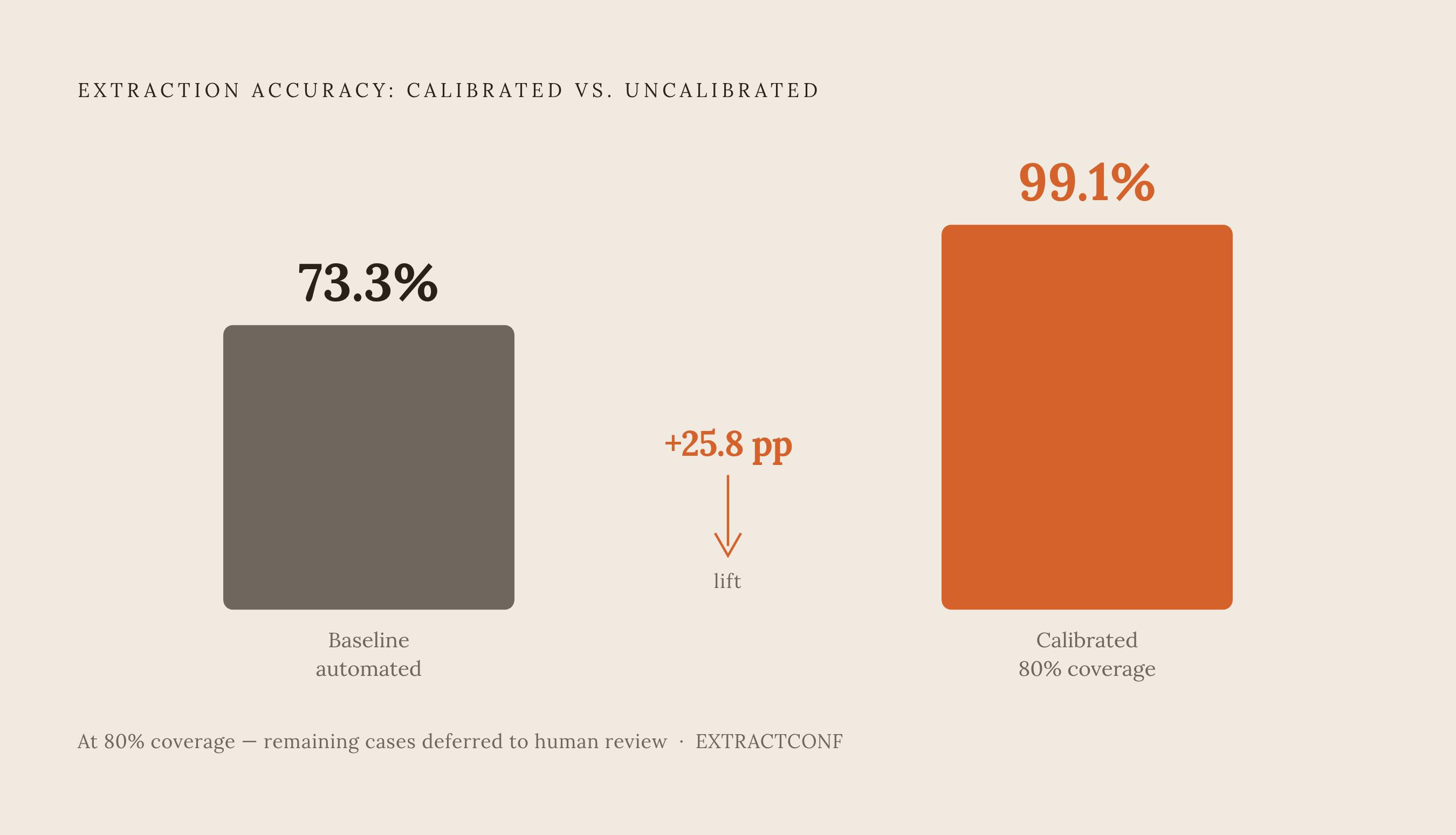
Modern IDP pipelines combine large language models, vision-language models, and domain-specific models during extraction, then run validation rules and confidence scoring before anything gets written to a downstream system. The EXTRACTCONF research found that a well-calibrated confidence engine, at 80% coverage, reached 99.1% automated accuracy, a 25.8 percentage-point improvement over the 73.3% base rate. That gap shows what proper calibration paired with selective deferral to a human can accomplish, compared to running extraction straight through without it.
What the validation layer produces at the end is a confidence assessment paired with the original value. It's a routing decision: automate it, flag it for a person to look at, or reject it outright.
Designing human-in-the-loop escalation specifically for handwritten field failures
Where to set the confidence threshold is a business decision, not a modeling one. Setting it means picking an acceptable error rate first, then asking what share of documents can clear that bar without a human touching them. Raise the threshold and accuracy on automated extractions goes up, but more documents get routed to manual review. Lower it and more gets automated, but more errors slip through. Teams have to make that trade-off on purpose, rather than inheriting whatever default the vendor shipped with.
Escalation for handwritten fields needs more than a queue with a low-confidence flag attached to it. A reviewer needs the original document image cropped to the handwritten field itself, not just the extracted text sitting next to a confidence number. They need to know the confidence score and which validation rule actually triggered the escalation. And they need the adjacent typed fields visible, since those often carry the context that tells a reviewer what the handwritten value is supposed to say.
Without that context, a human reviewer is guessing, and a guessing reviewer may not be any more accurate than the model whose mistake they're supposed to fix. The difference in tooling shows up here: some systems surface all of that context together, while others return a low-confidence value and leave the downstream system, or a person much further down the chain, to notice something went wrong.
Corrections made during review should feed back into the model. That feedback loop is what separates a document AI product that improves on recurring patterns from a tool that treats every document as if the same mistakes had never been corrected before. A useful measure is how the pipeline performs at your chosen quality threshold on handwritten fields specifically, not blended into an overall accuracy number that typed fields make look better than it is. That number tells you how much labor the pipeline actually removes, versus how much it just shifts from one team to another.
The build-vs-buy calculation when handwriting recognition is a requirement
Building a handwriting-capable pipeline in-house is a meaningfully bigger project than building one for typed documents. The recognition problem, the calibration problem, and the validation layer all need separate investment, and none of them can be skipped without the whole system falling short on the fields that matter most.
Research on in-house pipeline development found that fewer than 10% of in-house parsing pipelines ever reach production, largely because edge cases pile up faster than engineering teams can patch around them. Handwriting adds an entire category of edge case that a typed-document pipeline never has to deal with in the first place. Keeping up with the pace of change in vision-language models becomes close to a full-time job on its own, and even solid OCR tends to plateau without ongoing investment in layout models, correction agents, and the infrastructure needed to turn human feedback into model improvement.
One consideration worth weighing: a team switchingits cloud mortgage platform to a managed IDP solution cut implementation time from 6 months to 6 weeks, according to a Grooper case study. Mortgage documents happen to be exactly the mixed typed-and-handwritten case this piece keeps coming back to.
Self-hosting or building from scratch is justified in a narrower set of cases: data residency rules that rule out external API calls, air-gapped or heavily regulated environments, document volumes so large that per-page API cost exceeds the operating cost of self-hosting at sustained throughput, and engineering teams that have actually demonstrated they can maintain ML infrastructure, not just stand it up once.
Zero-data-retention processing isn't optional for documents carrying handwritten financial or personal identifiers. Any vendor evaluation needs to confirm exactly how document images and extracted values get handled, stored, and eventually deleted. Security certifications like SOC 2, GDPR compliance, and ISO 27001, along with deployment options such as EU or US region hosting or on-premise deployment, matter directly here, given that handwritten fields are so often the ones carrying the most sensitive personal data on the page.
The right question is whether a team has the resources and commitment to build this. It's whether that team can maintain it at the accuracy level the business actually requires, continuously, as document formats shift and the population of handwriting styles feeding the system keeps changing under it.
Evaluating a handwriting-capable document extraction tool against your actual workload
Vendor-quoted accuracy is a starting point, not a conclusion. The only number that means anything is accuracy measured against your own documents, low-quality scans and cursive fields included, since those are what the pipeline will actually be asked to ingest on a normal Tuesday.
A short evaluation checklist covers most of what matters. Does the system detect that a field is handwritten and process it differently, or does it treat every field the same regardless of how it was written? Can it handle a mixed document, part typed and part handwritten, without the handwriting dragging down accuracy on the typed portion sitting right next to it? Are the confidence scores calibrated, tested by manually checking a batch of 0.90-plus extractions and confirming the error rate sits below 10%? Does the validation layer apply real field-type logic, format checks, cross-field consistency, reference lookups, or does it just repeat the recognition model's own confidence back at you? Does escalation surface the original image, the rule that triggered review, and surrounding field context to the person doing the reviewing? And do corrections actually feed back into the model, or does the error rate on the same recurring handwriting pattern stay flat no matter how many times someone fixes it?
Field-level accuracy benchmarking on your own document sample is the right methodology here. Break accuracy down by field type, numeric, free-text, identifier, and by document source, and the distribution that emerges will tell you far more than any single average number could. The operational metric that actually matters is automation rate at a defined quality threshold for handwritten fields specifically, not overall document accuracy, which typed fields tend to inflate past what the handwriting performance alone would justify.
Pricing structures matter more than they might seem to at first glance. A vendor charging per correctly extracted page, rather than per page processed regardless of outcome, has incentives that line up with getting the hardest fields right. A vendor absorbing the cost of a wrong extraction has a different relationship to handwriting accuracy than one collecting the same fee whether the extraction was right or not. Any vendor unwilling to put per-field accuracy on an SLA is, in effect, asking the customer to carry all the risk of the miscalibration and silent-failure problems this piece has walked through from the start.