Scaling Closing Disclosure Field Extraction Across Multi-Lender Mortgage Operations
Accuracy and validation matter more than volume in mortgage disclosure extraction.

Scaling Closing Disclosure field extraction across multi-lender mortgage operations takes more work on accuracy and validation than on the number of pages processed. An extraction API that is ready for use must return structured fields, allow field-level confidence checks, and provide data for cross-document reconciliation before the values reach the loan origination system. Processing more pages is useful only when silent errors do not become compliance exposure and investor repurchase risk.
Why the Closing Disclosure is the highest-stakes extraction target in a mortgage file
A single mortgage file spans hundreds of pages, including applications, income verification, appraisals, title documents, and regulatory forms. Each role needs different fields from that stack. The Closing Disclosure, or CD, sits at the end of the chain, after upstream data has been established. Its values are therefore the ones regulators, investors, and auditors interrogate first.
The extraction scope includes loan terms, projected payments, itemized loan costs and other costs, and cash to close. These values must map to the requirements of the loan origination system, or LOS, and servicing systems. They are not free-form business data. The CD contains regulatory fields governed by TILA-RESPA disclosure requirements and defined tolerance categories, so a wrong value can become a potential disclosure violation.
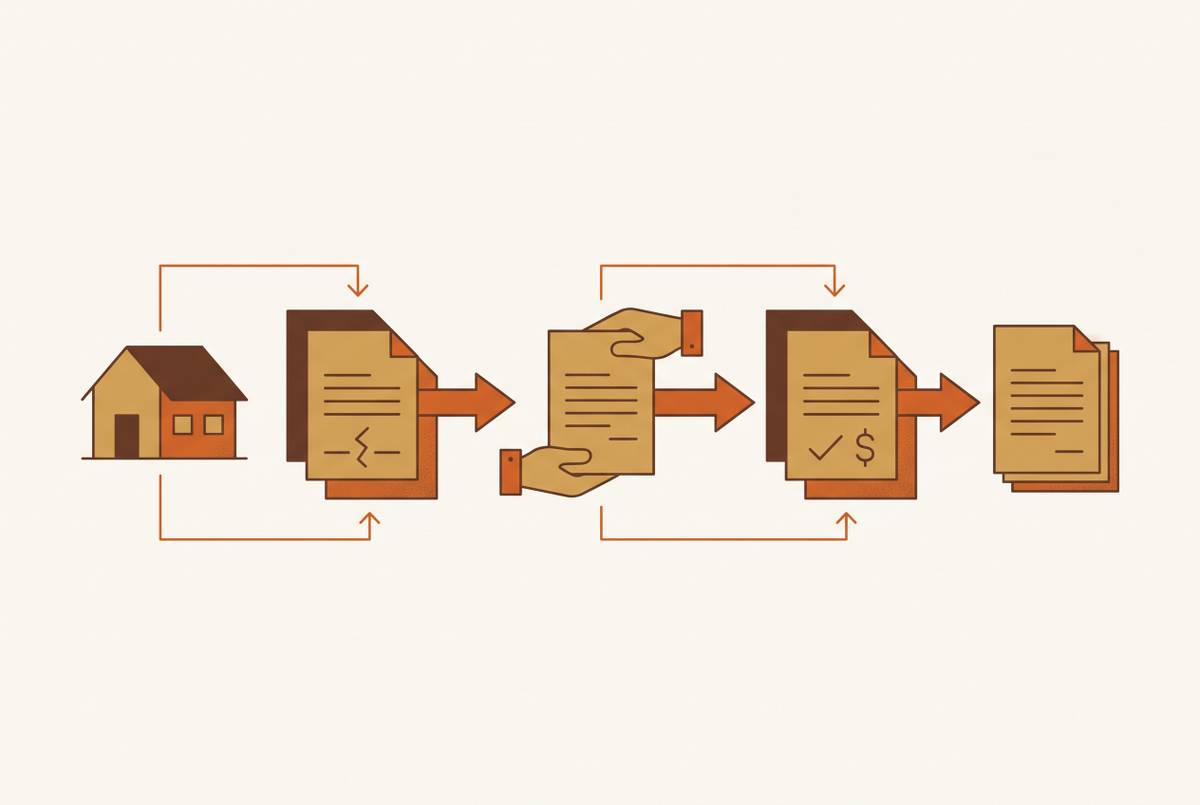
The highest-value workflow compares the Loan Estimate with the CD before closing. Some fields must match exactly, while others can change only within the set tolerances. To make that comparison, the system must read the number and extract the right field from each document. Differences in layouts, fee names, and document versions across lenders make what looks like data entry hard to get right each time.
How silent extraction errors on the CD become compliance exposure and repurchase risk
An extraction can fail without an error message. The value can look plausible and still be wrong. When that value passes into quality control, investor delivery, and servicing, the mistake becomes harder to separate from the rest of the loan record. The mistake may be visible only in an audit finding, a curtailment, or an investor repurchase demand after closing.
The regulatory obligations make correction more demanding than rekeying. TILA-RESPA requires specific disclosures and calculations, while fair lending requirements call for consistent documentation. Audit trails must also show that data was captured correctly from source documents. A fee-line error therefore needs a replacement value and documented remediation that traces back to the source page.
A model may read a field correctly on one lender’s template and silently misread its counterpart on another settlement agent’s document. Investors and GSEs require delivered files to demonstrate that CD data matches the LOS record. If a systematic mismatch survives until post-closing audit, remediation costs become disproportionate to the cost of catching it during extraction.
Why the CD's field structure makes extraction harder than it looks in a demo
The CD requires structural interpretation. “Cash to Close” appears in multiple places at different calculation stages, so finding those words does not establish which value is final. Itemized fees create a related problem because “origination charge,” “origination fee,” and lender-specific labels can refer to the same regulatory category. Position alone cannot resolve those distinctions.
Document origin adds another layer of ambiguity. The lender-generated CD and the title-company CD contain largely the same fields, but they are produced independently and formatted differently. They may also legitimately disagree within tolerance. Treating them as interchangeable inputs can therefore produce a structurally wrong comparison even when the text itself is read correctly.
Different generation software produces different spacing, font rendering, and table structures, while scans add rotation, contrast variation, and degraded fine print. Page-level OCR also creates dependencies across the form. An eight-page CD requires eight page-level inference calls, which may run in parallel or as a batch, but a failure on page three can still undermine fee reconciliation elsewhere.
Field definitions themselves can require further clarification. MISMO’s SMART Doc Version 1.02 Implementation Guide reached Final Status in July 2026 and added guidance on late charge amounts and on identifiers for brokers and loan originators. Systems still need updates as field guidance and the way the industry works change.
Why aggregate accuracy scores hide the field-level failures that matter in CD extraction
An aggregate accuracy score gives every successful extraction a chance to conceal a consequential failure. A system can read borrower names and addresses correctly while repeatedly misreading the fee table. The useful measurement is whether each field is accurate enough for the workflow that depends on it.
That requires comparators suited to the field. Strings need character-level similarity checks, numeric values need comparison within defined tolerances, and dates need semantic calendar equivalence so formatting differences do not count as errors. Confidence needs the same field-by-field treatment. Amount fields tend to show higher confidence because their formatting is consistent, while dates can be less certain because placement and context vary.
Confidence and correctness are not interchangeable, either. Numeric fields tend to be better calibrated, while free-text fields can be overconfident at high predicted probabilities. The same confidence score can therefore be less trustworthy on a fee description than on an amount. A uniform review threshold ignores that difference and can send the wrong fields to human reviewers.
The reference answers need equal scrutiny. A test set labeled quickly by a single reviewer can embed that reviewer’s errors in the benchmark. A convenience sample from one lender also says little about performance across the network. Teams need to measure per-field accuracy against carefully prepared reference answers from the lender layouts and document generations they work with.
The validation architecture that catches CD extraction errors before they reach the LOS
Reliable extraction needs gates between model output and downstream records. The first is a confidence threshold calibrated by field type, with uncertain values routed to review. A fee-table amount and a borrower name warrant different thresholds because their error consequences differ. A single threshold for the whole document either sends values for review that do not need it or lets high-risk values through unchecked.
The second gate is programmatic cross-document reconciliation. The CD values that were extracted should be checked against the earlier Loan Estimate, using tolerance-category logic for each field. This is a rules engine operating on structured data. Its decisions are only as sound as the extracted fields it receives.
A tiered approach routes uncertain pages first to a specialized model, then to a general vision-language model, with human review reserved for values whose error cost exceeds the automation benefit. Review stays focused on genuine ambiguity. Confidence scores must also be calibrated and traceable to the source document.
Available products address different parts of this architecture. Areal’s platform includes a CD Balancer built for lender CD–to–title CD reconciliation, with LOS integration for ICE Encompass, MeridianLink, and Byte. Parseur’s mortgage document automation extracts fields and sends them through API and webhooks so teams can route them where they need to go.
Why zero data retention is not optional for CD processing under financial data regulations
A CD contains sensitive personal and financial information, so extraction accuracy cannot be the only acceptance test. Data custody needs an equally clear answer. Storing borrower documents in a vendor’s infrastructure, even temporarily, creates another exposure surface for the lender to audit and secure. A retention promise does not explain how that exposure is prevented.
A zero-retention design that teams can trust processes API payloads entirely in memory, maps schemas on the fly, and returns results without writing customer data to disk. The pipeline’s statelessness with respect to those documents is an architectural property. It also keeps the vendor’s document storage separate from the lender’s obligation to maintain a source-traceable audit record.
Delayed deletion is a different commitment. Mortgage OCR states that documents are deleted within 24 hours and no copies are retained, which is not immediate zero retention during processing. For European borrower data, GDPR’s data minimization principle adds a separate constraint. The system should receive only what it needs for the document in scope, rather than sync an entire repository to retrieve occasional fields.
The build-vs-buy calculus for multi-lender CD extraction pipelines
The strongest case for building is control. On static, predictable government forms, custom OCR lets developers specify which fields to process and which to exclude. That can be useful when sensitive identifiers must remain outside extraction.
The CD weakens that argument as the lender network grows. A pipeline that looks manageable with two lenders faces a different maintenance burden at twenty because each new layout needs testing, rule updates, and edge-case handling. Settlement agents and title companies add more differences. With template-based OCR, the growing template library becomes an ongoing maintenance bottleneck.
Systems built for this work ease that burden by using context and meaning to find fields. Buying can remove per-lender template work while still requiring validation. Throughput also needs separate accounting. OCR processes pages independently, while downstream parsing can run over the full extracted text in one pass, so fast parsing cannot compensate for an underprovisioned OCR stage.
Corrections create another continuing cost. The initial training set may have no examples of unusual fee structures, addenda that arrive late, or disclosure language used by a specific lender. An internally built system needs engineering capacity to retrain or update rules as those cases arrive. A product that learns from human-reviewed corrections shifts that maintenance work into the vendor’s infrastructure.
The commercial model changes the calculation as well. Raw per-page pricing charges for processing whether or not the fee table is correct. With per-correctly-processed-page pricing, payment depends on how well the fields are extracted. At multi-lender scale, total cost therefore includes the price of an API call, layout maintenance, OCR capacity, exception handling, and incorrect output.
What a production-ready CD extraction evaluation looks like at multi-lender scale
When a team chooses a CD extraction API, its tests should recreate the ways extraction can fail in production. The dataset should have CDs from each lender in the network, including scans, digitally generated PDFs, and exceptions found in past manual review. The largest lender is not a proxy for everyone else. A test dominated by its layout will not establish readiness for the next lender.
The results should expose the fields most likely to create downstream risk. Teams should ask for separate accuracy figures for fee tables, cash-to-close calculation fields, and fields that fall under TILA-RESPA tolerance categories. Matched Loan Estimate–CD pairs should then test whether extraction supports correct tolerance determinations.
Confidence calibration needs a deliberate challenge set. Tests with poor scans, unusual formatting, and lender-specific labels should check whether uncertain predictions get lower confidence scores and are sent for review. A high score is not enough by itself. The evaluation should also establish whether human-reviewed corrections improve later performance or leave the same edge cases to recur.
Teams should confirm zero data retention, request evidence of SOC 2, GDPR, and ISO 27001 compliance, and establish whether EU/US and on-premise deployment options meet their residency needs. Teams should then weigh the price against the results they measured. A per-correctly-processed-page commitment makes accuracy part of what the vendor owes the lender, while raw per-page billing makes the lender pay for errors it must still catch.