Regulator-Grade Field Validation in Automated Closing Disclosure Review
Extraction API must validate each field separately to meet regulator tolerance requirements.

Automated Closing Disclosure review meets regulator expectations only when it validates individual fields. For mortgage operations at scale, an extraction API must supply field-level values, calibrated confidence scores, and source locations that support tolerance checks and a reconstructable audit trail.
What the Closing Disclosure is and what regulators actually require of it
The Closing Disclosure is a federally standardized five-page form that replaced the HUD-1 and TILA final disclosure. It gives the borrower final loan terms, projected payments, closing costs, and cash-to-close figures. The form must be delivered at least three business days before consummation. A significant APR increase, addition of a prepayment penalty, or change in loan product resets that clock and requires re-disclosure and re-delivery.
The form groups fees in labeled sections so they can be checked under TRID tolerance rules. Section A has zero tolerance, while Section B uses a 10% cumulative tolerance check. Section C and equivalent unlimited-tolerance categories allow changes between the Loan Estimate and Closing Disclosure without that restriction. Because the applicable rule depends on the fee’s classification, field-level validation is non-optional.
Why the revision rate makes field-level errors the norm, not the exception
For most loans, the disclosures must be compared more than once as they change. Each time, every line item on the lender CD must be reconciled with its counterpart on the title CD. The work repeats with every relevant revision. At volume, manual comparison cannot keep pace with that workload, and an earlier review cannot establish that a later version remains within tolerance. Revision handling must therefore be part of the validation design.
The FDIC’s compliance reporting identified TILA violations centered on loan estimates, closing disclosures, and periodic statements as a leading compliance finding. Federal regulators have also flagged understated finance charge disclosures and incorrect service provider listings. These are errors inside documents that already exist. A receipt check would not expose them, nor would a status showing that extraction finished. These recurring disclosure errors call for repeated field-level checks to validate what changed in each version.
What "document-level" automated review misses and why regulators notice
A system that confirms a CD was received, classified, and extracted has completed document processing. It has not established compliance with the fee rules. Consider a Section A fee incorrectly treated as Section B. The cumulative 10% check could pass even though the fee violates its zero-tolerance rule. Every amount could be extracted correctly while the system still returns a false pass, because classification determines which test runs.
A workflow completion flag does not establish delivery at least three business days before consummation. The system needs the specific delivery timestamp and must separately detect changes that restart the clock. Otherwise, a completed delivery task can conceal a new re-disclosure obligation. The distinction is between reporting an action and gating it before a violation occurs.
Tolerance breaches need automatic re-disclosure triggers rather than a finding added after the workflow has moved on. Federal regulators are using AI-driven anomaly detection to find data patterns that do not match across disclosures. A lender without comparable field-level scrutiny is running behind the examiner.
The specific field-level checks a regulator-grade CD validation system must perform
The zero-tolerance check compares each Section A fee with its corresponding LE value. Its predicate is an exact match, with any variance flagged for review. An overage requires lender cure, even if it is one dollar. Amounts must therefore be extracted to the cent. Rounding can erase the discrepancy the check exists to detect.
The cumulative-tolerance check groups all Section B fees before comparing their total with the corresponding LE total. Individual fee variances do not independently determine the result. The failure condition is a cumulative increase beyond 10%. A fee assigned to the wrong bucket can inflate or deflate the subtotal and produce the wrong result despite accurate extraction. Unlimited-tolerance fees must remain separate so that their permitted changes do not distort that calculation.
The timing check validates the delivery timestamp against consummation using the three-business-day requirement. Clock-reset detection evaluates each relevant field change independently. A re-disclosure check runs when there is a significant APR increase, a newly added prepayment penalty, or a loan product change. Durable workflow timers must preserve timing enforcement through server restarts and queue-worker crashes.
Cash-to-close reconciliation checks the page-three calculation and its LE comparison figure independently of the fee buckets. The checks on long-term costs cover APR, total interest percentage, and finance charge on page five. These are computed disclosures subject to TILA accuracy requirements. Validation must test their arithmetic.
How extraction accuracy at the field level determines whether tolerance checks are meaningful
If extraction transposes digits in a fee amount, the rule evaluates the wrong number and can record a pass while leaving the actual discrepancy undetected. That creates evidence of a check without reliable evidence of compliance. Extraction and validation are therefore inseparable parts of the result. Their quality cannot be evaluated as though one stops where the other starts.
Amounts tend to extract more consistently because their formatting is regular, while dates and service provider names show greater variability. A document-wide accuracy score conceals those differences. For that reason, it is not a useful service-level metric for CD validation. The relevant measure is whether each field type is reliable enough for the decision that follows.
OCR and vision models also fail differently. OCR errors tend to produce visibly garbled characters that a format check can flag. A vision model can instead produce a plausible but wrong fee amount that passes both format checks and confidence thresholds. Transposed digits need not look suspicious at all. For CD review, that invisible error is especially dangerous because downstream arithmetic can work perfectly on the wrong value.
Confidence must be calibrated for each field type. A model that gives high scores to both correct and incorrect fee extractions provides no useful routing signal. Thresholds for each field must send values with low confidence to human review before tolerance checks run. Grounding then links each extracted value to its page and pixel region in the source document.
Auditability as a regulatory requirement, not an operational preference
A log saying that validation passed records an outcome. It does not explain how the system reached it. Audit-ready traceability records the extracted CD value, its source location, the corresponding LE field, the tolerance rule, the confidence score, and any human-review disposition. An examiner must be able to reconstruct the comparison from that record. A correct output without that evidence leaves the automated process opaque.
The audit trail must be built into the architecture. Its record must be append-only, written synchronously with every loan record change, and stored in tamper-evident form. Tenant isolation through row-level security protects the separation between records. Human dispositions must include whether the value was accepted, corrected, or escalated, with a timestamp and reviewer identity. Re-disclosure records must connect the triggering field change to the new delivery timestamp and timing check.
Rule history is part of that evidence. The record must identify which rule version applied, when it took effect, and what the system did with it. A centralized regulatory index supports that chain by monitoring rule sources, capturing versions, detecting changes, and feeding updated rules into validation workflows. An outcome-only log cannot establish which standard governed the decision. Without version-specific traceability, the lender cannot defend the automated process against an examiner whose tools already operate at field level.
How do you extract and validate Closing Disclosure fields at scale?
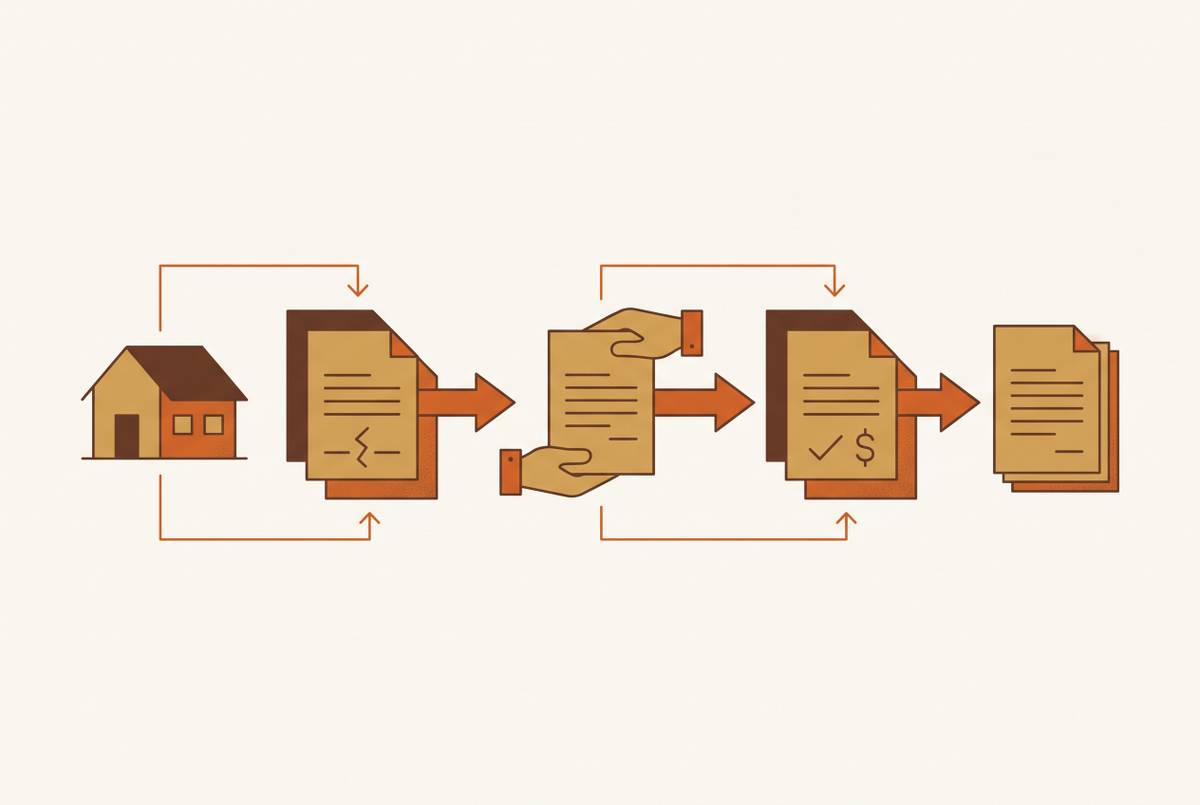
A production-grade pipeline starts by classifying the LE, lender CD, title CD, and settlement fee sheet separately. Classification comes before extraction because the wrong document type sends the file into the wrong extraction path. Downstream accuracy cannot repair that structural mistake. Each extracted fee then receives a per-field confidence score and a grounding reference, including its page number and bounding box. Values below the applicable threshold go to human review before any tolerance calculation.
The next operation assigns each fee to its tolerance bucket based on fee type. Layout variation makes position-based classification unreliable on non-standard documents. Section B subtotals are computed from the classified fee set. This stage produces the fee groups that the comparison stage needs using computed subtotals, because a printed subtotal may itself be wrong.
Three-way comparison then reconciles the LE, lender CD, and title CD. Section A values are compared pairwise between the LE and lender CD, then between the lender and title CDs, with non-zero differences flagged as violation candidates. Section B uses cumulative tolerance arithmetic, with any overage calculated in dollars to support the lender-cure obligation. The two comparisons answer different questions. Lender-to-title discrepancies remain separate findings from LE-to-CD tolerance breaches.
Timing validation follows with the applicable business-day calendar. It checks delivery against consummation and independently tests each clock-resetting field change. Durable timers keep those timing checks in force when infrastructure fails. A reviewer then receives every flagged field along with its value, source reference, comparison result, and the rule that applies. That context supports a disposition without forcing the reviewer to reconstruct the entire comparison.
Throughout the sequence, every extraction, comparison, routing decision, and human disposition must leave an append-only record with the applicable rule version. Each stage leaves evidence that can be traced before the next stage starts. Continuous pre-close QC applies those checks across loans while defects can still be cured. For an extraction API buyer, the decisive fit criterion is whether the output supports this complete chain.
How the regulatory environment in 2026 raises the bar for automated systems specifically
The regulatory environment in 2026 puts scrutiny on the automated review system as well as the disclosure it produces. Federal agencies including the CFPB, OCC, HUD, FHFA, and FDIC have signaled sharper penalties for inaccurate disclosures and incomplete audit trails. The system itself is part of the examination. Field-level checks establish what was tested, while versioned evidence establishes whether the process used the applicable rule. Automation without both leaves a gap between the result and its defense.
A White House executive order directs agencies to consider replacing TRID’s strict timing requirements with a materiality-based standard. Current tolerance and timing requirements still govern while that process unfolds. Any transition would also require evidence that a lender’s system could evaluate materiality. A possible change in the standard does not remove the need to trace the fields behind a decision.
The same order directs agencies to give credit for good corporate conduct, self-correction, and a reasonable opportunity to remediate. Pre-close exception detection creates a record of that correction. A system that finds a discrepancy, routes it, and documents the disposition is better positioned under that posture than one that simply processes the loan. The distinction is concrete evidence of remediation.
Rising loan volumes make this design more urgent. With 30-year fixed rates having briefly dipped below 6.00% in February 2026, it becomes harder to keep validation gaps in check by comparing disclosures by hand alone. Complete loan coverage lets field-level checks scale without depending on a sampled fraction of files. Regulatory traceability, examiner scrutiny, and credit for self-correction all favor that same architecture. The engineering requirement and the regulatory direction are the same demand viewed from different angles.