High-Volume Closing Disclosure and Loan Package Extraction APIs for Mortgage Operations
APIs that extract mortgage documents at scale must handle fifteen document types, not one.

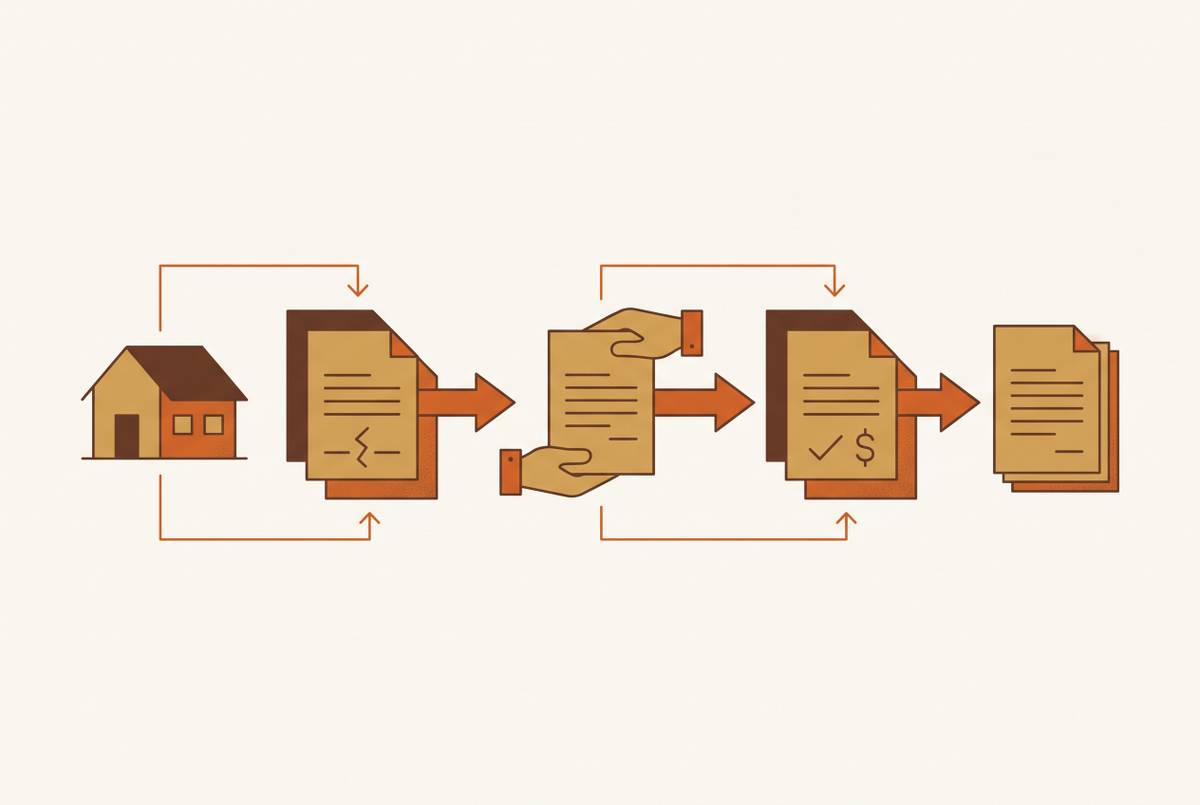
High-volume Closing Disclosure and loan package extraction is a different engineering problem from standard document AI. A loan file is not one document read well. It is fifteen or more document types in a single multi-hundred-page PDF, every field carrying regulatory weight. This guide covers the APIs that handle that reality at production scale, and the criteria for choosing one.
Why mortgage document extraction is harder than standard document AI
A typical loan file has 15 or more different document types in a single multi-hundred-page PDF. That means the extraction system must be simultaneously competent across incompatible formats, not just one. A mortgage file combines Form 1003 applications, W-2s, pay stubs, bank statements, tax returns, appraisals, title commitments, and Closing Disclosures in one package.
Microsoft Azure Document Intelligence v4.0 ships five distinct prebuilt mortgage models: 1003, 1004, 1005, 1008, and Closing Disclosure. One that handles pay stubs well may not handle title commitments. This is why purpose-built extraction APIs like Invofox, which support custom document schemas and per-field accuracy measurement against ground truth rather than relying on a single generic model, are designed for the reality that every document type in a loan package demands its own extraction approach.
The Closing Disclosure sits at the center of regulatory exposure. It is a legal document that outlines loan amount, interest rate, estimated monthly payments, closing costs, and cash-to-close figures. UiPath Document Understanding extracts a defined schema from Closing Disclosures including borrower name, disbursement date, loan ID, loan total amount, loan term, loan type, property address, seller name, seller address, cash-to-close for borrower and seller, payoff amounts, and CD purpose. TILA-RESPA requirements mandate specific disclosures and calculations. The extraction problem is structural before it is technical, because the file itself is not one kind of document.
Where generic OCR and LLM-only extraction break down in production mortgage pipelines
The failure modes of generic extraction in mortgage workflows are not random. They are predictable consequences of applying tools designed for simpler document populations to a file type that violates their assumptions. The first failure is multi-page table continuity. Bank statement transactions can run ten or more pages. A failure here silently drops transaction history.
Document separation errors are the second failure. Multiple document types embedded in one PDF are hard to cleanly split. Processing delays block the pipeline rather than flagging a single document.
Confidence scores without grounding are a fourth failure. A field may be extracted with high confidence yet still be wrong in business context. A date may be read accurately but outside an acceptable range. Nutrient's mortgage API documentation draws the explicit contrast: LLM-only prompting produces generated answers that can change between runs, with no signal for which values to trust and no way to point back to the page. Governed extraction produces predictable structured output tied to source coordinates. An LLM-based pipeline that does not separate visual rendering from the PDF text layer is vulnerable to injected instructions embedded in hidden text.
The cascade effect is what turns these failures from annoyances into financial exposure. An underwriting exception not caught becomes a QC defect. A QC defect not caught after investor delivery can trigger a repurchase demand. The cost structure of mortgage operations means that a silent error is not a single mistake. It is a liability that compounds through the pipeline.
What a production-grade mortgage extraction pipeline actually requires
Reliable extraction from mortgage documents at scale requires a set of architectural properties that go beyond raw OCR accuracy: document classification, per-field confidence with grounding, validation against business rules, human review routing, and traceable output. The first requirement is multi-document classification and splitting. The pipeline must identify each document type in a multi-page package and apply the right extraction schema to each. Without this, the downstream fields are wrong even when the OCR is right.
Per-field confidence scores must be grounded in source coordinates. Confidence must be traceable to the pixel location on the page, not inferred from the model's internal state. Nutrient describes this as "coordinates and page references anchor every value to its source location." The tradeoff must be configurable.
Cross-document validation is where most pipelines quietly fall short. Income figures must be reconcilable across pay stubs, W-2s, and VOEs. Loan amounts must be consistent between the Note, the Closing Disclosure, and the security instrument. Nutrient's API returns typed JSON for systems and validation, or Markdown for search and AI workflows, from a single API call. Markdown serves RAG, search, and AI-assisted underwriting workflows. Both come from the same document pass.
Volume and format tolerance are table stakes. Azure Document Intelligence v4.0 supports up to 2,000 pages per PDF on paid tiers, with a 500 MB file size limit. An accuracy SLA is not a marketing claim. It is the boundary between a tool and an accountable system.
API options for Closing Disclosure and loan package extraction
The APIs available for mortgage document extraction differ most consequentially not in whether they can read a Closing Disclosure, but in whether they provide accuracy guarantees, grounded confidence scores, cross-document validation, and the security architecture that regulated financial workflows require. Here is how the current options compare against those criteria. Invofox offers a document intelligence API that extracts structured JSON from PDFs and images, including invoices, bank statements, payslips, closing disclosures, and any structured document. It carries a contractual 99.2% per-field accuracy SLA under the 'Perfect Docs Guaranteed' model. Pricing is built around pages extracted correctly. Field-level confidence scores are calibrated and traceable to source content, not inferred from model state, which supports the audit trail requirement for TILA-RESPA and fair lending documentation. Its agentic validation layer applies business-rule checks beyond raw extraction, catching cross-document inconsistencies like a loan amount on the Note versus the Closing Disclosure that confidence scores alone cannot flag. Security certifications include SOC 2, GDPR, and ISO 27001, with EU/US and on-premise deployment options available. Zero-data-retention processing is opt-in for Scale and Enterprise clients, which matters for files containing borrower Social Security numbers, income data, asset balances, and property information.
Azure Document Intelligence v4.0 went generally available on November 30, 2024. Microsoft's prebuilt mortgage models cover five document types with distinct model IDs: Form 1003, Form 1004, Form 1005, Form 1008, and Closing Disclosure. The v4.0 GA release adds the ability to extract signatures from mortgage forms 1003, 1004, 1005, and closing disclosure. It supports PDF, JPEG, PNG, BMP, TIFF, and HEIF input. The paid tier handles up to 2,000 pages per PDF and 500 MB file size. Custom neural model training supports up to 50,000 pages of training data and 1 GB total, while custom classification supports up to 10,000 pages and 2 GB. Integration is available via REST API, C# SDK, Python SDK, Java SDK, and JavaScript SDK.
UiPath Document Understanding offers a US Mortgage Closing Disclosures model. Its pre-trained extractor covers main borrower full name, additional borrower names, seller full name, Closing Disclosure purpose, disbursement date, loan ID, loan total amount, loan term, loan type, property address, seller address, date issued, closing date, payoff amounts for first and second mortgages, borrower's total cash to close, seller's total cash to close, interest rate, and borrower and seller from/to options. It operates within the UiPath Intelligent Document Processing platform with trainable splitter, custom extractor training, and annotation tooling. UiPath does not publish a contractual per-field accuracy SLA, though confidence-based routing is configurable within the platform.
Nutrient Data Extraction API extracts loan applications, income and asset verification, appraisals, title documents, and Closing Disclosures as typed, auditable JSON. Every value carries a source citation and confidence score. It explicitly addresses the LLM-only limitation with predictable structured output tied to source document coordinates, confidence signals that route uncertain values to human review, and layout-aware structure preserving tables, forms, and key-value regions. It outputs spatial JSON for extraction and validation, or Markdown for RAG and search workflows, from a single API call. Loan document-specific accuracy benchmarks are still being scoped due to limited publicly available annotated mortgage datasets, though a general data extraction API benchmark tested on a 200-document corpus is available. Nutrient is trusted by enterprise customers including Lufthansa, Disney, Autodesk, UBS, Dropbox, and IBM. None of these are named as mortgage-specific deployments in the source.
Mortgage OCR by Lido, last updated June 2026, handles URLA/1003, HUD-1 Settlement Statements, Closing Disclosures, Truth-in-Lending disclosures, W-2, pay stubs, tax returns, appraisals, title commitments, and insurance certificates. It claims accuracy of 97 to 99 percent on standard mortgage documents with field-level confidence scoring, flagging uncertain fields for human review rather than silently accepting them. Output formats include Excel, Google Sheets, CSV, and JSON, with REST API integration for Encompass, Byte, and Calyx loan origination systems as well as servicing platforms. A testimonial from a servicing director describes processing a 40,000-loan archive in three weeks.
The build-vs-buy calculus for mortgage document extraction
Building a mortgage document extraction pipeline from scratch produces a proof of concept quickly and a production system slowly. What building actually requires beyond the model is image processing and OCR, document separation and classification, extraction, a human review application, output formatting, LOS integration, and operations. Everything else is the team's engineering responsibility.
Four production problems hide inside a proof of concept. A system that is correct on most fields still fails silently unless it knows which answers to doubt. Calibrated confidence and routing logic are non-trivial to build and maintain.
Where buying wins is clear. Where building retains an argument is also clear. Invofox's on-premise deployment option is a relevant counter for the strictest compliance cases, since it means the extraction model runs inside the lender's own environment. In mortgage operations, every edge case that reaches underwriting unchecked carries regulatory and repurchase exposure.
Data security and compliance requirements that the API must satisfy
Mortgage documents contain borrower Social Security numbers, income figures, asset balances, and property addresses. The security and retention posture of the extraction API is a compliance requirement, not a procurement preference. Zero-data retention is the sharpest test. Zero-data retention eliminates that obligation and reduces breach surface. It must be contractually confirmed, not just stated in marketing copy.
Required certifications for 2026 financial services deployments are SOC 2 Type 2, ISO 27001, GDPR compliance, and EU AI Act preparedness. Some lenders operate under policies that prohibit sending borrower documents to any third-party cloud service. Invofox holds SOC 2, GDPR, ISO 27001, and HIPAA certifications, and offers both EU/US cloud and on-premise deployment, the latter available for Enterprise clients. Documents are not retained after extraction by default.
Audit trail requirements complete the picture. TILA-RESPA and fair lending regulations require that lenders can demonstrate data was captured correctly from source documents. When evaluating any API against these requirements, ask for a signed DPA or enterprise agreement clause confirming zero retention, and request the vendor's most recent SOC 2 Type 2 report. The document itself.
Evaluating an API before committing to production volume
A vendor that performs well on demo documents and clean PDFs may degrade significantly on the document population a lender actually processes. Evaluation must be designed to surface that gap before production commitment. Use a representative sample of the lender's actual loan packages, including multi-document PDFs, scanned files at varying DPI, and edge cases like multi-page bank statement tables and non-standard Closing Disclosure layouts.
Measure per-field accuracy against ground truth, not overall document accuracy. A document that is 95% correct field-by-field may still extract income, assets, or cash-to-close incorrectly. The fields that matter most are precisely where errors are most consequential. A confidence score of 0.95 should mean the extracted value is correct the vast majority of the time on your document population. Test whether the vendor's confidence scores actually predict correctness on your data, or whether they are uniformly high regardless of extraction quality.
Check routing behavior on low-confidence fields. Verify the output schema maps to your LOS or servicing platform without transformation. Mortgage OCR names Encompass, Byte, and Calyx as supported LOS integrations. Confirm your target platform before committing.
Ask for the SLA in writing. A vendor that will not put accuracy in a contractual SLA is transferring all error risk to the lender. Invofox's 'Perfect Docs Guaranteed' offer and pay-per-correctly-processed-page pricing model make accuracy a commercial commitment. SOC 2 Type 2 report, signed DPA confirming zero retention, and deployment options, cloud versus on-premise, should be resolved before any production data transits the API. The cost of guessing makes accuracy a contractual requirement, and APIs built around pay-for-correct-results pricing shift accountability from the buyer to the extraction system itself.